Introduction
The quest to understand the diversity of life on Earth did not begin with modern laboratories or DNA sequencing; it began over two millennia ago with a man walking along the shores of the Aegean Sea. Aristotle’s Classification of Animals represents the first serious attempt in human history to organize the natural world into a logical, hierarchical system. By moving away from folklore and toward a method based on physical structure and reproductive habits, Aristotle transformed nature into a subject of rigorous study. Today, he is widely celebrated as the father of zoology because he dared to ask not just what an animal was, but why it belonged to a specific group.
Aristotle’s Study of Animals
Aristotle’s passion for the natural world was most evident in his seminal work, Historia Animalium (The History of Animals). Unlike many philosophers of his time who preferred abstract reasoning, Aristotle was an empiricist. He spent years on the island of Lesbos, observing marine life, dissecting specimens, and interviewing local fishermen to gather data.
His study was not merely a collection of trivia. He looked for patterns—what he called “the causes” of an animal’s design. He examined the differences between internal and external parts, lifestyles, and habitats. This massive undertaking was one of the most significant Aristotle contributions to science, as it established that the physical world could be decoded through systematic investigation. He documented more than 500 species, an incredible feat considering he lacked the tools we take for granted today, such as binoculars or microscopes.
Two Main Groups of Animals
The genius of Aristotle’s Classification of Animals lay in his ability to find a primary “divider.” He noticed that some animals had red blood while others seemed to have a clear fluid or none at all.
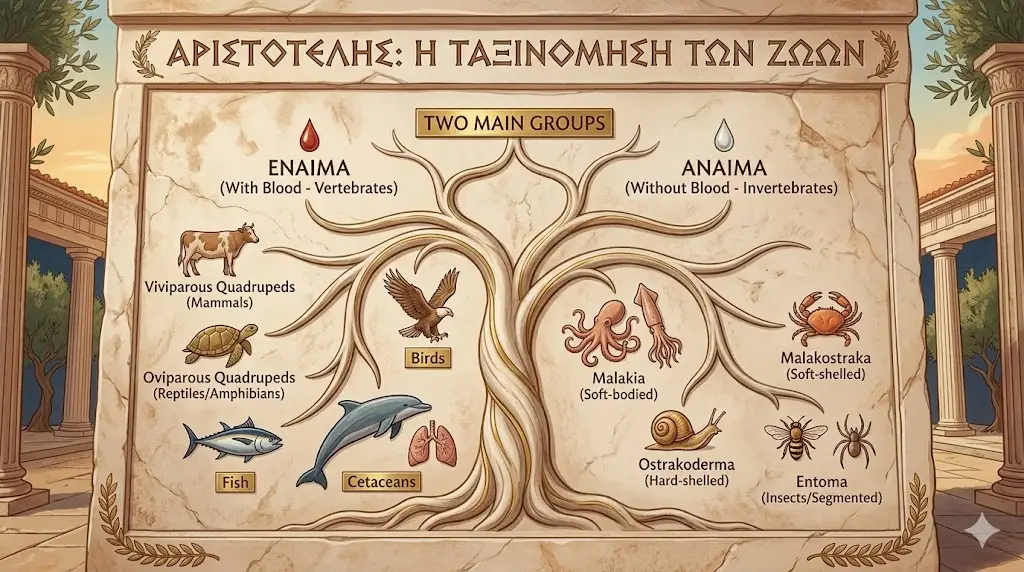
He divided the animal kingdom into two major groups:
- Enaima (Animals with blood): These roughly correspond to what we now call vertebrates.
- Anaima (Animals without blood): These are what we now categorize as invertebrates.
While we now know that all animals have some form of circulatory fluid (like hemolymph in insects), Aristotle’s distinction was a brilliant first step. It allowed him to create a “Great Chain of Being” (Scala Naturae), where life was arranged on a ladder from the simplest organisms at the bottom to the most complex—humans—at the top. This structured thinking was a core part of the broader Aristotle contributions to biology, providing a skeleton that future naturalists would flesh out for centuries.
Aristotle’s Categories of Animals
Within his two major groups, Aristotle further subdivided creatures into “genera” (groups) based on their shared characteristics. He was remarkably accurate in many of these subdivisions:
The Enaima (Vertebrates)
- Viviparous Quadrupeds: Four-legged animals that give birth to live young (Mammals).
- Oviparous Quadrupeds: Four-legged animals that lay eggs (Reptiles and Amphibians).
- Birds: Defined by feathers and flight.
- Fish: Defined by gills and fins.
- Cetaceans: Aristotle correctly identified whales and dolphins as separate from fish because they possessed lungs and gave birth to live young.
The Anaima (Invertebrates)
- Malakia: Soft-bodied animals like the octopus and squid.
- Malakostraka: Soft-shelled animals like crabs and lobsters.
- Ostrakoderma: Hard-shelled animals like snails and oysters.
- Entoma: Small, segmented animals (Insects and spiders).
Observation as the Basis of Biology
For Aristotle, the eyes were the most important tool a scientist possessed. He famously argued that “credit must be given to observation rather than to theories.” This philosophy is the reason Aristotle’s Classification of Animals was so successful; it was grounded in reality.
He noticed, for instance, that ruminants (like cows) had multiple stomachs to process grass, whereas animals with simple teeth had simple stomachs. He observed the brooding habits of the catfish and the social structures of bees. By focusing on “analogous” parts—showing how a bird’s wing performs the same function as a fish’s fin—he pioneered the field of comparative anatomy. He wasn’t just listing animals; he was analyzing the “functional design” of life.
Influence on the History of Science
The influence of Aristotle’s system cannot be overstated. His classification remained the standard for Western science until the 18th century. When Carolus Linnaeus developed the modern system of binomial nomenclature (Genus and Species), he built directly upon the foundations laid by Aristotle.
Even though modern science has corrected some of his errors—such as his belief that some insects were born from “spontaneous generation” in mud—his methodology remains intact. He taught us that to understand the whole, we must understand the parts. The very vocabulary we use in biology today—terms like “organ,” “species,” and “genus”—finds its roots in the Aristotelian tradition.
Frequently Asked Questions (FAQs)
Did Aristotle classify plants as well?
Aristotle focused primarily on animals. However, his student Theophrastus followed his mentor’s methods to classify the plant kingdom, becoming the “Father of Botany.”
How did Aristotle distinguish between humans and other animals?
Aristotle believed that while humans shared biological traits with animals (the “sensitive soul”), they were unique because they possessed a “rational soul” and the ability to use logic.
Was Aristotle’s classification system perfect?
No. He lacked knowledge of microscopic life and made some errors regarding the internal anatomy of “bloodless” animals, but his vertebrate classifications were remarkably close to modern science.
What is the ‘Scala Naturae’?
It is the “Ladder of Nature,” a concept where Aristotle ranked all living things in a hierarchy of complexity, with humans at the top.
Conclusion
Aristotle’s Classification of Animals was more than just an ancient list; it was the birth of a new way of seeing. By looking at a dolphin and seeing a mammal instead of a fish, or by looking at a bee and seeing a complex social organism, Aristotle invited us to see the deep logic embedded in nature. His work reminds us that science begins with wonder and is sustained by the patient, careful observation of the world around us. Two thousand years later, every biologist who steps into the field is, in a sense, a student of Aristotle.