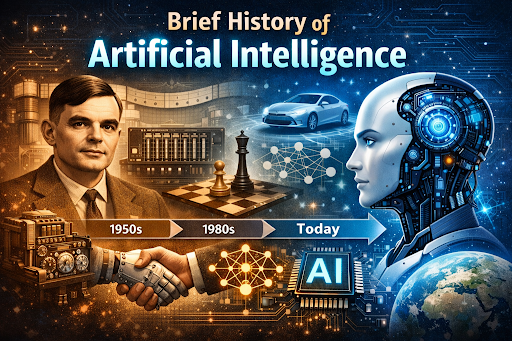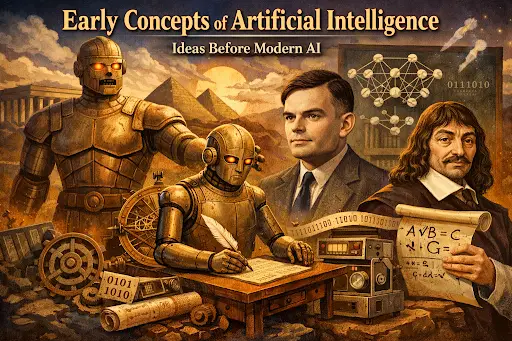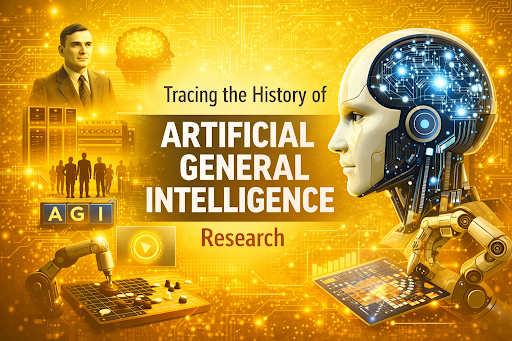
The artificial general intelligence research history reflects one of the most ambitious scientific quests ever attempted. For decades, researchers, philosophers, and engineers have pursued the dream of building machines capable of human-level reasoning, learning, and problem-solving.
Unlike narrow AI systems that perform specialized tasks such as image recognition or speech translation, artificial general intelligence (AGI) aims to create machines that can understand and learn any intellectual task that humans can perform. This concept has captivated scientists since the earliest days of computing.
From theoretical foundations proposed by Alan Turing to modern breakthroughs in deep learning and large language models, the artificial general intelligence research history reveals a fascinating timeline of innovation, setbacks, and renewed optimism.
Understanding this journey provides insight into how the dream of general intelligence evolved and how today’s AI systems may eventually lead to machines with truly general cognitive abilities.
The Genesis of the AGI Dream
The origins of the artificial general intelligence research history date back to the earliest days of computer science when pioneers began imagining machines capable of thinking.
Long before modern neural networks or generative AI existed, researchers believed computers might one day replicate human reasoning.
Alan Turing, the Universal Machine, and the Turing Test
One of the earliest and most influential figures in the artificial general intelligence research history was Alan Turing. His concept of the Universal Machine laid the theoretical foundation for modern computing.
Turing also proposed the famous Turing Test, which evaluates whether a machine can imitate human conversation convincingly enough that a human evaluator cannot distinguish it from another person.
This concept remains central to debates about Narrow AI vs. AGI and continues to influence modern AI research.
Turing’s work also contributed significantly to Alan Turing Artificial Intelligence, where the philosophical foundations of machine intelligence were first explored.
These early ideas established the intellectual framework that would guide the evolution of general artificial intelligence concepts.
The Dartmouth Workshop of 1956: The Birth of the “AI” Concept
Another milestone in the artificial general intelligence research history occurred in 1956 with the Dartmouth Workshop.
This historic event introduced the term “artificial intelligence” and brought together leading researchers who believed machines could eventually simulate human intelligence.
The conference launched decades of research into symbolic reasoning, learning algorithms, and cognitive architectures.
Many of the ideas discussed during this meeting influenced the development of First AI Programs, which attempted to replicate human reasoning using symbolic logic.
The Dartmouth Workshop effectively began the timeline of AGI development and marked the birth of modern artificial intelligence research.
The Eras of Optimism and the “AI Winters”
The artificial general intelligence research history includes periods of tremendous excitement followed by significant setbacks.
Researchers initially believed AGI could be achieved within a few decades. However, the complexity of human intelligence proved far more challenging than expected.
Early Symbolic AI and the “General Problem Solver”
During the 1960s and 1970s, AI researchers focused on symbolic reasoning systems.
These systems attempted to simulate human problem-solving using logical rules and symbolic representations.
One famous example was the “General Problem Solver,” which attempted to solve complex tasks by searching through logical possibilities.
This approach dominated early artificial intelligence research and contributed to the development of Evolution of Machine Learning Algorithms, where early computational learning techniques began emerging.
Despite initial success, symbolic AI systems struggled to handle real-world complexity, ambiguity, and uncertainty.
Why Funding Dried Up: Facing the Reality of Computational Limits
As expectations grew unrealistic, many early AI projects failed to deliver the promised breakthroughs.
Governments and funding agencies began losing confidence in artificial intelligence research.
This period became known as the AI Winters, when investment and research activity dramatically declined.
The primary challenges included:
Limited computational power
Insufficient data for training systems
Inability to handle real-world uncertainty
Overreliance on rigid symbolic reasoning
These difficulties slowed progress in the artificial general intelligence research history for nearly two decades.
However, the field would eventually experience a powerful resurgence.
The Resurgence: Connectionism and Deep Learning
Artificial general intelligence research history experienced a major revival with the rise of neural networks and connectionist models.
Instead of relying on rigid symbolic rules, these models learned patterns directly from data.
Neural Networks and the Crucial Shift from Narrow AI
Neural networks introduced a completely new approach to artificial intelligence.
Inspired by the structure of the human brain, these systems learned by adjusting connections between artificial neurons.
This breakthrough helped spark the modern The Rise of Neural Networks, which transformed how AI systems are trained.
Advances in computing power and large datasets enabled researchers to build increasingly powerful models capable of recognizing patterns in speech, images, and text.
This shift played a crucial role in the artificial general intelligence research history by demonstrating that machines could learn complex representations rather than relying on fixed rules.
The Scaling Hypothesis: Does Bigger Computation Mean Smarter AI?
One of the most influential ideas in modern AI research is the Scaling Hypothesis.
This theory suggests that increasing model size, training data, and computational resources leads to more capable AI systems.
The success of large-scale models has reinforced this idea and accelerated the artificial general intelligence research history.
Research discussed in Big Data and Artificial Intelligence Evolution highlights how massive datasets and powerful GPUs have enabled unprecedented progress in AI capabilities.
The scaling hypothesis has become central to debates about whether large models could eventually lead to general intelligence.
Modern AGI Research and the Impact of Foundation Models
In recent years, the artificial general intelligence research history has entered a transformative era driven by foundation models and generative AI.
These models are trained on vast datasets and can perform multiple tasks without task-specific programming.
Are Large Language Models (LLMs) Stepping Stones to AGI?
Large language models have sparked intense debate among AI researchers.
Systems such as GPT-4 demonstrate remarkable capabilities in reasoning, language generation, coding, and knowledge synthesis.
These models represent significant milestones in Large Language Models History, where increasingly powerful architectures have expanded AI capabilities.
While LLMs remain examples of narrow AI, their ability to generalize across tasks suggests they may serve as stepping stones toward AGI.
This development has significantly accelerated the artificial general intelligence research history.
Reinforcement Learning and the Generalization of AlphaGo
Another major milestone occurred with the development of deep reinforcement learning systems such as AlphaGo.
AlphaGo defeated world champion Go players by combining neural networks with reinforcement learning techniques.
These breakthroughs are closely related to research explored in Reinforcement Learning History and modern deep reinforcement learning systems.
Reinforcement learning allows AI systems to learn through interaction with environments, a crucial step toward general intelligence.
Researchers are also exploring training methods such as self supervised learning in artificial intelligence to improve the adaptability of AI systems.
These innovations are pushing the boundaries of artificial general intelligence research history.
The Philosophical and Ethical Debates Surrounding AGI
The pursuit of AGI raises important philosophical and ethical questions about the future of humanity and technology.
As AI systems grow more powerful, researchers must consider both the potential benefits and risks.
The Alignment Problem: Ensuring AGI Remains Safe for Humanity
One of the most significant concerns in the artificial general intelligence research history is the AI Alignment problem.
Alignment refers to ensuring that advanced AI systems behave in ways consistent with human values and intentions.
If AGI systems become more intelligent than humans, ensuring safe and ethical behavior becomes critical.
Researchers are developing new methods to address this challenge, including value learning, interpretability research, and safety frameworks.
These issues are also closely related to the broader discussion surrounding Artificial Superintelligence (ASI).
Expert Predictions: How Close Are We to True General Intelligence?
Experts remain divided about when—or whether—AGI will be achieved.
Some researchers believe AGI could emerge within the next few decades, while others argue that human-level intelligence requires breakthroughs that have not yet been discovered.
Progress in Generative AI History and Modern Artificial Intelligence Applications suggests that AI capabilities are evolving faster than many expected.
The artificial general intelligence research history shows that breakthroughs often occur unexpectedly after long periods of slow progress.
Many researchers believe the next major transformation may arrive through the Future of Artificial Intelligence Technology, where new architectures and learning techniques unlock unprecedented cognitive abilities.
Frequently Asked Questions (FAQs)
What is artificial general intelligence?
Artificial general intelligence refers to AI systems capable of performing any intellectual task that humans can do, rather than specializing in a single function.
Why is the artificial general intelligence research history important?
The artificial general intelligence research history helps explain how ideas about machine intelligence evolved and how current AI technologies may lead to general intelligence.
What is the difference between narrow AI and AGI?
Narrow AI systems specialize in specific tasks, while AGI systems aim to demonstrate human-level reasoning and adaptability across a wide range of domains.
Are large language models examples of AGI?
Large language models demonstrate impressive capabilities but remain forms of narrow AI. However, they may represent important stepping stones toward AGI development.
What risks are associated with AGI?
Major concerns include the AI alignment problem, ensuring safety, and preventing unintended consequences if highly intelligent systems act outside human control.
Conclusion
The artificial general intelligence research history reveals a remarkable journey of scientific ambition, technological breakthroughs, and philosophical debate.
From early theoretical ideas proposed by Alan Turing to modern foundation models and deep learning systems, the pursuit of AGI has continually pushed the boundaries of computing and cognitive science.
Although true general intelligence has not yet been achieved, rapid advances in machine learning, reinforcement learning, and generative AI suggest that the dream of AGI may eventually become reality.
As research continues, understanding this history will remain essential for guiding the responsible development of intelligent machines that could reshape the future of humanity.