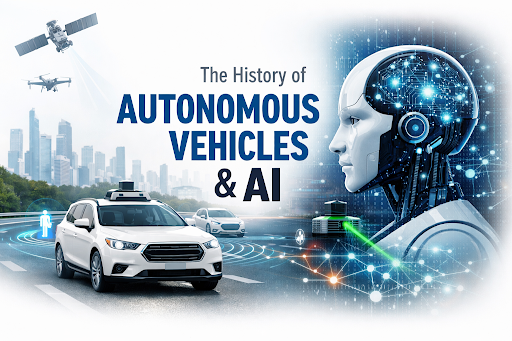
The autonomous vehicles artificial intelligence history is one of the most fascinating technological journeys of the modern era. What once seemed like science fiction—cars driving themselves without human input—has gradually become a reality thanks to decades of innovation in artificial intelligence, robotics, and computing.
From early experiments with radio-controlled vehicles to today’s deep learning powered self-driving cars, the road toward autonomy has been long and filled with breakthroughs. Advances in computer vision, machine learning algorithms, sensor fusion technologies, and massive datasets have transformed the dream of self-driving cars into a rapidly evolving industry.
Understanding the autonomous vehicles artificial intelligence history helps explain how modern autonomous systems work today and where they may lead in the coming decades.
Early Beginnings: Automation Before Modern AI
Long before machine learning and neural networks existed, engineers were already experimenting with automated transportation systems. Early prototypes relied on mechanical control systems rather than intelligent algorithms.
These early developments laid the groundwork for the future autonomous vehicles artificial intelligence history, proving that vehicles could be guided without constant human control.
The 1920s to 1980s: Radio Control and Magnetic Tracks
One of the earliest demonstrations of automated driving occurred in the 1920s when engineers showcased radio-controlled cars navigating city streets. These vehicles were remotely operated rather than truly autonomous, but they sparked curiosity about the potential of automated transportation.
By the 1950s and 1960s, researchers experimented with vehicles guided by embedded wires or magnetic tracks in roads. These systems followed predefined paths and lacked real intelligence, yet they represented the first serious attempt at vehicle automation.
During this time, the foundations of AI research were also forming. The famous Dartmouth Conference in 1956 formally introduced artificial intelligence as a field of study. Early ideas such as Alan Turing Artificial Intelligence theories and the development of The Perceptron neural network model later influenced the evolution of intelligent driving systems.
The autonomous vehicles artificial intelligence history therefore overlaps closely with the broader development of artificial intelligence itself.
The Role of DARPA’s ALV Project in the 1980s
The Autonomous Land Vehicle (ALV) project, funded by the U.S. Defense Advanced Research Projects Agency (DARPA), marked a turning point in automated vehicle research.
Unlike earlier mechanical systems, the ALV used cameras and computer vision algorithms to interpret its environment. Though limited by computing power at the time, it represented a major leap forward in the autonomous vehicles artificial intelligence history.
These early experiments also paralleled developments in robotics and machine perception, which are discussed in the History of Robotics and Artificial Intelligence.
The Turning Point: Machine Learning Enters the Fray
The next major chapter in the autonomous vehicles artificial intelligence history began when machine learning started replacing rigid rule-based programming.
Instead of manually coding every possible driving situation, engineers began training algorithms to recognize patterns from data.
The Impact of the DARPA Grand Challenges (2004–2007)
Few events accelerated the progress of self-driving technology more than the DARPA Grand Challenges.
These competitions challenged research teams to build autonomous vehicles capable of navigating complex terrain without human intervention.
The first race in 2004 ended with no vehicle finishing the course. However, rapid innovation followed. By 2005, several vehicles successfully completed the challenge.
The 2007 Urban Challenge raised the difficulty even further by introducing simulated city environments. Vehicles had to follow traffic rules, avoid obstacles, and interact with other cars.
These competitions dramatically advanced the autonomous vehicles artificial intelligence history, proving that AI could handle real-world driving scenarios.
Many companies leading autonomous vehicle development today—including Google’s Waymo—trace their roots back to DARPA teams.
Transitioning from Rule-Based Systems to Early Neural Networks
Earlier autonomous systems relied on strict programming rules: if a camera detected a lane marking, the car followed it.
However, such rigid systems struggled with unpredictable conditions like rain, shadows, or damaged road markings.
The rise of machine learning allowed vehicles to learn from large datasets rather than relying solely on hand-coded instructions.
Advances described in Evolution of Machine Learning Algorithms and The Rise of Neural Networks played a critical role here.
Researchers began experimenting with neural networks for object recognition, enabling vehicles to detect pedestrians, traffic signs, and other cars more reliably.
This transition marks a critical moment in the autonomous vehicles artificial intelligence history, bridging early robotics with modern deep learning systems.
The Modern Era: Deep Learning and Computer Vision
Today’s autonomous vehicles rely heavily on deep learning algorithms and powerful graphics processing units (GPUs). These systems process enormous volumes of sensor data in real time.
This phase represents the most advanced stage of the autonomous vehicles artificial intelligence history so far.
How Convolutional Neural Networks (CNNs) Revolutionized Perception
Convolutional Neural Networks transformed how machines interpret visual information.
CNNs enable autonomous vehicles to perform complex computer vision tasks such as:
- Object detection
- Lane recognition
- Traffic sign classification
- Pedestrian tracking
The same breakthroughs also fueled progress in Image Recognition in Artificial Intelligence History.
Deep learning models trained on millions of images allow vehicles to interpret the world with impressive accuracy.
These advances also connect to emerging methods like self supervised learning in artificial intelligence, which allows AI systems to learn from unlabeled data—an important development for training autonomous driving models.
The rise of CNNs represents one of the most transformative milestones in the autonomous vehicles artificial intelligence history.
Mastering Sensor Fusion: Marrying LiDAR, Radar, and AI
Autonomous vehicles rely on multiple sensors working together, including:
- LiDAR
- Radar
- Cameras
- Ultrasonic sensors
Sensor fusion combines these inputs into a unified understanding of the environment.
For example:
- Cameras provide detailed visual data.
- Radar detects object speed and distance.
- LiDAR creates high-resolution 3D maps.
Advanced AI systems integrate these signals using machine learning models.
This approach significantly improves reliability and safety in modern autonomous vehicles.
The integration of sensor fusion technologies further demonstrates how far the autonomous vehicles artificial intelligence history has progressed.
Key Milestones by Tech and Automotive Giants
Several technology companies and automakers have played major roles in shaping the autonomous vehicles artificial intelligence history.
Waymo and the Birth of the Google Self-Driving Car Project
Google launched its self-driving car project in 2009, which later became Waymo.
Waymo’s vehicles use a combination of LiDAR, radar, and advanced machine learning models to navigate roads autonomously.
Today, Waymo operates fully driverless taxi services in select cities, representing a major milestone in the autonomous vehicles artificial intelligence history.
Waymo’s development strategy heavily emphasizes safety testing and large-scale data collection.
Their vehicles have logged millions of real-world miles and billions of simulated miles, helping improve AI models that handle complex driving situations.
Tesla’s Approach: Autopilot and Vision-Only AI Systems
Tesla has taken a different approach compared to many competitors.
Rather than relying heavily on LiDAR, Tesla focuses on camera-based perception powered by deep neural networks.
Tesla’s Autopilot and Full Self Driving (FSD) systems rely on large neural networks trained using massive datasets collected from Tesla vehicles worldwide.
This approach has sparked debate within the autonomous vehicles artificial intelligence history, as experts disagree on whether camera-only systems can achieve full autonomy.
However, Tesla’s rapid software updates and large-scale fleet learning represent a unique strategy in the development of self-driving AI.
The Future of AI in Autonomous Transport
The next chapter of the autonomous vehicles artificial intelligence history is still being written.
While impressive progress has been made, many challenges remain before fully autonomous vehicles become common.
Overcoming Edge Cases and Complex Urban Environments
One of the biggest challenges for self-driving systems is handling rare or unusual situations known as edge cases.
Examples include:
- Unexpected pedestrian behavior
- Construction zones
- Poor weather conditions
- Unpredictable driver actions
Solving these problems requires improved machine learning models and massive datasets.
Advances in AI training techniques—similar to those explored in Reinforcement Learning History—may help autonomous systems adapt more effectively.
The Road to SAE Level 5 Autonomy
The Society of Automotive Engineers (SAE) defines six levels of driving automation:
Level 0: No automation
Level 1–2: Driver assistance systems
Level 3–4: Conditional to high automation
Level 5: Full autonomy with no human driver required
Today most commercial systems fall within Advanced Driver Assistance Systems (ADAS) at Level 2.
Achieving Level 5 autonomy remains the ultimate goal of the autonomous vehicles artificial intelligence history.
Future breakthroughs in AI hardware, edge computing, and large-scale training data will play crucial roles in reaching this milestone.
Experts believe that advancements tied to the Future of artificial intelligence technology will dramatically accelerate progress in autonomous transportation.
Frequently Asked Questions (FAQs)
What is the autonomous vehicles artificial intelligence history?
The autonomous vehicles artificial intelligence history refers to the development of self-driving technology from early automated vehicle experiments to modern AI-driven autonomous systems using deep learning and sensor fusion.
When did self-driving cars first appear?
The earliest automated vehicle experiments began in the 1920s using radio-controlled vehicles. However, modern self-driving research accelerated during the 1980s and significantly advanced after the DARPA Grand Challenges in the 2000s.
What technologies enable autonomous vehicles today?
Modern autonomous vehicles rely on several technologies including computer vision, machine learning algorithms, LiDAR, radar, cameras, sensor fusion, and deep neural networks.
Which companies lead autonomous vehicle development?
Major companies working on autonomous driving include Waymo, Tesla, Cruise, Baidu, and several major automotive manufacturers integrating AI into their vehicles.
Will fully autonomous cars become common in the future?
While Level 5 autonomous vehicles are not yet widely available, rapid advances in AI and robotics suggest that fully autonomous transportation may become common in the coming decades.
Conclusion
The autonomous vehicles artificial intelligence history is a powerful story of technological evolution. From early radio-controlled experiments to today’s deep learning systems capable of interpreting complex environments, the field has progressed dramatically.
Breakthroughs in machine learning, computer vision, and sensor fusion have transformed autonomous driving from an experimental concept into an emerging industry with real-world applications.
Although challenges remain—especially regarding safety, regulation, and edge cases—the future of autonomous transportation looks promising. As artificial intelligence continues advancing, autonomous vehicles may soon reshape mobility, urban planning, and the global transportation ecosystem.