Introduction
When discussing the milestones of technological achievement, the deep blue chess computer history stands as one of the most defining moments of the 20th century. For decades, the game of chess was considered the ultimate test of human intellect, a complex battleground where intuition, strategy, and foresight reigned supreme. The idea that a machine could one day outsmart a human world champion seemed like pure science fiction. However, that perception shattered in May 1997.
The IBM Deep Blue chess computer accomplished what was previously thought impossible by defeating the reigning World Chess Champion, Garry Kasparov, in a six-game tournament. This event was not merely a victory for a machine; it was a profound breakthrough for AI in chess that captured the imagination of the entire world. To truly appreciate this turning point, we must dive into the deep blue chess computer history, tracing its roots from a university science project to a corporate powerhouse that permanently altered our understanding of cognition, computation, and the future of human-computer interaction.
Origins of the Deep Blue Project
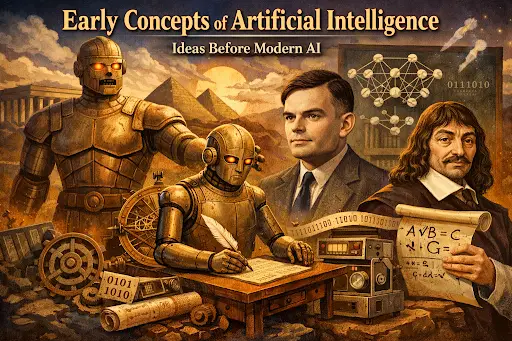
The pursuit of building a machine capable of mastering chess is almost as old as computing itself. Long before modern supercomputers, visionaries explored Alan Turing Artificial Intelligence concepts, theorizing that if a machine could solve chess, it could potentially solve any complex logic-based problem. In 1956, the famous Dartmouth Conference laid the formal groundwork for AI research, cementing chess as the “Drosophila” (fruit fly) of artificial intelligence—a standard testbed for measuring machine intelligence.
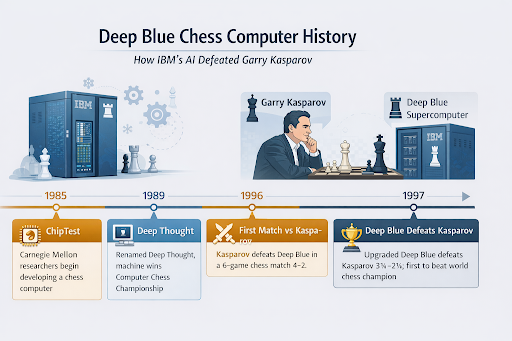
Following the creation of the First AI Programs, researchers spent decades trying to build a competitive chess machine. The direct lineage of Deep Blue began at Carnegie Mellon University in the mid-1980s under the guidance of Feng-hsiung Hsu. He developed a project initially known as ChipTest, which eventually evolved into the Deep Thought chess computer. Deep Thought was revolutionary for its time, but it still lacked the sheer computing muscle required to challenge a world champion.
Recognizing the immense potential, IBM hired Hsu and his team in 1989, officially bringing the project under the umbrella of IBM AI research. The system was rebuilt from the ground up, heavily funded, and rebranded as Deep Blue. The goal was singular and ambitious: to build a machine capable of beating the best human player on the planet.
How Deep Blue Chess Computer Worked
To understand how the machine achieved its eventual dominance, one must look under the hood of this supercomputer chess program. Unlike modern AI, which relies heavily on neural networks and pattern recognition, Deep Blue did not “think” or learn in the way humans do. While it is tempting to compare it to Early Machine Learning, Deep Blue was primarily a triumph of brute-force computation and highly optimized hardware.
Deep Blue was a massively parallel RS/6000 SP system featuring 30 processors and 480 custom VLSI (Very Large Scale Integration) chips designed specifically to execute chess algorithms. This unique architecture allowed the machine to evaluate an astonishing 200 million chess positions per second.
Instead of relying on intuition, the computer utilized a complex alpha-beta search algorithm combined with a highly sophisticated evaluation function. Grandmaster Joel Benjamin was brought in to help tune the system’s “chess knowledge,” ensuring the machine knew the value of pawn structures, king safety, and positional advantages. By searching up to 20 moves deep in certain situations, the machine could map out massive decision trees, calculating variations far beyond human capacity.
Deep Blue vs Garry Kasparov (1996 Match)
The highly anticipated Deep Blue vs Garry Kasparov showdown began with their first official match in Philadelphia in February 1996. Kasparov was the undisputed, dominant force in world chess, and many believed the machine was not yet ready for the Garry Kasparov vs computer challenge.
However, the world was stunned when Deep Blue won the very first game of the match. It marked the first time a computer had ever defeated a reigning world champion under standard tournament time controls. Despite the shock, Kasparov quickly adapted. He realized that playing standard, aggressive tactical chess played directly into the machine’s brute-force calculation strengths.
Kasparov shifted his strategy to a more closed, positional style of play that effectively neutralized the computer’s tactical vision. He went on to win three games and drew two, winning the match with a final score of 4-2. While humanity won the 1996 battle, the reality of machine vs human chess had shifted. The machine had drawn blood, and IBM immediately returned to the lab to upgrade their system.
The Historic 1997 Match: Man vs Machine
The stage was set for a highly publicized rematch in May 1997 in New York City. The Deep Blue chess match 1997 was arguably the most watched chess event in history. IBM had doubled the computer’s processing speed and refined its evaluation functions significantly.
The match was incredibly tense. Kasparov won the first game, but game two proved to be a psychological turning point. Deep Blue made a move (45. Ra6) that seemed so deeply positional and “human” that Kasparov was visibly shaken, eventually resigning in a position that analysis later showed he could have drawn. Kasparov suspected human intervention, a claim IBM vehemently denied, but the psychological damage was done.
After three subsequent draws, the score was tied 2.5 – 2.5 heading into the final Game 6. In a shocking uncharacteristic collapse, Kasparov made a known opening blunder in the Caro-Kann Defense. Deep Blue aggressively capitalized on the mistake, forcing Kasparov to resign in just 19 moves. The machine had won the match 3.5 to 2.5. The deep blue chess computer history was cemented in that moment: the machine had officially dethroned the human champion.
Why the Deep Blue Victory Was Important
The history of the Deep Blue supercomputer is not just a story about a board game; it was a watershed moment for technology and society. The 1997 victory challenged the deeply held philosophical belief that human intuition and creativity could never be mathematically calculated or overwhelmed by a machine.
During artificial intelligence in the 1990s, public perception of AI was still largely relegated to academic experiments and science fiction movies. Deep Blue brought the realities of computational power into the living rooms of millions. It proved that in domains governed by strict mathematical rules and immense complexity, a machine could out-calculate the greatest human mind. It forced humanity to redefine what it meant to be “intelligent” and shifted the benchmark for AI research from logic-based games to more abstract, real-world problems.
Impact of Deep Blue on Artificial Intelligence
The victory over Kasparov injected massive credibility and financial interest into the tech industry. For years, the AI field had struggled with periods of reduced funding and skepticism, historically known as AI Winters. The success of Deep Blue artificial intelligence helped thaw the industry, proving that large-scale, corporate-backed computing projects could yield groundbreaking results.
Furthermore, IBM chess computer history became a masterclass in parallel computing. The architecture developed for Deep Blue helped IBM build better, faster supercomputers for other industries. The ability to quickly search through massive databases of possibilities was later applied to complex problems in molecular dynamics, pharmaceutical drug discovery, financial modeling, and weather forecasting. The project proved that specialized hardware, combined with optimized software, was a viable path to solving the world’s most data-heavy problems.
Legacy of Deep Blue in Modern AI
Today, the computer chess history that Deep Blue authored feels like a distant prologue to the modern era of artificial intelligence. While Deep Blue was a marvel of brute-force calculation, subsequent chess AI development took a very different path.
Modern chess engines like Stockfish can easily run on a standard smartphone and would utterly crush both Deep Blue and Kasparov. More recently, Google’s AlphaZero changed the landscape again. Unlike Deep Blue, which was explicitly programmed with chess knowledge by human grandmasters, AlphaZero learned the game entirely by playing itself through neural networks. This shift perfectly illustrates the Evolution of Machine Learning Algorithms—moving away from hard-coded human logic toward systems that learn, adapt, and create their own intuitive understanding of data.
The chess computer evolution from a massive room-sized mainframe to an agile, self-taught neural network highlights how fast technology moves. Yet, none of this modern context diminishes the accomplishment of 1997. Deep Blue was the necessary bridge between theoretical computing and the modern AI revolution we are experiencing today.
Frequently Asked Questions (FAQs)
1. What happened to the Deep Blue computer after 1997?
After its historic victory, IBM dismantled the machine. Part of the original hardware is now on display at the Smithsonian National Museum of American History in Washington, D.C., preserving the deep blue chess computer history for future generations.
2. Did Deep Blue cheat during the 1997 match against Kasparov?
No. Garry Kasparov initially accused IBM of cheating, suggesting human grandmasters intervened during game two. However, IBM proved that all moves were generated by the computer’s algorithms. The perceived “human-like” moves were the result of the machine’s incredibly deep calculation capabilities and refined evaluation parameters.
3. Could Deep Blue beat modern chess computers today?
No. While it was a supercomputer in 1997, modern chess engines running on standard laptops are infinitely stronger. The advancement in search algorithms and processing efficiency means today’s software would easily defeat Deep Blue.
4. Was Deep Blue a true Artificial Intelligence?
By modern standards, Deep Blue was an “expert system” or “narrow AI.” It could not learn from its mistakes or apply its knowledge to anything other than chess. It relied on brute-force calculation rather than the deep learning neural networks used by AI today.
Conclusion
The legacy of the 1997 match extends far beyond the 64 squares of a chessboard. Exploring the deep blue chess computer history reveals a pivotal moment where the raw, mechanical power of computation finally overtook human cognitive dominance in a heavily structured environment. The victory of the IBM supercomputer over Garry Kasparov proved the viability of massively parallel computing and reinvigorated global interest in artificial intelligence. While today’s AI systems are vastly more complex and capable of true machine learning, they all trace a part of their lineage back to the day a computer sat across from a human champion and said “checkmate.” Deep Blue remains an enduring symbol of human ingenuity—a machine built by humanity, to push the absolute limits of human capability.