Introduction: Before AI Was Real, It Was an Idea
When we think about artificial intelligence today, we imagine smart assistants, chatbots, and self-driving cars. But long before modern AI systems existed, people were already imagining intelligent machines.
The early concepts of artificial intelligence did not begin with computers. They began with human curiosity.
In our previous article on the brief history of Artificial Intelligence, we explored how AI evolved into a scientific field. In this article, we go even further back — to a time before digital machines — to understand how the idea of artificial intelligence was born.
Ancient Imaginations of Artificial Beings
The idea of artificial intelligence is older than electricity.
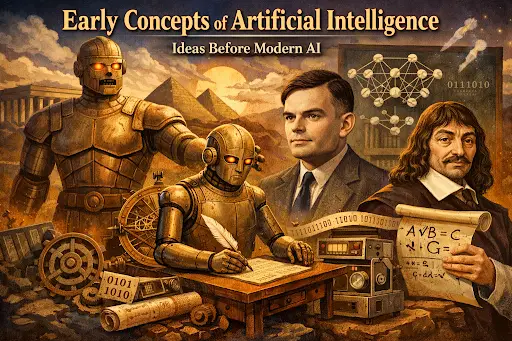
In ancient Greek mythology, there was a giant bronze figure named Talos, said to protect the island of Crete. While this was only a myth, it showed that humans were already imagining artificial beings that could think and act on their own.
Similar ideas appeared in other cultures too. These early stories were not science, but they reveal something important: humans have always been fascinated by the idea of creating intelligence outside the human body.
These myths planted the very first seeds of artificial intelligence.
Mechanical Automatons: The First Artificial “Machines”
During the Middle Ages and Renaissance, inventors built mechanical automatons — machines that could move automatically using gears and springs.
Some could write simple sentences. Others could play musical instruments.
Although these machines were not intelligent, they gave people proof that lifeless objects could imitate human behavior.
This mechanical creativity later influenced the development of the machines discussed in the history of computers, where devices slowly evolved from simple calculators to programmable systems.
The dream was slowly becoming more realistic.
Philosophical Foundations of Artificial Intelligence
Before computers existed, philosophers were already asking deep questions:
- Can human thinking be reduced to logic?
- Is the mind like a machine?
- Can reasoning follow clear rules?
In the 17th century, philosophers such as René Descartes and Gottfried Wilhelm Leibniz explored the idea that reasoning could follow mathematical rules. Leibniz even dreamed of a “universal language” of logic that machines could process.
These philosophical ideas became extremely important later when modern programming languages were developed. After all, programming is based on logic and structured rules.
In many ways, AI began as a philosophical question before it became a technological reality.
Alan Turing and the Question: “Can Machines Think?”
The true turning point came in the 20th century.
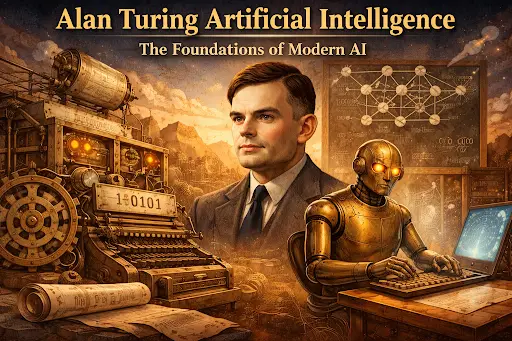
In 1950, British mathematician Alan Turing asked a revolutionary question:
“Can machines think?”
Instead of debating the definition of “thinking,” he proposed a practical test, now known as the Turing Test. If a machine could communicate in a way that was indistinguishable from a human, it could be considered intelligent.
Turing’s ideas connected intelligence with computation. This was possible because computers were already evolving — as explained in the history of computers.
Without advances in computing hardware and later operating systems, AI research would not have progressed.
Turing did not build modern AI systems, but he provided the intellectual foundation for them.
Early Neural Ideas Before Digital AI
Around the 1940s, researchers began thinking about artificial neurons — mathematical models inspired by the human brain.
They believed intelligence might emerge if machines could imitate how neurons work.
These early neural concepts were simple compared to modern deep learning, but they introduced a powerful idea: machines could learn patterns instead of just following fixed instructions.
This idea would later evolve into machine learning and neural networks — key parts of modern AI.
How Early Concepts Led to Modern Artificial Intelligence
By the mid-20th century, all the essential pieces were coming together:
- Philosophical logic
- Mechanical automation
- Mathematical reasoning
- Early computing systems
- Theoretical models of neural networks
These early concepts of artificial intelligence created the intellectual environment that led to the Dartmouth Conference in 1956 — the event where AI officially became a scientific field.
Without centuries of imagination and experimentation, modern AI would not exist.
Why Understanding Early AI Concepts Matters Today
Understanding early AI concepts helps us see that artificial intelligence did not appear suddenly.
It evolved slowly.
Just like the evolution of the Internet and computing systems, AI developed step by step — from myth to machine, from philosophy to programming.
When we study these origins, we can better understand where AI might go next.
Frequently Asked Questions (FAQs)
1. What are the early concepts of artificial intelligence?
The early concepts of artificial intelligence refer to the philosophical, mechanical, and theoretical ideas about intelligent machines that existed before modern AI systems were created.
2. Did artificial intelligence exist before computers?
No, practical AI systems did not exist before computers. However, the ideas and theories about intelligent machines existed long before digital computing began.
3. Who first proposed the idea of machine intelligence?
Alan Turing was one of the first scientists to seriously propose that machines could think. His 1950 paper introduced the famous Turing Test.
4. How did philosophy influence artificial intelligence?
Philosophy influenced AI by introducing logical reasoning and structured thinking, which later became the foundation for programming and computational intelligence.
5. Why are early AI concepts important?
They show how artificial intelligence evolved step by step and help us understand the deeper roots of modern AI technology.
Conclusion
The early concepts of artificial intelligence were not built with silicon chips or massive datasets. They were built with imagination, philosophy, and logic.
From ancient myths to Alan Turing’s groundbreaking ideas, the dream of intelligent machines has always been part of human history.
These early ideas laid the foundation for everything that followed — including the powerful AI systems we use today.