The digital world is currently undergoing a massive transformation in how data is processed and acted upon. For the last decade, the cloud has been the undisputed king of intelligence, acting as the centralized brain for every “smart” application. However, we are now witnessing a shift toward a more decentralized and efficient paradigm. This edge ai technology evolution represents the transition of artificial intelligence from massive, distant data centers directly into the local devices we use every day.
By bringing intelligence to the “edge” of the network—closest to where data is actually generated—we are solving critical issues of latency, privacy, and bandwidth. This article explores the rich history and the promising future of edge ai technology evolution, detailing how it has become a cornerstone of the modern industrial and consumer landscape.
What is Edge AI?
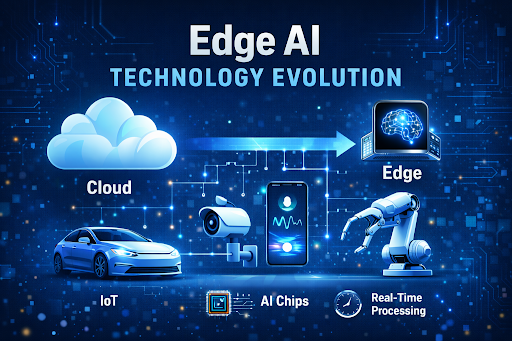
Edge AI refers to the deployment of machine learning models directly onto hardware devices, such as cameras, sensors, or mobile phones, rather than relying on a cloud-based server to do the heavy lifting. In the traditional model, a device would capture data, send it over the internet to the cloud, wait for the cloud to process it, and then receive an instruction.
The edge AI technology evolution changes this by enabling real-time AI processing on the device itself. This means your smart camera can recognize a face, or an autonomous car can detect a pedestrian, in milliseconds without needing an active internet connection. This on-device machine learning is what makes modern gadgets feel truly “intelligent” and responsive.
Early Foundations of Edge Computing
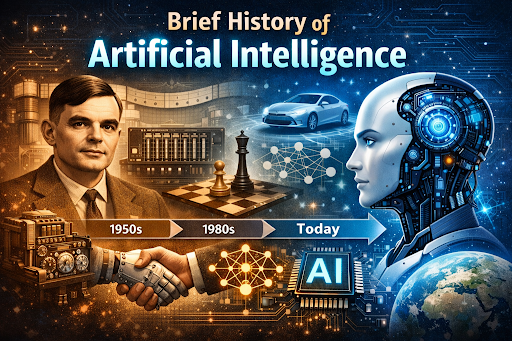
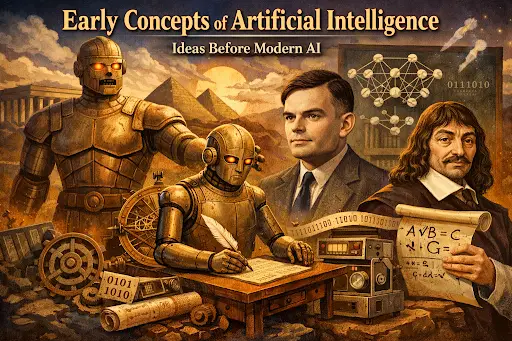
The edge ai technology evolution did not appear out of thin air; it was built upon decades of progress in distributed computing and networking. In the early days of the internet, the focus was primarily on centralized mainframe systems. This was the era of Early Machine Learning and the First AI Programs, where the sheer size of computers made “local” intelligence impossible.
As we moved through the Revival of Artificial Intelligence in the 1990s, the concept of content delivery networks (CDNs) emerged. Companies realized that moving data closer to the user improved speed. This was the precursor to modern edge computing technology. However, it wasn’t until the explosion of mobile devices and the Internet of Things (IoT) that the need for local intelligence became urgent. The foundations laid during the development of Expert Systems in Artificial Intelligence eventually evolved into the distributed AI computing frameworks we see today, where logic is spread across millions of nodes rather than one central core.
Integration of AI with Edge Devices
The integration phase of the edge ai technology evolution was driven by the realization that the cloud could not handle the sheer volume of data generated by billions of IoT devices. Sending every single byte of video or sensor data to the cloud was not only expensive but technically impossible due to bandwidth limitations.
This necessitated the growth of edge AI systems. Developers began shrinking deep learning models to fit into the constrained memory of embedded AI systems. This was a significant hurdle in the history of edge AI. While The Rise of Neural Networks provided mathematical power, engineers had to innovate through “model quantization” and “pruning”—techniques that make AI models smaller and faster without losing their accuracy. This allowed for the successful deployment of AI at the edge technology, turning simple sensors into smart sensors and devices.
Major Milestones in Edge AI Development
The edge AI technology evolution is marked by three critical milestones that moved the needle from “experimental” to “essential.”
1. IoT Expansion
The massive proliferation of connected devices provided the “body” for the AI. As everything from lightbulbs to industrial turbines became connected, the need for localized edge artificial intelligence development skyrocketed.
2. AI Hardware Acceleration
General-purpose CPUs were too slow for complex AI tasks. A major milestone in the edge AI technology evolution was the birth of specialized AI chips and processors. Companies like NVIDIA, ARM, and Apple began producing Neural Processing Units (NPUs) specifically designed for AI hardware acceleration, allowing devices to perform trillions of operations per second with minimal battery drain.
3. Efficient AI Models
The creation of architectures like MobileNet and TinyML allowed sophisticated tasks like Speech Recognition Artificial Intelligence History and computer vision to run on low-power microcontrollers. This made edge AI computing technology accessible to even the smallest, battery-operated gadgets.
Applications of Edge AI
The edge AI technology evolution has touched almost every sector of our lives, enabling Modern Artificial Intelligence Applications that were once the stuff of science fiction.
Smart Devices
Our smartphones are the most common examples of edge AI innovations. From real-time language translation to the “portrait mode” on your camera, these tasks are performed locally to ensure low latency computing and maximum privacy.
Autonomous Vehicles
Self-driving cars are perhaps the most critical application of the edge ai technology evolution. A car moving at 60 mph cannot wait for the cloud to decide if it should brake. It requires real-time AI processing to ensure safety, making it a masterpiece of edge AI architecture.
Smart Cities
In modern urban planning, edge AI is used in smart traffic lights and public safety systems. By processing video feeds locally, these systems can manage traffic flow and detect accidents instantly without streaming constant video to a central server, thus saving massive amounts of bandwidth.
Industrial Automation
In the “Industry 4.0” era, History of Robotics and Artificial Intelligence has transitioned into the use of edge AI for predictive maintenance. Smart sensors on factory floors can detect a microscopic vibration that indicates a machine is about to fail, stopping the line before a costly breakdown occurs.
Benefits of Edge AI
The edge ai technology evolution offers several “game-changing” advantages over traditional cloud-based systems:
- Latency: By eliminating the “round trip” to the cloud, devices can respond in real-time.
- Privacy and Security: Personal data, such as voice recordings or security footage, never has to leave the device, significantly reducing the risk of data breaches.
- Reliability: Edge devices can continue to function even if the internet connection goes down.
- Cost Efficiency: Reducing the amount of data sent to the cloud lowers transmission and storage costs.
Challenges in Edge AI Development
Despite its many benefits, the edge ai technology evolution faces several technical hurdles. The most prominent is the “power-performance tradeoff.” Running high-level AI consumes significant battery life, which is a major concern for mobile and remote IoT devices.
Additionally, managing a fleet of millions of decentralized devices is much harder than managing a single cloud server. Updating models, ensuring security across diverse hardware, and maintaining the growth of edge AI systems requires a complex orchestration layer that the industry is still perfecting. Finally, while hardware is getting better, the most advanced models (like large language models) are still too big for most edge devices, creating a “capability gap” that researchers are working hard to close.
The Future of Edge AI Technology
As we look forward, the edge AI technology evolution is moving toward “Collaborative AI.” This is a concept where the edge and the cloud work in a seamless loop. The edge handles the immediate, real-time actions, while the cloud handles long-term learning and heavy processing.
We are also seeing the rise of “Federated Learning,” a privacy-first AI training technique where millions of edge devices work together to train a global model without ever sharing their local data. In the future, the edge AI technology evolution will lead to a world where every object around us—from our clothes to the walls of our homes has some level of “ambient intelligence,” quietly and efficiently making our lives better without us even noticing.
Frequently Asked Questions (FAQs)
How is Edge AI different from Cloud AI?
Cloud AI processes data in a centralized server far away, which causes latency. Edge AI processes data directly on the device, allowing for instant responses and better privacy.
Why is the edge AI technology evolution important for 5G?
5G provides the high-speed connectivity needed to manage millions of edge devices. Together, 5G and edge AI enable things like remote surgery and massive-scale autonomous drone fleets.
Does Edge AI mean the cloud is going away?
Not at all. The edge AI technology evolution is about finding a balance. The cloud will still be used for storing massive datasets and training the initial models, while the edge will handle the execution (inference) in the real world.
Conclusion
The edge AI technology evolution has fundamentally changed our relationship with technology. We have moved from a world where “smart” meant “connected to a big server” to a world where our devices possess their own local intelligence. By focusing on real-time AI processing and privacy, the evolution of edge AI technology is enabling a new generation of autonomous vehicles, smart cities, and industrial breakthroughs. As hardware continues to shrink and AI models become more efficient, the edge AI technology evolution will continue to push the boundaries of what is possible, bringing us closer to a truly intelligent and responsive world.