Introduction to Transformer Models in Artificial Intelligence
The introduction of transformer models in artificial intelligence has sparked a monumental shift in how machines understand, process, and generate human-like data. Before this breakthrough, AI relied heavily on sequential processing methods that struggled with long-term context and computational efficiency. Today, transformer models in artificial intelligence serve as the foundational backbone for the most advanced applications we use daily.
Understanding the rise of transformer models AI requires looking at the limitations of past technologies. Recurrent Neural Networks (RNNs) and Long Short-Term Memory (LSTM) networks were the standard, but they processed data word by word. This made them slow and prone to forgetting early parts of a sentence. The arrival of transformer neural networks completely removed this sequential bottleneck, allowing for parallel data processing. In this article, we will explore how this incredible architecture functions, its profound impact on natural language processing, and why it remains the driving force behind modern digital innovation.
The Origins of Transformer Models
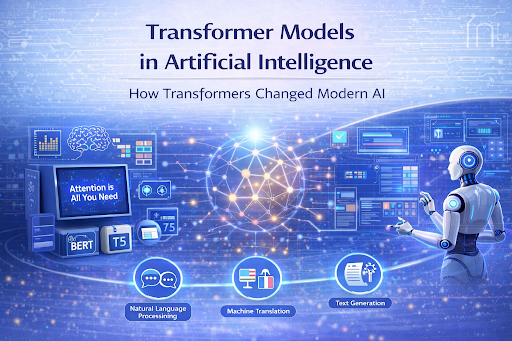
The true origins of transformer models in artificial intelligence trace back to a landmark 2017 research paper by Google researchers titled “Attention Is All You Need.” This paper introduced a novel neural network architecture that abandoned recurrence entirely in favor of an attention mechanism. This shift was a massive leap forward in the Evolution of Machine Learning Algorithms, proving that machines could understand the context of a word based on its surrounding words simultaneously, rather than sequentially.
The evolution of transformer models happened rapidly after this publication. Researchers quickly realized that this framework was incredibly scalable. The development of transformer models allowed engineers to train systems on unimaginably massive datasets using parallel processing. This efficiency meant that deep learning models could grow exponentially in size and capability, laying the groundwork for the highly sophisticated AI transformer technology that currently dominates the tech industry.
How Transformer Architecture Works
To truly grasp the power of transformer models in artificial intelligence, one must understand their underlying mechanics. The transformer architecture in AI is uniquely designed to handle vast amounts of data efficiently without losing contextual meaning.
Self-Attention Mechanism
At the core of this breakthrough is the self-attention mechanism. When reading a sentence, a human naturally pays more attention to certain words to understand the overall meaning. Self-attention enables the AI to do the same mathematically. It assigns a “weight” to every word in a sentence relative to every other word, determining which words are most heavily linked. This allows transformer models deep learning frameworks to maintain perfect context, even if the related words are far apart in a massive paragraph.
Multi-Head Attention
Multi-head attention takes the self-attention mechanism and runs it multiple times in parallel. Instead of just looking at the sentence through one contextual lens, the model examines the sequence modeling through several different “heads” simultaneously. One head might focus on grammatical structure, another on emotional tone, and another on subject-verb relationships. By combining these different perspectives, transformer models and machine learning systems gain an incredibly rich, nuanced understanding of complex data inputs.
Encoder-Decoder Structure
The original transformer was built using an encoder-decoder structure. The encoder’s job is to read the input data (like a sentence in English) and map it into a continuous mathematical representation, capturing all its contextual nuances. The decoder then takes this rich mathematical representation and generates the desired output (like translating that sentence into French). While some modern models use only the encoder (like the BERT model) or only the decoder (like GPT models), this fundamental two-part structure was crucial to the initial success of the architecture.
Transformer Models and Natural Language Processing
Nowhere is the impact of transformer models in artificial intelligence more visible than in the field of natural language processing (NLP). Before transformers, NLP tasks were notoriously rigid and often produced clunky, robotic text. Transformers revolutionized this by allowing machines to grasp sarcasm, idioms, and complex sentence structures.
The introduction of the BERT model (Bidirectional Encoder Representations from Transformers) by Google fundamentally changed how search engines understand user queries. Instead of just looking at keywords, BERT analyzes the context of words in relation to all the other words in the search phrase. This bidirectional understanding ensures that the system comprehends the true intent behind human language. As a result, transformer models in artificial intelligence have made digital communication, search, and text analysis incredibly fast and remarkably accurate.
Applications of Transformer Models
The versatility of transformer models in artificial intelligence has led to their adoption across almost every technological sector. What started as a text-based tool has expanded to handle various types of complex data.
AI Chatbots
Customer service and digital assistance have been transformed by AI chatbots powered by GPT models. These conversational agents leverage the massive context windows of transformers to remember previous parts of a conversation, resulting in fluid, coherent, and highly helpful dialogue that closely mimics human interaction.
Machine Translation
Global communication relies heavily on seamless machine translation. Transformers excel here because they look at an entire sentence at once, translating the meaning rather than just swapping words individually. This results in translations that respect the grammar, tone, and cultural nuances of the target language.
Content Generation
From writing software code to drafting marketing copy, content generation is a massive use case. By predicting the most logical next sequence of words based on their extensive training, these systems can generate highly creative, structured, and factually grounded essays, articles, and scripts in a matter of seconds.
Image Recognition
While initially designed for text, the architecture has been successfully adapted for visual data through Vision Transformers (ViT). Instead of words, the model breaks an image down into a sequence of small “patches” and uses attention mechanisms to understand how different parts of the image relate to one another. This represents a huge leap forward in Image Recognition in Artificial Intelligence History, allowing models to classify and analyze visuals with staggering accuracy.
Speech Processing
Audio transcription and real-time voice translation have drastically improved. By treating audio signals as sequential data, transformers can accurately transcribe spoken words, filtering out background noise and understanding different accents. This marks a significant milestone in Speech Recognition Artificial Intelligence History, paving the way for seamless human-computer voice interfaces.
Transformer Models and Large Language Models
You cannot discuss transformer models in artificial intelligence without mentioning large language models (LLMs). The scalability of the transformer architecture is what made LLMs physically and computationally possible. As we look at The Rise of Neural Networks, researchers discovered that simply making a transformer model larger—giving it more parameters and feeding it more data—predictably increased its reasoning capabilities.
Modern large language models contain hundreds of billions, sometimes trillions, of parameters. These massive networks serve as vast repositories of human knowledge, capable of passing bar exams, writing complex software, and engaging in deep philosophical debates. The efficiency of the transformer architecture allows these massive models to be trained on supercomputers in a reasonable timeframe, cementing transformer models in artificial intelligence as the definitive standard for advanced machine intelligence.
Future of Transformer Models in Artificial Intelligence
The future of transformer models in artificial intelligence is incredibly bright, though not without its challenges. Currently, the biggest hurdle is computational cost; running massive transformer neural networks requires immense amounts of electricity and highly specialized hardware. Researchers are actively working on creating more efficient, lightweight transformer models deep learning architectures that can run locally on smartphones and personal computers without needing a constant cloud connection.
Additionally, the future points toward fully multimodal AI. We are seeing the development of transformer models that can natively process text, audio, images, and video simultaneously within the same network. This will allow AI systems to interact with the real world in a much more holistic and human-like manner, deeply understanding environments, responding to visual cues, and communicating through natural speech in real-time.
Frequently Asked Questions (FAQs)
Why are transformer models in artificial intelligence better than older AI models?
They are superior primarily because of the self-attention mechanism, which allows them to process entire sequences of data in parallel rather than sequentially. This dramatically speeds up training times and allows the model to retain long-term context much better than older RNN or LSTM models.
What is the most famous example of a transformer model?
Currently, OpenAI’s GPT models (Generative Pre-trained Transformer) and Google’s BERT are the most widely recognized. These power many Modern Artificial Intelligence Applications, including advanced chatbots and modern search engine algorithms.
Can transformer models process things other than text?
Yes. While they were originally built for natural language processing, the underlying AI transformer technology has been successfully adapted to handle audio (speech recognition), visual data (image generation and analysis), and even complex biological data like protein folding.
Conclusion
The advent and continuous evolution of transformer models in artificial intelligence undeniably represents one of the most critical inflection points in modern computer science. By solving the complex problem of contextual understanding and enabling massive parallel processing, transformers shattered previous limitations and ushered in the era of generative AI. From powering sophisticated large language models to revolutionizing global machine translation and vision processing, their impact is deeply woven into the fabric of today’s digital world. As researchers continue to optimize and expand upon this brilliant architecture, we can expect transformer models to remain at the very forefront of artificial intelligence, continuously redefining the boundaries of what machines are capable of achieving.