Introduction
When we think about artificial intelligence today, our minds naturally drift toward generative models, chatbots, and self-driving cars. However, long before neural networks dominated the conversation, researchers sought to capture human logic in a much more direct way. This pursuit gave rise to expert systems in artificial intelligence, a revolutionary approach designed to solve complex problems by mimicking the decision-making capabilities of a human specialist.
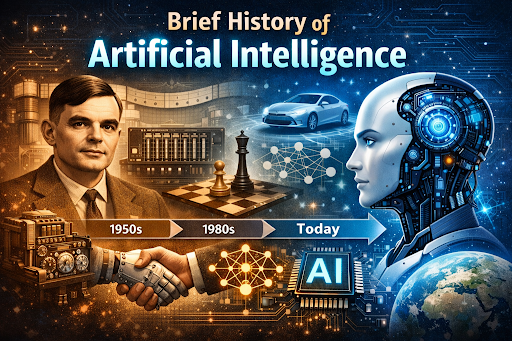
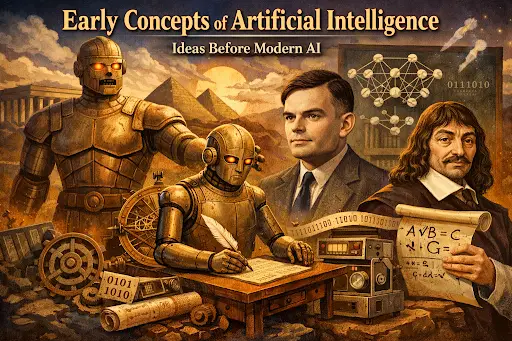
The ambition to create thinking machines can be traced back to the theoretical foundations of Alan Turing Artificial Intelligence concepts in the 1950s. While the field officially gained its name at the seminal 1956 Dartmouth Conference, it took a few decades for scientists to realize that general, all-knowing AI was incredibly difficult to build. Instead, they pivoted to narrow, specialized domains. By capturing the specific knowledge of doctors, chemists, or engineers, they created powerful tools that laid the groundwork for modern computing. In this guide, we will explore what these systems are, how they operate, and why they remain a fundamental part of the AI landscape.
What are Expert Systems in AI?
To provide a clear expert system definition, we can describe it as a computer program that uses artificial intelligence technologies to simulate the judgment and behavior of a human or an organization that has expert knowledge and experience in a particular field. Essentially, the goal is human expert emulation. Rather than learning from massive datasets through trial and error, these systems rely on hard-coded, highly structured logic provided by human professionals.
These programs function as highly specialized AI decision support systems. Whether it is diagnosing an infectious disease, troubleshooting a complex mechanical failure, or determining creditworthiness, an expert system is designed to ask the user a series of targeted questions, evaluate the answers against its internal rulebook, and output a professional recommendation.
Key Components of an Expert System
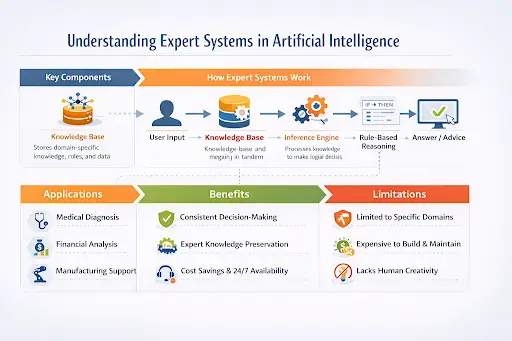
To successfully replicate human reasoning, these systems are built upon a distinct architecture. There are three primary expert system components that work together seamlessly:
- The Knowledge Base: This is the system’s brain. It contains all the factual and heuristic knowledge about the specific domain. The complex task of translating human experience into computer-readable formats is known as knowledge representation in expert systems. It stores the “rules” of the game.
- The Inference Engine: If the knowledge base is the brain’s memory, the inference engine is its analytical processor. The knowledge base and inference engine work in tandem; the engine applies logical rules to the data to deduce new information or arrive at a conclusion.
- The User Interface: This is how the human interacts with the system. It queries the user for specific inputs (e.g., “Does the patient have a fever over 101°F?”) and displays the final expert conclusion in a readable format.
How Do Expert Systems Work?
The mechanics behind these systems rely heavily on rule‑based decision making. In a traditional rule‑based expert system, knowledge is stored as a series of “IF-THEN” statements.
Imagine you are consulting an expert system designed to diagnose car troubles. The internal logic might look like this:
- IF the engine does not turn over AND the headlights are dim, THEN the battery is likely dead.
- IF the engine turns over normally AND the car will not start AND the fuel gauge reads empty, THEN the car is out of gas.
The inference engine navigates these rules using two primary methods:
- Forward Chaining: The system starts with the known facts and applies rules to extract more data until a goal is reached. (e.g., You input symptoms, and it outputs a diagnosis).
- Backward Chaining: The system starts with a hypothetical conclusion and works backward to see if the known facts support it. (e.g., The system hypothesizes the battery is dead and asks if your headlights are dim to confirm).
Applications of Expert Systems in AI
The practical uses of this technology span across numerous industries. Because they excel in highly regulated, logic-driven environments, expert system applications are vast and highly impactful.
Some classic and modern examples of expert systems in AI include:
- Medical Diagnosis: Systems like MYCIN, developed in the 1970s, could identify bacteria causing severe infections and recommend antibiotics based on the patient’s body weight.
- Financial Services: Banks use these systems to assess loan applications. By inputting an applicant’s credit history, income, and debt levels, the system uses expert rules to approve or deny the request.
- Manufacturing and Maintenance: Complex machinery often relies on fault-diagnosis systems. When a sensor detects an anomaly on a production line, the system can instantly deduce which component is failing and recommend maintenance.
- Customer Support: Many modern logic-tree chatbots are essentially advanced expert systems that guide customers through troubleshooting steps for software or hardware issues.
Benefits of Expert Systems in AI
The introduction of these tools marked a massive leap forward from the days of Early Machine Learning experiments. They offered tangible, immediate value to the businesses that deployed them.
- Consistency and Reliability: Unlike human experts, a computer does not get tired, stressed, or distracted. It will apply the same rules to a problem at 3:00 AM as it would at 3:00 PM.
- Accessibility of Knowledge: By capturing the expertise of top professionals, organizations can distribute that knowledge to junior employees or entirely different geographical locations.
- Explanation of Logic: Unlike modern “black box” neural networks, expert systems can explain exactly why they reached a conclusion by simply tracing back the IF-THEN rules they followed.
- Historic Impact: As some of the very First AI Programs to be successfully commercialized, they proved that artificial intelligence could have massive economic value, encouraging further investment in computer science.
Limitations of Expert Systems
Despite their logical elegance, evaluating expert system benefits and limitations reveals why they are no longer the dominant force in artificial intelligence.
The most significant hurdle is the “knowledge acquisition bottleneck.” Extracting rules from human experts and coding them into a system is incredibly time-consuming and expensive. Furthermore, human experts often rely on intuition or “gut feeling” that cannot be easily translated into rigid IF-THEN statements.
Additionally, these systems are notoriously “brittle.” If a system encounters a scenario that falls outside its programmed rules, it completely fails; it possesses zero common sense. This inability to adapt to new, unprogrammed situations led to a period of widespread commercial disillusionment in the late 1980s. The subsequent collapse of the expert system market was a primary catalyst for one of the most severe AI Winters, a period where AI funding and research drastically dried up.
The Future of Expert Systems in AI
Today, standalone rule-based systems are less common, but the underlying philosophy is far from dead. The Evolution of Machine Learning Algorithms has allowed developers to combine the structured logic of expert systems with the adaptive nature of deep learning.
We are now seeing the rise of “hybrid” or “neuro-symbolic” AI. In these modern systems, machine learning handles pattern recognition (like analyzing a medical X-ray), while an expert system rule base ensures the final output complies with medical regulations and best practices. Expert systems in artificial intelligence have evolved from being the entire brain to acting as the logical guardrails for more complex, data-driven models.
Frequently Asked Questions (FAQs)
What is the history of expert systems?
The history of expert systems dates back to the late 1960s and 1970s, primarily originating from researchers at Stanford University. Early programs like DENDRAL (for chemical analysis) and MYCIN (for medical diagnosis) proved that AI could perform at the level of human specialists in narrow domains.
Is expert system AI still relevant today?
Yes, though often integrated into larger software suites. Pure expert system AI is still used heavily in environments where strict compliance, auditability, and clear logic are required, such as tax calculation software, loan approval systems, and regulatory compliance monitors.
What is the main difference between an expert system and machine learning?
An expert system relies on explicit, human-programmed rules (deductive reasoning) to make decisions. Machine learning relies on feeding vast amounts of data into an algorithm so the computer can find its own patterns and write its own rules (inductive reasoning).
Conclusion
Understanding expert systems in artificial intelligence is essential for grasping how computers first learned to emulate human reasoning. By meticulously codifying the knowledge of specialists into a knowledge base and processing it through an inference engine, pioneers of computer science created tools that revolutionized medicine, finance, and engineering. While modern AI has largely shifted toward data-heavy machine learning, the logical transparency, reliability, and structured decision-making of expert systems ensure they will remain a vital component of enterprise technology for years to come.