Introduction
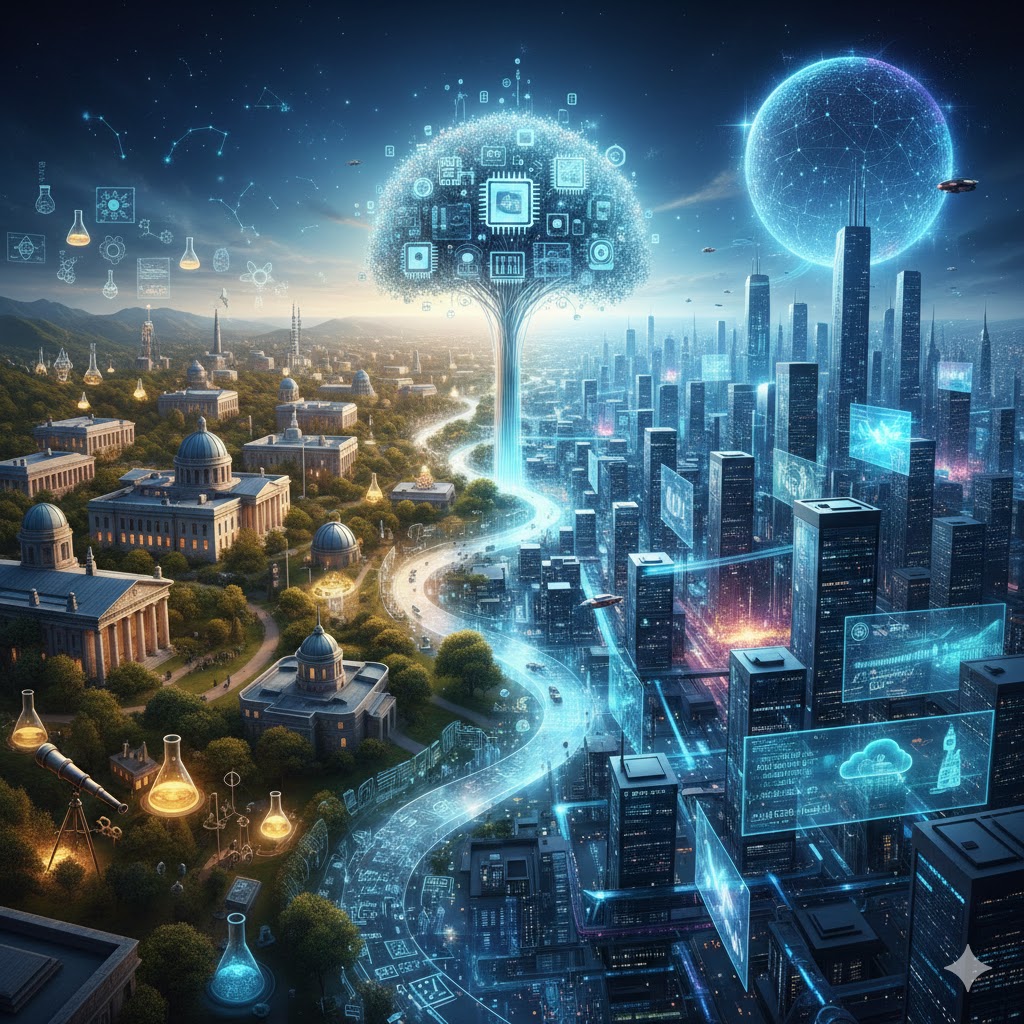
Every time you unlock your smartphone, search on Google, or use artificial intelligence, you are benefiting from centuries of scientific discovery. The modern digital world did not appear suddenly. It is the result of groundbreaking scientific research, revolutionary inventions, and the steady evolution of information technology.
Understanding the history of information technology helps us see how early scientific discoveries laid the foundation for computers, the internet, artificial intelligence, and today’s digital transformation.
The Scientific Foundations of the Digital Age
Modern information technology is built upon the discoveries of great scientists and mathematicians.
Mathematics: The Language of Computers
Mathematics forms the backbone of computer science. Concepts such as algorithms, binary numbers, and logical operations come directly from mathematical theory.
The development of Boolean algebra made digital circuits possible. Without mathematical logic, programming languages and software development would not exist.
Physics and Electricity
Scientific discoveries in physics made electronic technology possible. For example:
- Isaac Newton established the laws of motion, forming the basis of engineering.
- Michael Faraday made key discoveries in electromagnetism, enabling electrical power generation.
Electricity became the driving force behind telecommunication systems and electronic devices, which later evolved into computers.
Revolutionary Inventions That Changed Human Civilization
Scientific discoveries led to inventions that transformed how humans share and process information.
The Printing Press
The invention of the printing press revolutionized communication by making knowledge accessible to the masses. This accelerated education, research, and scientific progress.
The Telegraph and Telephone
The telegraph introduced long-distance communication through electrical signals. The telephone later allowed real-time voice communication. These technologies were early steps toward modern digital networks.
The Birth and Evolution of Computers
The history of computers is a crucial chapter in the development of modern IT.
Early Mechanical Computing
Charles Babbage designed the Analytical Engine in the 19th century, considered the first concept of a programmable computer. His ideas laid the groundwork for future computing systems.
Theoretical Foundations of Computer Science
Alan Turing introduced the concept of a universal machine capable of performing computations. His work formed the theoretical foundation of modern computer science and artificial intelligence.
The Electronic Computer Revolution
The 20th century saw the development of electronic computers. The invention of the transistor in 1947 replaced vacuum tubes, making computers smaller, faster, and more efficient.
Later, the microprocessor revolution in the 1970s allowed entire computing systems to fit on a single chip. This innovation led to personal computers, laptops, and eventually smartphones.
The Rise of the Internet and Modern Information Technology
The development of the internet marked the beginning of the true digital era.
Originally created for research communication, the internet evolved into a global network connecting billions of devices. It transformed business, education, healthcare, and entertainment.
Modern information technology now includes:
- Cloud computing
- Cybersecurity
- Data science
- Software engineering
- Artificial intelligence
These technologies drive digital transformation across industries worldwide.
Artificial Intelligence and the Future of IT
Artificial intelligence represents the latest stage in the evolution of information technology. AI systems use machine learning algorithms, data analysis, and automation to perform tasks that once required human intelligence.
Applications of AI include:
- Voice assistants
- Recommendation systems
- Medical diagnostics
- Autonomous vehicles
- Financial forecasting
AI demonstrates how scientific discoveries continue to shape the future of the digital world.
How Science Continues to Shape the Digital World
Scientific research remains essential for technological progress. Emerging fields such as quantum computing, robotics, biotechnology, and advanced cybersecurity show that innovation never stops.
Each new scientific breakthrough opens doors to new technological possibilities.
The history of information technology proves that science and technology are deeply connected. Without scientific discovery, there would be no digital transformation.
Conclusion
The modern digital world is the result of centuries of scientific discoveries, revolutionary inventions, and continuous innovation. From early mathematics and electricity to computers, the internet, and artificial intelligence, science has built the foundation of information technology.
As we move forward, future scientific breakthroughs will continue shaping the next generation of digital advancement.
Understanding this journey not only helps us appreciate modern technology but also prepares us for the innovations of tomorrow.