The dramatic story of galileo catholic church trial represents one of the most famous conflicts between scientific discovery and religious authority in world history. During the early seventeenth century Galileo Galilei presented powerful observational evidence that supported the heliocentric view of the universe. According to this view the Earth moved around the Sun rather than remaining fixed at the center of creation.
For centuries the Church and most scholars supported the geocentric cosmology inherited from ancient Greek philosophy and medieval theology. Galileo telescope observations challenged this tradition and ignited a profound intellectual conflict.
The historical episode known as galileo catholic church trial unfolded during the scientific revolution when new discoveries were rapidly transforming knowledge about nature and the cosmos.
Galileo earlier work including galileo galilei discoveries had already revealed mountains on the Moon and moons orbiting Jupiter. These observations suggested that the heavens were not perfect spheres and that Earth might not occupy a central cosmic position.
The controversy eventually culminated in the famous 1633 Inquisition trial that permanently altered the relationship between science and religious authority.
The Great Conflict Galileo vs the Catholic Church
The conflict behind galileo catholic church trial developed gradually over many years. Galileo supported the heliocentric ideas originally proposed by Nicolaus Copernicus.
According to the copernicus solar system model the Sun sits at the center of the planetary system while Earth and other planets orbit around it.
This theory explained several astronomical observations such as planetary retrograde motion and the phases of Venus.
One of the strongest pieces of observational evidence came from Galileo and the Phases of Venus which demonstrated that Venus must orbit the Sun rather than Earth.
Galileo telescope discoveries also included Galileo’s Jupiter Moon Discoveries which showed that celestial bodies could orbit planets instead of Earth.
Despite these discoveries many church authorities believed that heliocentrism contradicted biblical interpretation.
The debate gradually intensified until it led to the historic confrontation known as galileo catholic church trial.
The 1616 Injunction Silencing the Copernican View
The first major step toward galileo catholic church trial occurred in 1616 when the Roman Inquisition issued a decree regarding heliocentrism.
This decree known as the Decree of 1616 declared the heliocentric theory to be philosophically absurd and contrary to scripture.
Church authorities also placed Copernicus book on the Forbidden Books Index until certain passages were corrected.
Cardinal Robert Bellarmine issued a warning to Galileo known as the Bellarmine injunction. Galileo was instructed not to defend or teach heliocentrism as physical truth.
Although Galileo obeyed the injunction publicly he continued researching astronomy and physics.
During this period he produced important work on motion including Galileo’s Law of Falling Bodies, which laid the foundation of classical mechanics.
The restrictions placed upon Galileo in 1616 set the stage for the later galileo catholic church trial.
Dialogue Concerning the Two Chief World Systems
In 1632 Galileo published his most controversial work titled Dialogue Concerning the Two Chief World Systems.
The book compared the geocentric model of Ptolemy with the heliocentric theory of Copernicus.
Rather than presenting a purely technical treatise Galileo wrote the book as a philosophical dialogue between three characters.
Through the dialogue format Galileo explained the scientific arguments supporting heliocentrism.
The book quickly became one of the most discussed works of early modern science.
However its publication triggered renewed controversy which eventually led to galileo catholic church trial.
Simplicio and the Pope The Misstep That Led to Trial
One of the characters in Galileo dialogue was named Simplicio. This character defended the traditional geocentric view.
Unfortunately Simplicio arguments resembled statements previously made by Pope Urban VIII.
Many readers interpreted this as a subtle criticism of the Pope himself.
This misunderstanding angered church authorities and intensified the conflict surrounding Galileo work.
The controversy surrounding Dialogue Concerning the Two Chief World Systems became a direct cause of the galileo catholic church trial.
The 1633 Trial Heresy Fear and the Inquisition
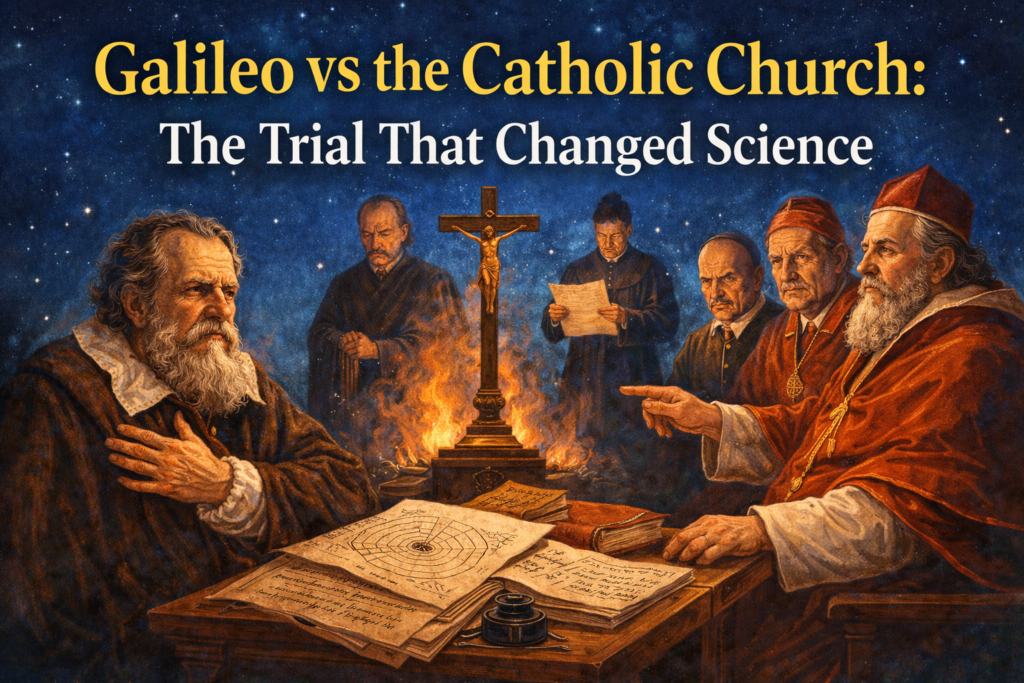
In 1633 Galileo was summoned to Rome to face the Roman Inquisition. He was seventy years old and in poor health.
During the trial church officials accused him of violating the 1616 injunction by promoting heliocentrism.
The charge was formally described as suspicion of heresy.
The trial proceedings focused on whether Galileo had presented heliocentrism as physical reality rather than as a mathematical hypothesis.
Church authorities feared that heliocentrism challenged traditional scriptural interpretation and church authority.
The trial therefore became a symbol of the broader struggle between emerging scientific knowledge and established doctrine.
This dramatic moment in history became known as galileo catholic church trial.
The Sentence Abjuration and Life Imprisonment
In June 1633 the Inquisition reached its verdict.
Galileo was forced to publicly renounce heliocentrism in a formal declaration known as the abjuration of 1633.
According to historical records he knelt before the court and read a statement rejecting the theory that Earth moves around the Sun.
The official sentence of the galileo catholic church trial condemned Galileo to life imprisonment.
However the sentence was soon commuted to house arrest due to his age and reputation.
Galileo spent the remaining years of his life under house arrest near Florence.
Despite these restrictions he continued writing scientific works.
His earlier book describing telescope discoveries known as Sidereus Nuncius Discoveries remained one of the most influential scientific publications in history.
And Yet It Moves The Legend of Galileo Defiance
A famous legend associated with galileo catholic church trial claims that after recanting heliocentrism Galileo whispered the phrase E pur si muove meaning and yet it moves.
Although historians debate whether he actually said these words the phrase symbolizes the triumph of scientific truth over authority.
The legend reflects the idea that empirical evidence cannot easily be suppressed.
Galileo discoveries continued to influence scientists long after the trial ended.
The intellectual courage associated with galileo catholic church trial helped inspire later generations of researchers to pursue scientific freedom.
Reconciliation The Church Modern View on Galileo Legacy
Centuries after the events of galileo catholic church trial the Catholic Church revisited the historical controversy.
In 1992 Pope John Paul II formally acknowledged that the Church had made mistakes in its handling of the Galileo case.
The Vatican statement recognized that the conflict arose partly from misunderstandings between science and scriptural interpretation.
Today the Vatican operates its own astronomical observatory and supports scientific research.
The reconciliation demonstrates how scientific knowledge and religious belief can coexist when interpreted with intellectual openness.
The historical memory of galileo catholic church trial now serves as an important lesson about the relationship between authority evidence and inquiry.
Frequently Asked Questions (FAQs)
What was the galileo catholic church trial?
It was the 1633 Inquisition trial in which Galileo was accused of promoting heliocentrism contrary to church doctrine.
Why did the Church oppose Galileo?
Church authorities believed heliocentrism conflicted with traditional interpretations of scripture.
What punishment did Galileo receive?
Galileo was forced to recant his views and was sentenced to house arrest for the remainder of his life.
Did Galileo discoveries influence science after the trial?
Yes his research on astronomy and physics strongly influenced later scientists including Isaac Newton.
What does the phrase E pur si muove mean?
The phrase means and yet it moves and symbolizes Galileo belief that Earth moves around the Sun.
Conclusion
The story of galileo catholic church trial represents one of the most powerful moments in the history of intellectual freedom. Galileo discoveries challenged long standing cosmological beliefs and introduced a new scientific method based on observation mathematics and experimentation.
Although the conflict with church authorities temporarily silenced Galileo voice his ideas continued spreading throughout Europe.
His discoveries helped confirm the heliocentric structure of the solar system and influenced generations of scientists.
The legacy of Galileo courage also reflects a much longer intellectual journey showing how ancient greek scientists changed modern science and helped humanity better understand the universe.