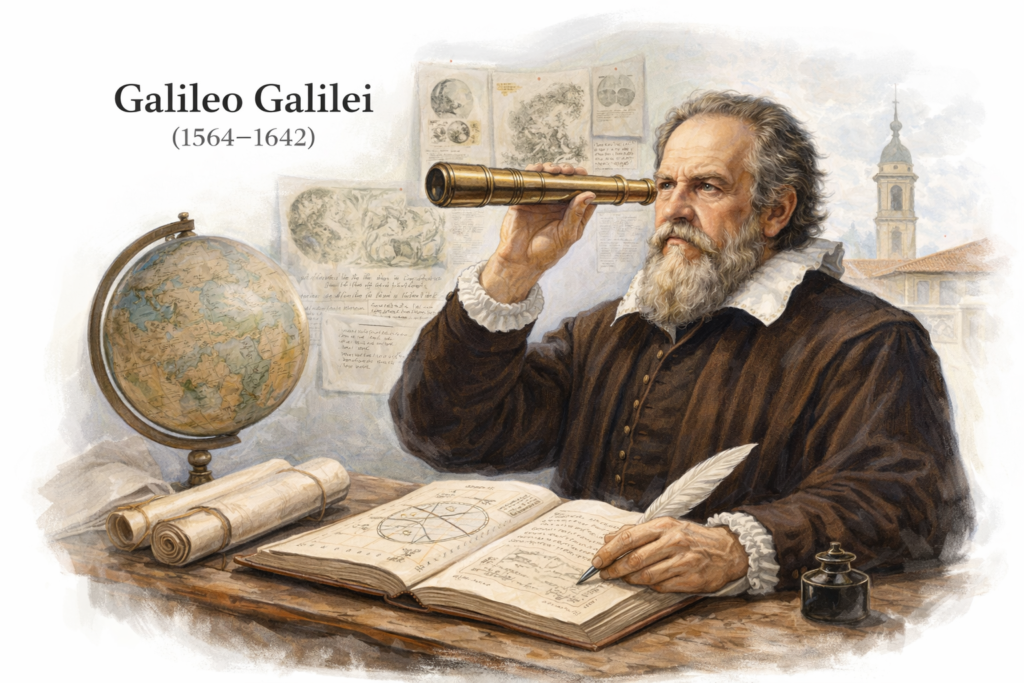
The story of galileo galilei discoveries represents one of the most powerful turning points in the history of science. During the late Renaissance and early Scientific Revolution, Galileo Galilei challenged centuries of traditional beliefs about the universe. His observations, experiments, and mathematical insights transformed astronomy, physics, and the scientific method itself.
At a time when scholars relied heavily on ancient philosophical traditions, Galileo insisted that knowledge must come from direct observation and experimentation. His work showed that the universe could be understood through mathematics and evidence rather than authority.
The impact of galileo galilei discoveries was profound. By improving the telescope, observing celestial bodies, and studying motion on Earth, Galileo helped humanity see the universe in a completely new way.
Today, the scientific principles behind galileo galilei discoveries still influence astronomy, physics, engineering, and space exploration.
Early Life and Curiosity of Galileo Galilei
Galileo Galilei was born on February 15, 1564, in Pisa, Italy. His father, Vincenzo Galilei, was a musician and scholar who valued experimentation and independent thinking.
Growing up in a family that encouraged questioning and creativity, Galileo developed a natural curiosity about how the world worked. As a child, he often built mechanical devices and experimented with simple machines.
This curiosity eventually led to the remarkable galileo galilei discoveries that reshaped scientific thought.
Education and Intellectual Development
Galileo began studying medicine at the University of Pisa in 1581. However, he quickly became fascinated with mathematics and natural philosophy.
His professors noticed his talent for geometry and mechanics, which inspired him to pursue scientific studies instead of medicine.
During his university years, Galileo began studying the motion of objects. He famously observed a swinging lamp in a cathedral and noticed that the time it took to swing remained nearly constant.
This observation led to the concept of the pendulum period, which can be described mathematically as:Where:
- T = period of oscillation
- L = length of the pendulum
- g = gravitational acceleration
Such mathematical insights later became part of the broader framework of galileo galilei discoveries.
Galileo’s Passion for Observation
One defining characteristic of galileo galilei discoveries was his reliance on observation rather than philosophical speculation.
Before Galileo, many scholars believed ancient authorities like Aristotle were always correct. Galileo challenged this tradition by conducting experiments and measuring results.
He believed that the laws of nature could be expressed mathematically, a principle that later influenced scientists such as Kepler and Newton.
This approach eventually became the foundation of the modern scientific method.
Galileo’s Telescope and the New Universe
In 1609, Galileo heard about a newly invented optical device called a telescope. He quickly improved the design and built a much more powerful instrument.
With this telescope, Galileo began observing the night sky in unprecedented detail.
His observations revealed a universe far more complex than anyone had imagined.
Among his most famous observations were the moons orbiting Jupiter. These objects demonstrated that not everything revolved around Earth.
This revolutionary discovery is explored further in Galileo’s Jupiter Moon Discoveries.
The observation strongly supported the heliocentric theory and contributed to the growing acceptance of the copernicus solar system model.
The Phases of Venus and Evidence for Heliocentrism
Another groundbreaking observation involved the planet Venus.
Galileo observed that Venus changed shape in a sequence of phases similar to the Moon. This phenomenon could only occur if Venus orbited the Sun rather than Earth.
This discovery provided powerful evidence supporting the heliocentric model of the universe.
The scientific significance of this observation is discussed in Galileo and the Phases of Venus.
These observations further strengthened the influence of galileo galilei discoveries in challenging traditional cosmology.
Galileo’s Experiments on Motion
While Galileo is famous for astronomy, he also made groundbreaking contributions to physics.
Through experiments with inclined planes, Galileo studied how objects move under the influence of gravity.
He discovered that the distance an object falls increases with the square of time.
This relationship can be expressed mathematically as:Where:
- s = distance fallen
- g = gravitational acceleration
- t = time
This principle became one of the earliest mathematical descriptions of motion.
The story behind these experiments is explored further in Galileo’s Law of Falling Bodies.
Sidereus Nuncius: A Book That Changed Astronomy
In 1610, Galileo published a revolutionary book titled Sidereus Nuncius (The Starry Messenger).
This work described many of his telescopic discoveries, including:
- mountains on the Moon
- thousands of stars in the Milky Way
- the moons of Jupiter
The publication shocked scholars across Europe and transformed the study of astronomy.
The discoveries described in this work are discussed further in Sidereus Nuncius Discoveries.
The publication helped establish Galileo as one of the most influential scientists of his time.
Conflict with Religious Authorities
Despite his groundbreaking achievements, Galileo’s support for heliocentrism eventually brought him into conflict with the Catholic Church.
Church authorities believed the idea that Earth moved around the Sun contradicted traditional interpretations of scripture.
In 1633, Galileo was tried by the Roman Inquisition and forced to recant his support for the heliocentric theory.
This dramatic historical episode is explained in Galileo’s Trial and Conflict with the Church.
Although Galileo spent the rest of his life under house arrest, his scientific influence continued to grow.
Galileo’s Influence on Modern Science
The influence of galileo galilei discoveries extends far beyond his lifetime.
His work helped establish several fundamental principles of science:
- observation-based research
- experimental verification
- mathematical description of natural laws
These ideas later inspired scientists such as Johannes Kepler and Isaac Newton.
Without galileo galilei discoveries, modern physics and astronomy might have developed very differently.
Mathematical Legacy of Galileo’s Work
Galileo’s scientific method relied heavily on mathematics.
For example, he discovered that velocity increases uniformly during free fall:Where:
- v = velocity
- g = gravitational acceleration
- t = time
These equations allowed scientists to predict motion with remarkable accuracy.
Such mathematical reasoning became a central feature of modern physics.
FAQs About Galileo Galilei
Who was Galileo Galilei?
Galileo Galilei was an Italian astronomer, physicist, and mathematician who played a major role in the Scientific Revolution.
Why are galileo galilei discoveries important?
galileo galilei discoveries transformed scientific thinking by introducing observation and experimentation as the foundation of knowledge.
What did Galileo discover with the telescope?
He discovered Jupiter’s moons, the phases of Venus, mountains on the Moon, and many new stars in the Milky Way.
What was Galileo’s contribution to physics?
Galileo developed the mathematical description of motion and discovered the laws governing falling objects.
Why did Galileo face a trial?
Galileo supported the heliocentric theory that Earth moves around the Sun, which conflicted with traditional religious interpretations.
Conclusion
The influence of galileo galilei discoveries represents one of the most powerful transformations in human understanding of the universe. Galileo’s courage, curiosity, and dedication to evidence-based science helped overturn centuries of mistaken beliefs about nature.
By observing the heavens through telescopes and studying motion through experiments, Galileo showed that the universe operates according to mathematical laws that humans can discover and understand.
His achievements—from Galileo’s Jupiter Moon Discoveries to Galileo and the Phases of Venus, from Galileo’s Law of Falling Bodies to Sidereus Nuncius Discoveries, and even Galileo’s Trial and Conflict with the Church—demonstrate the remarkable journey of a scientist who dared to question tradition.
Ultimately, Galileo’s work continues a long intellectual tradition showing how ancient greek scientists changed modern science, while also opening the door to the scientific discoveries that would shape the modern world.