The story of galileo phases of venus represents one of the most powerful turning points in the history of astronomy. For centuries scholars believed Earth stood at the center of the universe and that all planets moved around our world. This geocentric belief dominated science and philosophy for nearly two thousand years.
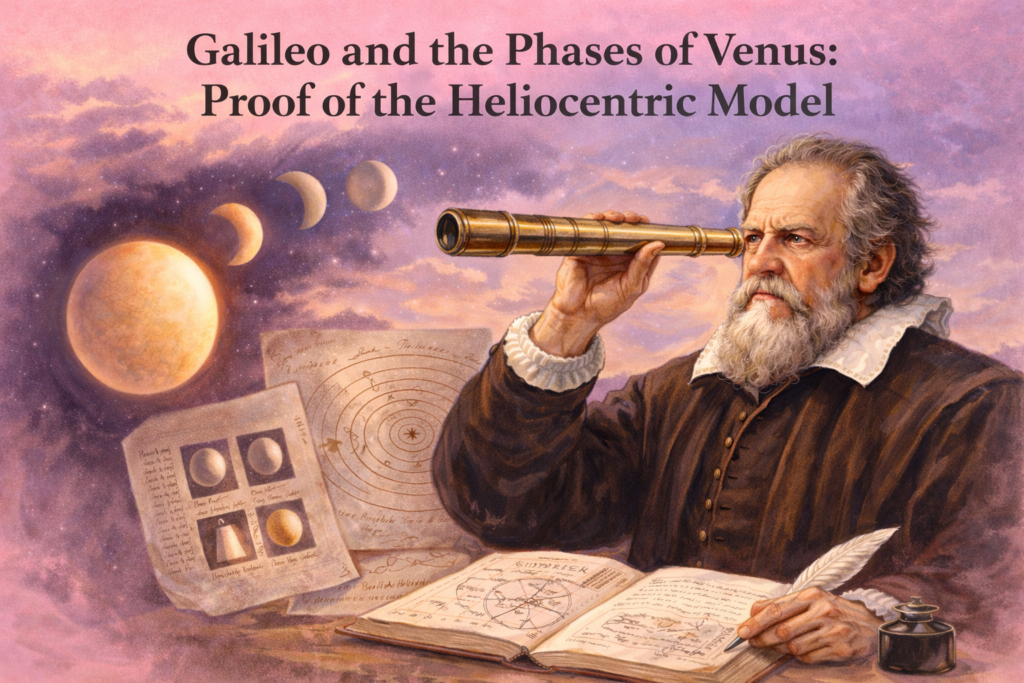
However everything began to change when Galileo Galilei used a telescope to observe the planet Venus. His careful study revealed that Venus displayed a full cycle of phases similar to the Moon.
These observations created a powerful challenge to the traditional Earth centered model of the cosmos. The changing illumination of Venus could only be explained if the planet orbited the Sun rather than Earth.
The discovery known as galileo phases of venus provided one of the strongest observational proofs supporting the heliocentric solar system.
The influence of galileo phases of venus also reinforced earlier galileo galilei discoveries that had already begun transforming scientific understanding of the universe.
Galileo and the Phases of Venus A Scientific Turning Point
When Galileo pointed his improved telescope toward Venus in 1610 he noticed something remarkable. The planet did not appear as a simple bright point of light. Instead it showed distinct shapes that changed over time.
Sometimes Venus appeared as a thin crescent. At other times it appeared nearly half illuminated. Eventually it appeared almost fully illuminated like a miniature full Moon.
These changing shapes are known as planetary illumination phases and they occur when sunlight reflects from the surface of a planet.
The discovery of galileo phases of venus became a scientific turning point because it revealed the true geometry of the solar system.
These observations were later described in Sidereus Nuncius Discoveries, one of the most influential astronomical publications of the seventeenth century.
The Geometry of the Heavens Venus in the Geocentric Model
To understand why galileo phases of venus were so revolutionary we must first examine the traditional geocentric system.
The ancient Greek astronomer Ptolemy proposed that Earth sat at the center of the universe while planets moved around it in circular paths called epicycles.
In the Ptolemaic system Venus was always located between Earth and the Sun.
This geometry created a major limitation for the phases of Venus.
Because Venus never moved behind the Sun in the geocentric model it could never appear fully illuminated.
This contradiction eventually became a key argument against the Earth centered system.
Why Ptolemy Predicted Limited Phases
According to the Ptolemaic system Venus would only show crescent or partial phases.
This happens because the illuminated side of Venus would always face the Sun while the observer on Earth would see only a portion of the bright hemisphere.
In geometric terms the visible illuminated fraction can be estimated using the angle between the Sun Venus Earth alignment.
The illuminated fraction of a planet can be approximated byWhere:
F represents illuminated fraction
theta represents phase angle between Sun Venus and Earth.
Under the Ptolemaic system the angle never allowed Venus to reach a full illumination state.
However the telescope observations made by Galileo clearly showed a full phase of Venus.
This contradiction exposed the failure of the geocentric model.
The 1610 Observation Venus Mimics the Moon
In 1610 Galileo carefully observed Venus through his telescope over many months. He noticed that Venus displayed a sequence of phases almost identical to those of the Moon.
The phases included
crescent Venus
half illuminated Venus
gibbous Venus
full Venus
These changes provided direct observational proof that Venus must orbit the Sun.
The discovery of galileo phases of venus quickly became one of the strongest pieces of evidence supporting the copernicus solar system model.
It also strengthened the impact of earlier discoveries such as Galileo’s Jupiter Moon Discoveries, which showed that planets could have their own systems of orbiting bodies.
From Crescent to Full The Significance of Size Changes
Galileo also noticed something equally important about Venus.
When Venus appeared as a thin crescent it looked larger through the telescope. When Venus appeared nearly full it looked smaller.
This effect occurs because the distance between Earth and Venus changes during its orbit around the Sun.
The apparent angular diameter of Venus can be estimated usingWhere:
theta represents angular diameter
D represents physical diameter of Venus
d represents distance from Earth.
When Venus lies closer to Earth its angular size increases. When it moves to the far side of the Sun its apparent size decreases.
This observation provided additional confirmation for galileo phases of venus.
Proving the Copernican Theory Through Visual Evidence
The heliocentric theory proposed by Nicolaus Copernicus placed the Sun at the center of the solar system with planets orbiting around it.
In this model Venus sometimes moves between Earth and the Sun and sometimes moves behind the Sun.
This geometry naturally produces a full range of phases.
Therefore the observed galileo phases of venus perfectly matched the predictions of the heliocentric system.
The Venusian cycles proof became one of the clearest examples of observational evidence supporting Copernican theory.
The discovery helped convince many scientists that the Sun centered model was correct.
The Mathematical Impossibility of the Earth Centered View
When astronomers attempted to explain galileo phases of venus using the geocentric model they encountered serious mathematical contradictions.
The Ptolemaic system could not produce the full phase of Venus because Venus never traveled behind the Sun relative to Earth.
Attempts to modify the model required extremely complex epicycle combinations which created unrealistic planetary paths.
This epicycle contradiction exposed the fundamental weakness of the geocentric system.
The new telescope observations therefore forced astronomers to reconsider the entire structure of the solar system.
These discoveries helped spark the seventeenth century astronomy revolution.
How Venus Ended the Debate on the Solar System Structure
The evidence provided by galileo phases of venus played a crucial role in ending the debate between heliocentric and geocentric cosmology.
When combined with other observational proof such as Galileo’s Law of Falling Bodies and telescope discoveries the heliocentric model became increasingly convincing.
Even though Galileo later faced opposition from religious authorities described in Galileo’s Trial and Conflict with the Churc, the scientific evidence could not be ignored.
The phases of Venus ultimately became one of the most powerful examples of optical evidence in astronomy.
This discovery transformed planetary science origins and reshaped humanity understanding of the universe.
Frequently Asked Questions (FAQs)
What are the phases of Venus?
The phases of Venus are changes in the visible illuminated portion of the planet as it orbits the Sun similar to the phases of the Moon.
Why were galileo phases of venus important?
They provided direct observational proof that Venus orbits the Sun rather than Earth.
When did Galileo observe the phases of Venus?
Galileo first recorded the phases of Venus in 1610 using his improved telescope.
Did the phases of Venus prove heliocentrism?
Yes the full sequence of phases matched predictions of the Sun centered solar system.
Why could the geocentric model not explain Venus phases?
In the geocentric system Venus always remained between Earth and the Sun which prevented it from appearing fully illuminated.
Conclusion
The discovery of galileo phases of venus stands as one of the most powerful moments in scientific history. Through careful observation Galileo revealed that Venus behaves exactly as predicted by a Sun centered solar system.
This evidence helped dismantle the ancient belief that Earth stood at the center of the universe. The observation of planetary illumination patterns provided clear visual proof supporting heliocentrism.
The importance of these discoveries reflects a long intellectual journey showing how ancient greek scientists changed modern science while also demonstrating how new evidence can transform our understanding of the cosmos.