The story of galileo telescope discoveries represents one of the most dramatic turning points in the history of astronomy. At the beginning of the seventeenth century humanity still believed that Earth stood at the center of the universe and that the heavens were perfect and unchanging. Ancient philosophers such as Aristotle had taught that celestial bodies moved in perfect circles around our planet.
Everything began to change when Galileo Galilei turned a simple optical device toward the sky.
Using a refined telescope Galileo began making observations that would challenge centuries of accepted knowledge. These early telescopic observations revealed moons orbiting Jupiter mountains on the Moon and an enormous number of stars within the Milky Way. The discoveries shocked scholars and forced scientists to rethink the structure of the cosmos.
The importance of galileo telescope discoveries goes far beyond astronomy. They demonstrated that observation and evidence could overturn even the most deeply rooted scientific traditions. These discoveries also helped confirm the copernicus solar system model which placed the Sun at the center of planetary motion.
Today the influence of galileo telescope discoveries continues to shape modern astronomy space exploration and planetary science.
Introduction to Galileo Telescope Discoveries
Before the early seventeenth century astronomy relied primarily on naked eye observations. Ancient astronomers had mapped the sky and recorded planetary movements but they could not see detailed features of celestial objects.
This situation changed dramatically with the arrival of the telescope.
Galileo did not invent the telescope but he greatly improved it and used it as a scientific instrument. His observations in 1609 and 1610 marked the beginning of early telescopic astronomy.
The revolutionary nature of galileo telescope discoveries became clear when he began publishing his findings. His observations provided direct evidence that the heavens were not perfect spheres but dynamic worlds with complex structures.
These revolutionary telescope findings helped launch a new era of scientific investigation.
The Invention and Refinement of the Galilean Telescope
The first telescopes appeared in the Netherlands around 1608. These early devices were simple spyglasses used for observing distant objects on land and sea.
Galileo immediately recognized the scientific potential of the instrument.
Through experimentation with lens grinding and refractor telescope design he improved the telescope dramatically. His improved design became known as the Galilean telescope.
The instrument consisted of a convex objective lens and a concave eyepiece lens. Light entering the telescope was refracted through these lenses allowing distant objects to appear larger.
The magnification of a telescope can be expressed mathematically asWhere
M represents magnification
fo represents focal length of the objective lens
fe represents focal length of the eyepiece lens
By adjusting lens curvature Galileo increased the magnification of his telescope far beyond the original spyglass.
These improvements made galileo telescope discoveries possible.
Moving from Spyglass to Scientific Instrument
At first the telescope was simply a tool for viewing distant objects such as ships or towers. Galileo recognized that it could become a powerful instrument for studying the heavens.
He spent months improving lens quality alignment and optical clarity.
The improved telescope allowed Galileo to observe celestial bodies with unprecedented detail. His telescope improvements in 1609 opened a completely new window into the cosmos.
This transformation from spyglass to scientific instrument was essential for the breakthrough of galileo telescope discoveries.
Achieving 20x Magnification in 1610
By 1610 Galileo had achieved a remarkable improvement in telescope power. His instrument could magnify objects roughly twenty times larger than they appeared to the naked eye.
This level of magnification allowed him to observe previously invisible features of celestial bodies.
For example the angular size of an object seen through a telescope increases according to the magnification factorWhere
theta represents original angular size
theta prime represents magnified angular size
This mathematical relationship shows how magnification enlarges distant objects making them visible to observers.
The ability to achieve twenty times magnification made the revolutionary galileo telescope discoveries possible.
Discovering the Medicean Stars The Moons of Jupiter
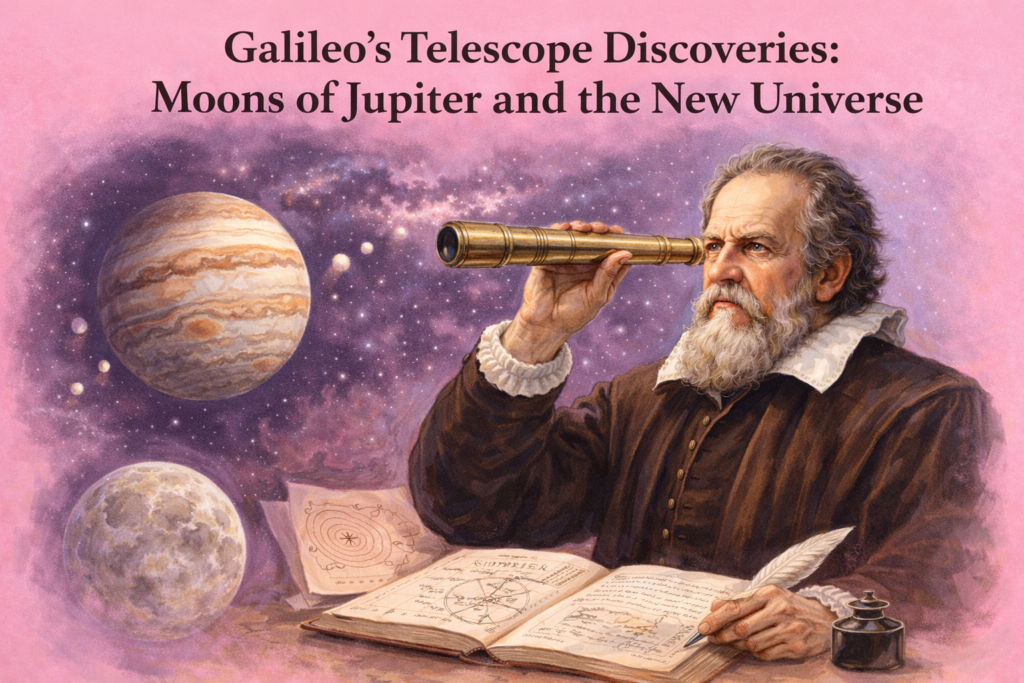
In January 1610 Galileo observed something extraordinary while studying the planet Jupiter.
He noticed several small points of light near the planet that changed position night after night.
At first Galileo thought these were distant stars. However careful observation revealed that they moved in a pattern around Jupiter.
These objects were later identified as Jupiter satellites now known as Io Europa Ganymede and Callisto.
This discovery is often referred to as the Medicean stars because Galileo named them in honor of the powerful Medici family.
The event represents one of the most famous moments in the history of celestial observations and a central part of galileo telescope discoveries.
Observing the Nightly Dance of Four Satellites
Galileo carefully recorded the changing positions of Jupiter satellites night after night.
He noticed that the moons alternated between appearing on one side of Jupiter and then the other. This motion suggested they were orbiting the planet.
The orbital period of a moon can be approximated using Kepler third lawWhere:
T represents orbital period
r represents orbital distance
These observations eventually contributed to our understanding of celestial mechanics and planetary science origins.
The discovery of Jupiter satellites demonstrated that not everything revolved around Earth. This realization was a key milestone in the story of galileo telescope discoveries
Why Jupiter Moons Shattered Geocentric Beliefs
Before Galileo astronomers believed that every celestial object orbited Earth.
However Jupiter satellites provided direct observational proof that a planet could have its own system of orbiting bodies.
This discovery challenged the geocentric model and provided powerful support for heliocentrism.
The cosmic perspective shift caused by galileo telescope discoveries forced scientists to reconsider the structure of the universe.
The evidence also supported the work discussed in Galileo and the Phases of Venus, which further confirmed the heliocentric model.
Mountains on the Moon and the Imperfect Heavens
One of Galileo most surprising observations involved the surface of the Moon.
When he looked through his telescope he noticed dark shadows along the lunar surface. These shadows indicated that the Moon contained mountains valleys and craters.
By measuring the length of shadows Galileo estimated the height of lunar mountains.
The approximate height of a mountain can be calculated using simple trigonometryWhere:
h represents mountain height
L represents shadow length
alpha represents solar angle
These observations proved that the Moon was not a perfect smooth sphere but a world with physical features similar to Earth.
This discovery directly challenged the Aristotelian idea that the heavens were perfect.
Such insights formed a major part of galileo telescope discoveries.
Mapping the Milky Way A Universe of Infinite Stars
Another astonishing discovery occurred when Galileo pointed his telescope toward the Milky Way.
To the naked eye the Milky Way appeared as a faint glowing band across the sky. Through his telescope Galileo saw that it consisted of countless individual stars.
This discovery expanded the known size of the universe dramatically.
The starry messenger discoveries described thousands of previously unseen stars. Galileo realized that the cosmos was far larger and more complex than previously imagined.
The detailed observations later became part of Sidereus Nuncius Discoveries, a groundbreaking publication that revealed Galileo findings to the world.
The mapping of the heavens marked another important milestone in galileo telescope discoveries.
Legacy of Galileo Discoveries in Modern Space Exploration
The influence of galileo telescope discoveries continues to shape modern science.
Galileo approach to observational proof laid the foundation for modern astronomy. Today astronomers use space telescopes orbiting Earth to explore distant galaxies planets and stars.
The discovery of Jupiter satellites inspired centuries of research into planetary systems.
In fact the NASA Galileo spacecraft which explored Jupiter from 1995 to 2003 was named in honor of Galileo Galilei.
His work also influenced studies of motion and gravity such as those described in Galileo’s Law of Falling Bodies.
Despite the enormous scientific value of his discoveries Galileo faced intense opposition. His support for heliocentrism eventually led to conflict with religious authorities described in Galileo’s Trial and Conflict with the Churc.
Nevertheless the importance of galileo telescope discoveries eventually reshaped scientific thinking across the world.
Frequently Asked Questions (FAQs)
What did Galileo discover with his telescope?
Galileo discovered Jupiter satellites mountains on the Moon countless stars in the Milky Way and many other celestial features.
Why were Galileo telescope discoveries important?
They provided observational proof that the universe was far more complex than ancient models suggested.
What are the Galilean moons?
The four largest moons of Jupiter Io Europa Ganymede and Callisto discovered by Galileo in 1610.
Did Galileo invent the telescope?
No the telescope was invented earlier in the Netherlands but Galileo improved it and used it for astronomical research.
Why did Galileo discoveries challenge traditional beliefs?
They provided direct evidence against the geocentric model and supported heliocentrism.
Conclusion
The remarkable story of galileo telescope discoveries shows how observation and evidence can transform human understanding of the universe. By improving the telescope and carefully studying the sky Galileo revealed moons orbiting Jupiter mountains on the Moon and countless stars in the Milky Way.
These discoveries shattered the ancient belief in perfect unchanging heavens and helped confirm the heliocentric structure of the solar system.
The impact of Galileo work continues to shape astronomy and space exploration today. His courage to challenge tradition reflects a much older intellectual journey showing how ancient greek scientists changed modern science and inspired generations of thinkers to explore the mysteries of the cosmos.