To the modern student, trigonometry is often a series of functions on a calculator, but to the ancient world, it was the key to unlocking the dimensions of the universe. Hipparchus and the Development of Trigonometry represents one of the most significant intellectual leaps in human history. By finding a way to relate the angles of a triangle to the lengths of its sides, Hipparchus provided the mathematical “ruler” necessary to measure things that no human could ever touch—the distances to the moon, the sun, and the stars. As the Hipparchus Father of Astronomy, his need for precision in the heavens forced him to become the architect of a new mathematical language.
Who Was Hipparchus?
Hipparchus of Nicaea was a Greek polymath whose work in the 2nd century BCE bridged the gap between speculative philosophy and empirical science. While he is celebrated for his Star Catalog, his most enduring contribution to the field of mathematics was his ability to synthesize Babylonian numerical data with Greek geometric theory.
He spent much of his career on the island of Rhodes, observing the sky with a level of detail that was unprecedented. However, he realized that observation alone was not enough. To turn sightings into a map, he needed a way to calculate the sides of spherical triangles. This necessity drove the development of trigonometry hipparchus is now famous for, making him a central figure in Greek mathematics trigonometry.
The Need for Trigonometry in Astronomy
In ancient astronomy history, the sky was viewed as a great sphere. When an astronomer observed two stars, they were essentially looking at two points on a curve. To find the distance between them or to track the motion of a planet, one had to solve “spherical triangles.”
Without trigonometry, these calculations were nearly impossible. Hipparchus realized that the traditional geometry of Euclid, while brilliant for flat surfaces, needed to be adapted for the heavens. His work on Lunar and Solar Observations required a method to predict eclipses and planetary positions with high accuracy. Thus, trigonometry in ancient astronomy was born out of a practical need to navigate the infinite.
Hipparchus and the First Trigonometric Table
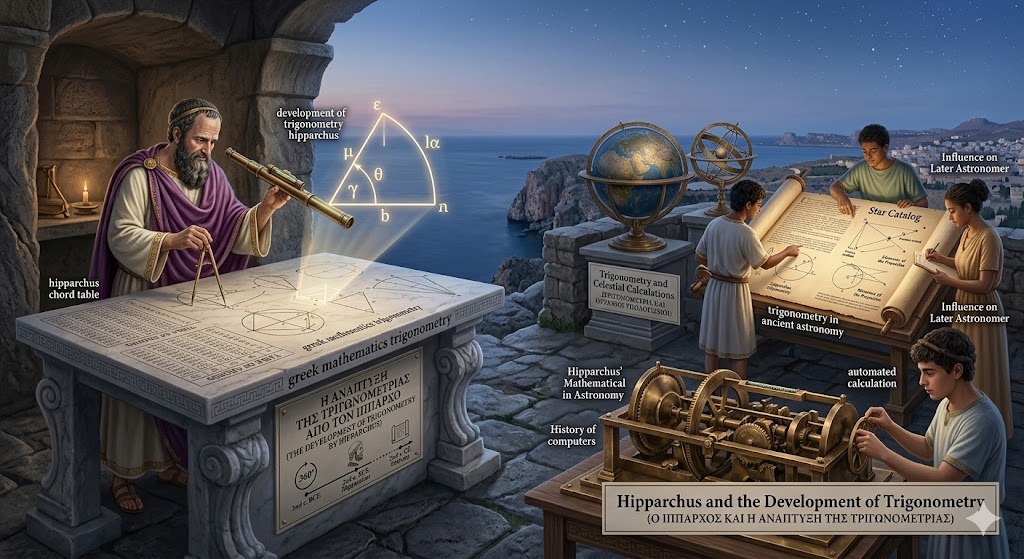
Hipparchus is credited with creating the first functional trigonometric table in history. While modern students use “sine” and “cosine,” Hipparchus used “chords.” A chord is a straight line segment whose endpoints both lie on a circular arc.
By calculating the lengths of chords for various angles, he created a reference guide that allowed astronomers to convert angular measurements into linear distances. This hipparchus chord table was the ancestor of every math table used in schools today. It allowed for the Discovery of the Precession, as it gave him the tools to measure the minute shifts in stellar positions over vast periods of time.
How Chord Tables Worked
The hipparchus trigonometry system was based on a circle divided into 360 degrees, a convention he likely adopted from the Babylonians. He would calculate the length of a chord for a specific central angle within a circle of a fixed radius.
If you knew the angle between two stars and the radius of the “celestial sphere,” the chord table told you the straight-line distance between them. This was a massive shift in the history of trigonometry because it moved math away from abstract shapes and toward functional, table-based calculations. These early trigonometric tables were the “software” of the ancient world, enabling complex Hipparchus’ Mathematical Methods in Astronomy.
Mathematical Innovation in Ancient Greece
The era of hipparchus mathematics contributions was a golden age for logic. However, Hipparchus was unique because he favored the “chord” over the more abstract geometric proofs of his peers. He used a radius of 3438 units for his circle—a specific number chosen because it made the circumference equal to $2\pi \times radius$, simplifying the relationship between arc length and angle.
This innovation in ancient trigonometry history allowed for the first real-time calculations of the sun’s eccentricity. By using his chord tables, he could explain why the sun appeared to move faster at certain times of the year, a feat that showcased his mastery of both math and the cosmos.
Influence on Later Mathematicians
The Influence on Later Astronomer and mathematician communities was immediate. Menelaus of Alexandria and later Claudius Ptolemy took Hipparchus’ foundations and expanded them. Ptolemy’s Almagest contains a more refined chord table that remained the standard for 1,200 years.
During the Middle Ages, Indian mathematicians took the Greek “chord” and realized that half-chords were even easier to work with. These half-chords eventually became the “sine” function we use today. Without the initial development of trigonometry hipparchus provided, the entire lineage of Islamic and Renaissance mathematics would have been delayed by centuries.
Trigonometry and Celestial Calculations
Hipparchus used his math to achieve things that seemed like magic to his contemporaries. For example, by measuring the angles of a solar eclipse from two different locations, he used trigonometry to calculate the distance from the Earth to the Moon.
His ability to link the Star Catalog to a mathematical grid meant that he could predict the future positions of celestial bodies. This was the first time that humanity had a mathematical “crystal ball.” Astronomy and trigonometry became two sides of the same coin, a relationship that persists in modern astrophysics.
Why Hipparchus Is Called the Father of Trigonometry
While there were precursors to his work, Hipparchus is called the Father of Trigonometry because he was the first to organize it into a systematic discipline. He didn’t just solve one triangle; he created a table to solve any triangle.
His work represents the transition from “shadow-stick” geometry to sophisticated numerical analysis. By providing the world with the first early trigonometric tables, he gave scientists the ability to describe the physical world in the language of numbers. This is why his name is often cited alongside the History of computers, as his tables were the first step toward automated calculation.
Legacy of Hipparchus’ Trigonometry
The legacy of Hipparchus and the Development of Trigonometry is found in every bridge we build, every plane we fly, and every satellite we launch. Trigonometry is the foundation of navigation (GPS), engineering, and even the digital graphics we see on our screens.
When we look back at the history of trigonometry, we see a man on the island of Rhodes, armed with nothing but a sighting tube and a deep understanding of circles. He looked at the chaos of the night sky and found an underlying order. He proved that the universe is not just something to be admired—it is something to be calculated.
Frequently Asked Questions (FAQs)
Did Hipparchus use sine and cosine?
No, Hipparchus used “chords,” which are related to sines. A chord of an angle $\theta$ is equivalent to $2 \times \sin(\theta/2)$ in modern trigonometry.
How did trigonometry help Hipparchus in astronomy?
It allowed him to calculate the distances and sizes of the Sun and Moon, predict eclipses, and map the positions of stars in his catalog by converting angular sightings into linear coordinates.
Why is his chord table lost?
Like many ancient works, Hipparchus’ original writings did not survive. We know about his chord tables primarily through the writings of later astronomers like Ptolemy, who described his methods in the Almagest.
What is the “Table of Chords”?
It was a list that paired angles with the lengths of the chords they subtended in a circle. It functioned exactly like a modern trig table, allowing for quick calculations without re-deriving geometric proofs every time.
Did the Babylonians invent trigonometry before Hipparchus?
The Babylonians had advanced knowledge of right triangles and used ratios, but Hipparchus was the first to create a table that related angles to side lengths for use in general astronomy.
Conclusion
The story of Hipparchus and the Development of Trigonometry is one of the most inspiring chapters in the history of science. It shows how one man’s desire to understand the stars led to the creation of a mathematical tool that changed the world. By combining the Star Catalog with his revolutionary chord tables, he bridged the gap between the Earth and the heavens. As the Hipparchus Father of Astronomy, his mathematical legacy ensures that as long as we continue to measure the world around us, we are standing on the shoulders of a Greek genius from Nicaea.