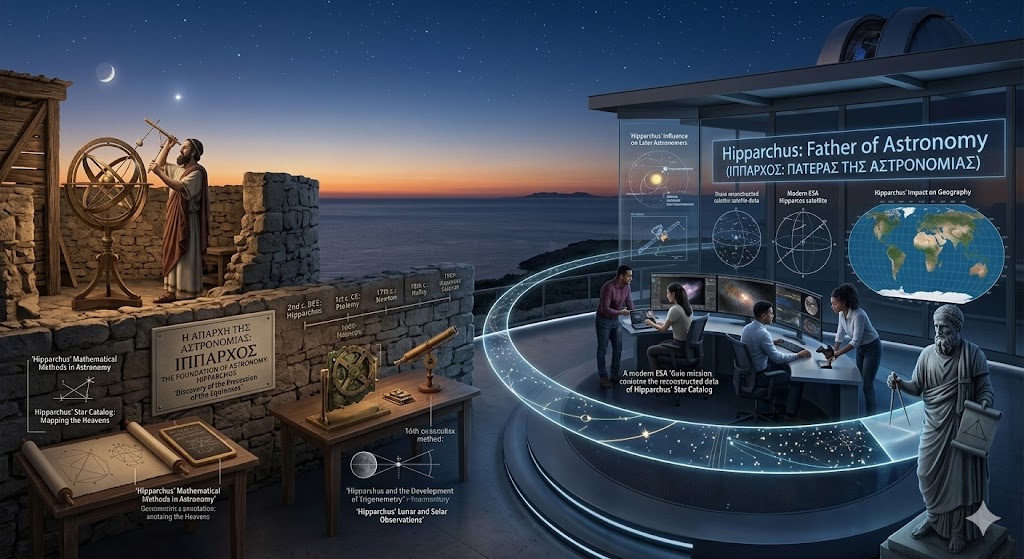
The history of science is often written in the stars, but it was a single man in the second century BCE who first provided the map to read them. Hipparchus Father of Astronomy is a title earned through a lifetime of meticulous observation, radical mathematical innovation, and an unwavering commitment to precision. While many of his contemporaries relied on philosophical speculation to explain the heavens, Hipparchus turned to data, geometry, and systematic recording. His work transformed astronomy from a branch of mythology into a rigorous mathematical science, laying the foundation for everything from the voyages of ancient explorers to the modern satellite systems we use today.
The Life and Context of a Hellenistic Genius
Hipparchus was born in Nicaea (modern-day Iznik, Turkey) around 190 BCE, though much of his most significant work was conducted on the island of Rhodes. Living during the Hellenistic period, he was surrounded by a culture that prized logic and geometry. However, Hipparchus went a step further by bridging the gap between Babylonian arithmetic and Greek geometry.
He was active between 162 and 127 BCE, a period where he observed the skies with instruments he likely improved or invented himself. Although most of his original writings have been lost to time—surviving primarily through the later works of Ptolemy—his shadow looms large over the scientific world. To understand the cosmos, one must first understand Hipparchus’ Mathematical Methods in Astronomy, which provided the language necessary to describe celestial motion.
The Star Catalog: A Heavenly Census
One of the most awe-inspiring achievements of antiquity was the creation of the first comprehensive star catalog. Driven by the appearance of a “new star” (possibly a supernova), Hipparchus realized that the heavens were not as immutable as the Greeks believed. He set out to record the positions and brightness of approximately 850 to 1,000 stars.
By documenting these stars using a coordinate system, he allowed future generations to check if the stars had moved, faded, or brightened. This Star Catalog was not just a list; it was a snapshot of the universe that remained the gold standard for over a thousand years. He also introduced the magnitude scale to rank stars by their brightness, a system that astronomers still use in a modified form today.
The Discovery of Precession
Perhaps the most sophisticated discovery attributed to Hipparchus Father of Astronomy is the precession of the equinoxes. While comparing his own observations with those made by earlier astronomers like Timocharis, Hipparchus noticed a slight, consistent discrepancy. The positions of the stars had shifted relative to the equinoxes.
He correctly deduced that the Earth’s axis was slowly “wobbling” like a spinning top, causing the celestial equator to move. This Discovery of the Precession revealed a cycle that takes roughly 26,000 years to complete. That an ancient observer could detect such a minute shift without a telescope is a testament to his incredible precision and patience.
Hipparchus and the Invention of Trigonometry
Astronomy is essentially the study of triangles in the sky, and Hipparchus was the first to formalize the tools needed to measure them. He is widely credited with the invention of trigonometry. He compiled a “table of chords,” which was the functional precursor to the modern sine table.
By creating a way to relate the lengths of the sides of a triangle to its angles, he allowed for the calculation of distances that could not be physically measured. This Development of Trigonometry was the “engine” that drove his astronomical models. Without these mathematical breakthroughs, the ability to predict eclipses or planetary positions would have remained impossible.
Lunar and Solar Observations: Measuring the Distance to the Moon
Hipparchus was obsessed with the timing of the sun and moon. He calculated the length of the solar year with an error of only six minutes. Even more impressively, he used the parallax method—observing the moon from two different locations during a solar eclipse—to estimate the distance from the Earth to the Moon.
His Lunar and Solar Observations resulted in an estimate that was between 60 and 63 times the Earth’s radius. The actual value is approximately 60. This level of accuracy, achieved in 150 BCE, remains one of the greatest feats of human calculation in history. He also developed models to explain the “eccentric” motion of the sun, accounting for why seasons are not equal in length.
The Instruments of Discovery
Hipparchus did not just use his eyes; he used his mind to build tools. While he did not invent the astrolabe in its final form, he is credited with developing the mathematical projections needed to create it. He used the armillary sphere and the dioptra to measure angles between celestial bodies.
These Mathematical Methods were revolutionary because they moved away from the “perfect circles” of Plato and toward models that actually matched the data observed in the night sky. He was a scientist who prioritized what he saw over what he thought should be true.
Legacy and Influence on the Scientific World
The influence of Hipparchus cannot be overstated. Roughly 300 years after his death, Claudius Ptolemy wrote the Almagest, which leaned heavily on Hipparchus’ data and models. In many ways, Ptolemy’s work was a synthesis and expansion of Hipparchus’ genius.
From the Middle Ages to the Renaissance, his Influence on Later Astronomers such as Al-Battani, Copernicus, and Tycho Brahe was profound. Even modern ESA (European Space Agency) missions, such as the Hipparcos satellite, are named in his honor, continuing his mission of mapping the stars with ever-increasing precision.
Hipparchus as a Geographer
Beyond the stars, Hipparchus applied his astronomical knowledge to the Earth. He was the first to insist that geographic locations be determined by latitude and longitude. He utilized his knowledge of eclipses to calculate differences in longitude between distant cities, essentially inventing the scientific method of cartography. His work ensured that the History of Geography would be forever tied to the study of the stars.
Frequently Asked Questions (FAQs)
Why is Hipparchus called the Father of Astronomy?
He is called the Father of Astronomy because he was the first to apply rigorous mathematics (trigonometry) to astronomical observations, created the first star catalog, and discovered the precession of the equinoxes.
What did Hipparchus discover about the Moon?
He calculated the distance to the Moon with remarkable accuracy and developed models to predict lunar eclipses by studying the Moon’s irregular motion and its orbit’s inclination.
Did Hipparchus invent the telescope?
No, the telescope was not invented until the early 17th century. Hipparchus used naked-eye observation tools like the dioptra, armillary spheres, and sighting tubes.
How did Hipparchus discover precession?
He discovered it by comparing his own data on the positions of stars with records from astronomers 150 years prior, noticing that the stars had shifted slightly in a systematic way.
What is the “Hipparcos” satellite?
The Hipparcos satellite was an ESA mission launched in 1989 to measure the positions and distances of stars with extreme accuracy, named as an acronym for “High Precision Parallax Collecting Satellite” in honor of Hipparchus.
Conclusion
The story of Hipparchus Father of Astronomy is a story of human potential. With nothing but his eyes, a few wooden instruments, and a brilliant mathematical mind, he unraveled the secrets of the Earth’s wobble, the distance to the moon, and the coordinates of the stars. He taught us that the universe is not a chaotic mystery, but a structured system that can be measured and understood. Today, every time we use a GPS to find our location or look at a star map on our phones, we are utilizing the legacy of a man who looked at the sky over 2,000 years ago and decided to map the infinite.