The foundation of modern planetary science was built on the rocky shores of Rhodes more than two thousand years ago. Hipparchus’ Lunar and Solar Observations represent the first time in human history that the two most dominant bodies in our sky were treated as subjects of rigorous mathematical inquiry rather than just divine symbols. By applying a level of precision that was unheard of in the second century BCE, Hipparchus transformed our understanding of time, distance, and celestial mechanics. As the Hipparchus Father of Astronomy, his work on the Sun and Moon provided the data necessary for his later Discovery of the Precession, proving that the universe was a clockwork system governed by geometric laws.
Hipparchus and Ancient Astronomical Research
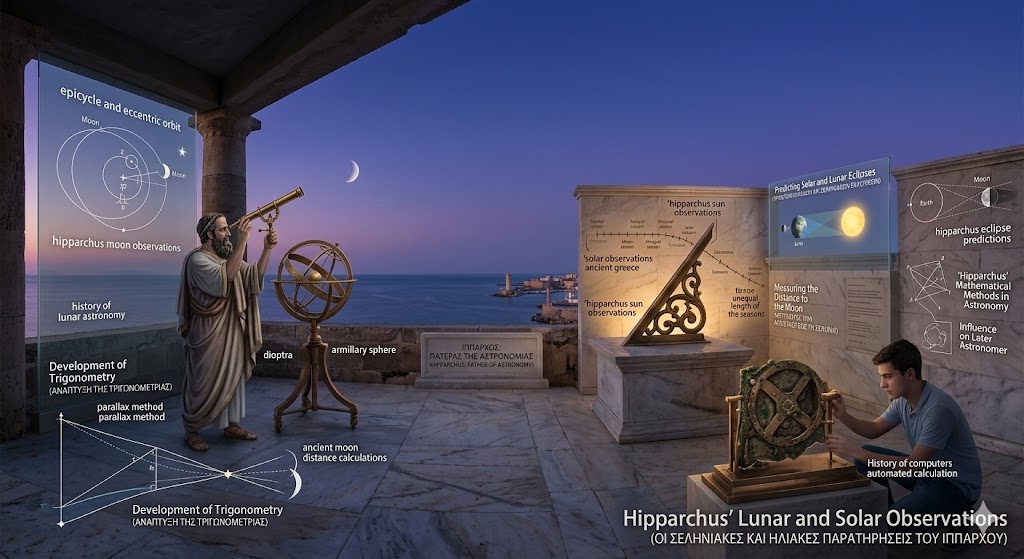
Ancient astronomy hipparchus was a blend of relentless observation and radical innovation. While his predecessors had noted the general patterns of the heavens, Hipparchus was the first to realize that “general patterns” were not enough for true science. He established an observatory where he utilized advanced tools like the dioptra and the armillary sphere to track the coordinates of celestial bodies.
His research was anchored by Hipparchus’ Mathematical Methods in Astronomy, which allowed him to turn raw visual data into predictive models. This period of Greek history was a turning point where the qualitative descriptions of the heavens were replaced by quantitative measurements. His commitment to accuracy was so profound that it led to the creation of his famous Star Catalog, ensuring that any future changes in the sky could be detected by those who followed him.
Observing the Motion of the Moon
The moon is notoriously difficult to track because its speed and position appear to change throughout its cycle. Hipparchus moon observations focused on these irregularities, known as anomalies. He spent years documenting the lunar orbit, noting that the moon does not move in a perfect circle around the Earth.
To explain this, he utilized the concept of “epicycles”—small circles whose centers move around the circumference of larger circles. This allowed him to account for why the moon appeared larger and moved faster at certain points in its orbit (perigee) and smaller or slower at others (apogee). This was a landmark in the history of lunar astronomy, as it was the first successful attempt to model non-uniform motion using geometry.
Measuring the Distance to the Moon
One of the most mind-boggling achievements of antiquity was the ancient moon distance calculations performed by Hipparchus. Using the principle of parallax—the apparent shift of an object against a background when viewed from two different locations—he set out to find the distance between the Earth and its satellite.
During a solar eclipse, he compared the observations of the eclipse from two different latitudes. By applying the Development of Trigonometry, which he pioneered, he calculated that the moon was approximately 60 times the radius of the Earth away from us. Remarkably, modern science confirms that the average distance is about 60.3 Earth radii. This was a triumph of human logic, proving that the scale of the universe could be grasped through mathematics.
Studying the Motion of the Sun
Just as he did with the moon, hipparchus sun observations sought to explain why the seasons were not of equal length. He noted that the time from the spring equinox to the summer solstice was longer than the time from the summer solstice to the autumnal equinox.
Hipparchus concluded that the Sun’s path was “eccentric,” meaning the Earth was not located exactly at the center of the Sun’s circular orbit. This was a critical insight for solar observations ancient greece, as it allowed him to create a model that accurately predicted the Sun’s position at any given time of the year.
Determining the Length of the Year
Before Hipparchus, the length of the year was often estimated roughly. However, he wanted a value that would satisfy his rigorous standards. By comparing his own solar observations with those made by Babylonian and earlier Greek astronomers, he determined the length of the “tropical year”—the time it takes for the Sun to return to the same equinox.
He calculated the year to be 365.25 days minus about 1/300th of a day. This is approximately 365 days, 5 hours, and 55 minutes, which is within minutes of the actual value. This discovery was vital for the Discovery of the Precession, as it highlighted the tiny shift between the tropical year and the sidereal year (measured against the stars).
Predicting Solar and Lunar Eclipses
Hipparchus eclipse predictions were perhaps his most famous hipparchus astronomical discoveries. By combining his models of solar and lunar motion, he could calculate when the shadow of the Earth would fall on the moon, or when the moon would block the sun.
He developed a system to predict not just the occurrence of an eclipse, but its duration and the degree of obscuration. This required a deep understanding of the “nodes”—the points where the moon’s tilted orbit crosses the path of the sun (the ecliptic). His work turned eclipses from terrifying omens into predictable, natural events.
Mathematical Models of Celestial Motion
The genius of Hipparchus lay in his ability to translate physical sights into abstract models. He was not just looking; he was building a geometric universe. His use of chords and triangles was the first step in the Development of Trigonometry, providing the tools to solve complex spherical problems.
These models were the first “software” for understanding the cosmos. They allowed later scientists to visualize the universe as a series of interlocking mathematical gears. This approach is why he is often compared to the pioneers in the History of computers, as he was essentially creating algorithms to solve the movement of the stars.
Influence on Later Astronomers
The Influence on Later Astronomer figures was immediate and lasted for over a millennium. Claudius Ptolemy used Hipparchus’ Lunar and Solar Observations as the primary source for his Almagest. In many cases, Ptolemy simply updated Hipparchus’ data to his own era.
Islamic astronomers during the Middle Ages further refined these models, and eventually, they reached the desks of Copernicus and Kepler. While Kepler eventually replaced circles with ellipses, he could only do so because Hipparchus had provided the initial baseline for what “accurate” observation looked like.
Legacy of Hipparchus’ Observations
The legacy of hipparchus astronomy contributions is still felt in the 21st century. The way we measure time, the way we predict eclipses, and the way we map the coordinates of the stars all trace back to his work in Rhodes.
His Star Catalog and his solar/lunar data proved that nature is consistent and measurable. He gave humanity the confidence to look at the sky not with fear, but with the curiosity of a mathematician. He remains the ultimate example of how a single person, armed with a sighting tube and a brilliant mind, can measure the very foundations of the heavens.
Frequently Asked Questions (FAQs)
How did Hipparchus calculate the distance to the moon?
He used the parallax method during a solar eclipse, measuring the difference in the moon’s position from two different locations on Earth and using trigonometry to find the distance.
Why are Hipparchus’ observations considered so accurate?
He was the first to use long-term data (comparing his work to Babylonian records) and pioneered trigonometry to account for the curvature of the sky.
What is the “eccentric” model of the sun?
It is a model where the Sun travels in a perfect circle, but the Earth is slightly off-center, explaining why the seasons have different lengths.
Did Hipparchus predict solar eclipses accurately?
Yes, he was able to predict lunar eclipses with great precision and solar eclipses with significant accuracy, although solar eclipses were harder due to the moon’s parallax.
What instruments did Hipparchus use?
He primarily used the dioptra for measuring angles, the armillary sphere for celestial coordinates, and the gnomon (shadow stick) for solar height.
Conclusion
Hipparchus’ Lunar and Solar Observations are more than just ancient data points; they are the origin story of scientific inquiry. By refusing to accept that the heavens were unknowable, the Hipparchus Father of Astronomy laid the groundwork for every space mission and satellite in orbit today. Through his Star Catalog, his Development of Trigonometry, and his relentless pursuit of the truth, he showed us that the Sun and Moon are not just lights in the sky—they are the keys to understanding our place in the infinite.