Introduction
The history of healing is as old as humanity itself, yet for millennia, it was a practice shrouded in mysticism, superstition, and divine intervention. This changed in ancient Greece when one man shifted the course of human history by separating the art of healing from the realm of the supernatural. Hippocrates: Father of Medicine, established a legacy that moved medical practice toward a rational, scientific discipline. By asserting that diseases were caused by environmental factors, diet, and living habits rather than the wrath of gods, he laid the foundational stones for what we now recognize as modern healthcare.
Early Life and Education
Born around 460 BCE on the Greek island of Kos, Hippocrates was born into a family with a long lineage of healers. It is believed that he was part of the Asclepiads, a guild of physicians who claimed descent from Asclepius, the Greek god of medicine. However, Hippocrates was not content with traditional temple healing.
He received his early education from his father and other prominent thinkers of the time, traveling extensively throughout Greece and Asia Minor. These travels allowed him to observe different climates, water sources, and local diseases, reinforcing his belief that the environment played a critical role in human health. During this period, he began to refine the practice of clinical observation, moving away from the “divine” and toward the “physical.”
Major Contributions of Hippocrates
The shift from magic to logic was not an overnight occurrence; it was the result of several monumental shifts in methodology that Hippocrates introduced.
1. Systematic Observation of Patients
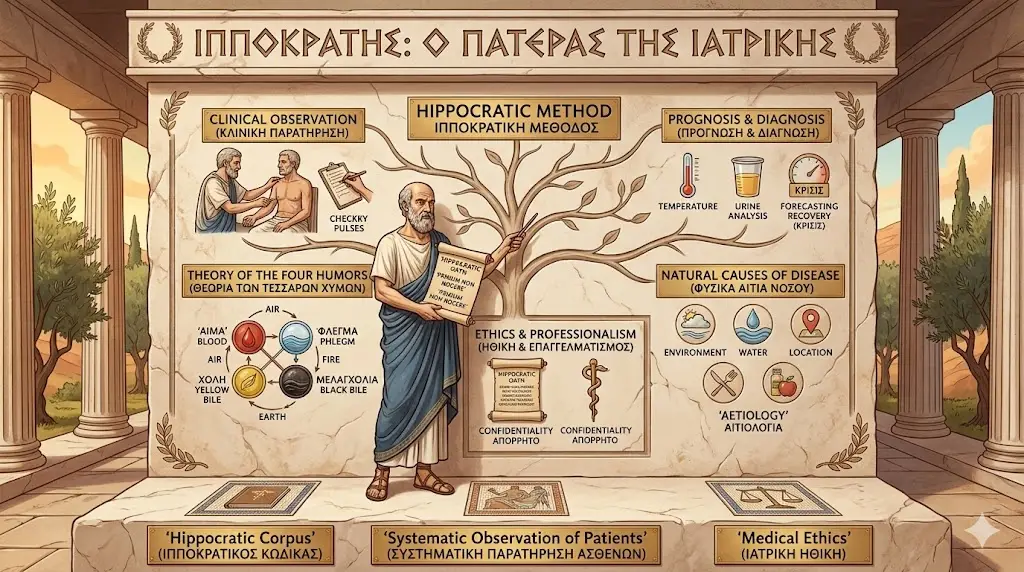
Before Hippocrates, a physician’s role was often seen as that of a priest. Hippocrates redefined the doctor as an observer. He insisted that a physician must record a patient’s symptoms with meticulous detail. He looked for patterns in the progression of illnesses—noting the “crisis,” the point at which the patient would either begin to recover or succumb to the disease.
He tracked pulses, fevers, and even the appearance of urine and sweat. His key medical discoveries and observations allowed him to predict the outcome of a disease, a practice we now call prognosis. This was revolutionary because it gave medicine a predictive power it never previously possessed.
2. Hippocratic Theory of Medicine
Hippocrates is perhaps most famous for the Theory of the Four Humors. While modern science has replaced this theory, its historical importance cannot be overstated because it was a purely physical explanation for health. He believed the body was composed of four essential fluids:
| Humor | Element | Seasonal Association | Personality/Health Link |
| Blood | Air | Spring | Sanguine (Energetic) |
| Yellow Bile | Fire | Summer | Choleric (Ambitious) |
| Black Bile | Earth | Autumn | Melancholic (Analytical) |
| Phlegm | Water | Winter | Phlegmatic (Calm) |
According to this theory, illness occurred when these humors fell out of balance. While we now know about germs and genetics, the Hippocratic focus on “balance”—achieved through diet, rest, and cleanliness—remains a cornerstone of wellness today.
3. Hippocratic Oath
No contribution of Hippocrates is more enduring than the ethical standard he set for the profession. The Hippocratic Oath and its historical significance lie in its creation of a “contract” between the doctor, the patient, and the community. It established that a physician must first “do no harm” (primum non nocere).
The oath prohibited doctors from administering poisons, performing unnecessary surgeries, or violating the privacy of their patients. Even today, thousands of years later, medical students across the globe recite a modernized version of this oath, proving that the ethical soul of medicine remains Greek at its core.
4. Clinical Writings and the Hippocratic Corpus
Much of what we know about this era comes from the Hippocratic Corpus, a collection of around 60 to 70 medical works. While scholars believe that Hippocrates did not write all of them himself—many were likely written by his students or followers—they all share the same philosophical dedication to rationalism.
These texts cover everything from pediatrics and surgery to epidemics and fractures. They served as the primary medical textbooks for nearly two thousand years, providing a structured body of knowledge that allowed the medical profession to grow across different cultures, from the Roman Empire to the Islamic Golden Age and into the European Renaissance.
5. Emphasis on Ethics and Professionalism
Hippocrates transformed the physician from a wandering craftsman into a respected professional. He emphasized the importance of a doctor’s appearance, demeanor, and honesty. He believed that the reputation of the profession was just as important as the cure itself.
He advocated for cleanliness—not just of the hands, but of the environment where the patient was treated. He also emphasized the “healing power of nature” (Vis Medicatrix Naturae), suggesting that the doctor’s job was to support the body’s own natural ability to heal itself through proper nutrition and hygiene.+1
Legacy of Hippocrates
The legacy of Hippocrates: Father of Medicine is found in every hospital wing and every medical school lecture hall. He moved the human race away from the fear of the unknown and toward the courage of investigation.
By documenting the natural history of diseases, he created a tradition of learning that allowed each generation of doctors to build upon the successes and failures of the previous one. He taught us that the human body is not a puppet of the gods, but a complex biological system that responds to the world around it. His name has become synonymous with the highest ideals of the medical calling: compassion, skill, and integrity.
Frequently Asked Questions (FAQs)
Why is Hippocrates called the ‘Father of Medicine’?
He is given this title because he was the first to establish medicine as a rational science, separating it from religion and philosophy, and creating the first ethical standards for practitioners.
What is the ‘Hippocratic Oath’ used for today?
While the original text has been updated to reflect modern laws and values, the essence remains the same: it is a pledge taken by new doctors to uphold ethical standards and prioritize patient welfare.
What was Hippocrates’ view on diet and exercise?
Hippocrates believed that diet and exercise were the primary tools for maintaining the balance of the four humors. He famously said, “Let food be thy medicine and medicine be thy food.”
What is the Hippocratic Corpus?
The Hippocratic Corpus is an ancient collection of medical writings that established the methodology of observation, diagnosis, and treatment used by Greek physicians.
Conclusion
The story of Hippocrates: Father of Medicine is the story of the birth of human reason in the face of suffering. He provided a light in the dark ages of medical ignorance, teaching us that through observation, empathy, and ethical conduct, we could understand the mysteries of our own bodies. His work reminds us that while technology and treatments change, the core of medicine—the relationship between a healer and a patient—is timeless. As long as there are those who dedicate their lives to the service of health, the spirit of Hippocrates will continue to guide the way.