Introduction
The evolution of healthcare from ancient rituals to modern clinical practice owes its most significant debt to the shores of ancient Greece. Hippocrates Medical Discoveries and Observations served as the catalyst that separated the art of healing from the clutches of magic and divine retribution. By emphasizing that the human body is a product of its environment, diet, and habits, Hippocrates introduced a world where diseases had natural causes and, therefore, natural cures. This fundamental shift allowed medicine to become a structured discipline, grounded in evidence rather than superstition.
The Shift from Superstition to Scientific Medicine
Before the 5th century BCE, falling ill was often interpreted as a sign of divine displeasure. Patients would flock to temples, praying for the gods to lift their “curse.” Hippocrates challenged this status quo by asserting that “every disease has its own nature, and arises from external causes.”
As the man widely recognized as Hippocrates: Father of Medicine, he argued that the physician’s role was to understand the laws of nature. He believed that the sun, the wind, and the water quality of a city were more relevant to a patient’s health than the whims of an Olympian god. This rationalism was the first step toward a scientific medical system, encouraging healers to look at the world around them for answers.
Systematic Observation of Patients
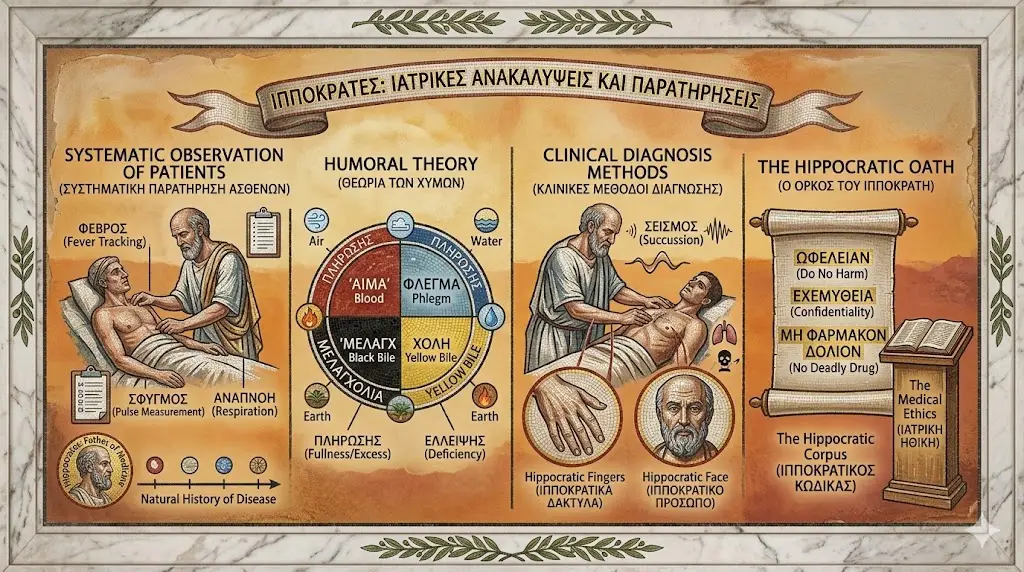
The core of Hippocratic practice was the belief that a doctor must be a master of the senses. He believed that by looking, touching, hearing, and even tasting, a physician could uncover the truth of an ailment. This led to some of the most important Hippocrates Medical Discoveries and Observations regarding the progression of illness.
He introduced the concept of the “crisis”—a specific moment in the life of a disease where the patient would either begin to recover or rapidly decline. To identify this moment, he recorded symptoms with surgical precision.
He noted the “Hippocratic Face”—the hollow eyes and sunken temples of a dying patient—which is still a recognized clinical sign today. By tracking the “natural history” of a disease, he allowed physicians to provide a prognosis, giving families a realistic expectation of what was to come.
Humoral Theory
Perhaps the most famous of all his theories was the Humoral Theory. Hippocrates proposed that the body contained four distinct fluids, or “humors,” which needed to stay in perfect balance for a person to remain healthy.
| Humor | Element | Season | Organ |
| Blood | Air | Spring | Heart |
| Yellow Bile | Fire | Summer | Liver |
| Black Bile | Earth | Autumn | Spleen |
| Phlegm | Water | Winter | Brain |
While we now know that diseases are caused by pathogens and genetics, this theory was revolutionary because it was purely physical. It suggested that if a person had too much “phlegm,” they were cold and wet, and thus needed “warm and dry” treatments (like specific herbs or heat). This established the medical principle of “opposites cure,” which dominated Western medicine for nearly two thousand years.
Clinical Diagnosis Methods
Hippocrates did not just theorize; he practiced. He developed a variety of clinical diagnosis methods that are the direct ancestors of modern physical exams. He practiced “succussion”—the act of shaking a patient by the shoulders and listening to the chest to hear the sound of fluid in the lungs.+1
He was the first to describe “clubbing” of the fingers as a sign of chronic lung disease (now called Hippocratic fingers). His observations were so accurate that they were compiled into The Hippocratic Corpus, a massive library of medical knowledge that documented everything from how to set a broken bone to the proper way to conduct a surgery in a clean environment. He insisted that the doctor’s hands must be clean and the nails trimmed, recognizing the importance of hygiene long before the discovery of germs.
The Hippocratic Oath
Medicine in the ancient world was an unregulated trade. To ensure that doctors held themselves to a higher standard, he established a code of conduct. The Hippocratic Oath and its historical significance cannot be overstated; it was the world’s first professional ethics contract.
The oath demanded that a physician never use their knowledge to harm a patient, never provide a deadly drug, and always maintain patient confidentiality. It established the physician as a servant of humanity, bound by a moral code that transcended profit or fame. This ethical framework remains the bedrock of the patient-doctor relationship in the 21st century.
Influence on Future Medicine
The ripples of Hippocrates Medical Discoveries and Observations were felt through the Roman Empire, the Islamic Golden Age, and the European Renaissance. Galen, the great Roman physician, built his entire career on the foundations laid by Hippocrates. During the Middle Ages, Arabic scholars translated the Greek texts, preserving the knowledge of anatomy and hygiene when it was nearly forgotten in the West.
Even today, we use Hippocratic terminology every time we speak of an “acute” illness, a “chronic” condition, or an “exacerbation.” He taught us that the body has an innate ability to heal itself—Vis Medicatrix Naturae—and that the doctor’s primary job is to remove the obstacles to that natural healing.
Frequently Asked Questions (FAQs)
What was Hippocrates’ most important discovery?
His most important contribution was the shift toward clinical observation. By recording the daily changes in a patient’s condition, he turned medicine into a data-driven science.
What are ‘Hippocratic Fingers’?
This refers to a specific swelling of the fingertips and nails (clubbing) that Hippocrates correctly identified as a sign of underlying heart or lung disease.
Why is The Hippocratic Corpus significant?
The Hippocratic Corpus is significant because it is a collection of 60 medical works that established the first standardized medical knowledge base in history, covering everything from diet to surgery.
How did Hippocrates view the cause of disease?
He believed diseases were caused by environmental factors (like air and water), lifestyle choices (diet and exercise), and imbalances in the body’s four humors, rather than the gods.
Conclusion
The legacy of Hippocrates Medical Discoveries and Observations is not found in a museum, but in every stethoscope and every medical record used today. He took a world filled with fear and replaced it with a world filled with facts. By teaching us to observe, to listen, and to act with integrity, he didn’t just find cures; he found a way to make medicine a noble profession. As we continue to unlock the secrets of the human genome and advanced surgery, we do so while standing on the shoulders of the man from Kos who first dared to look at a patient and see a person, not a curse.