Introduction
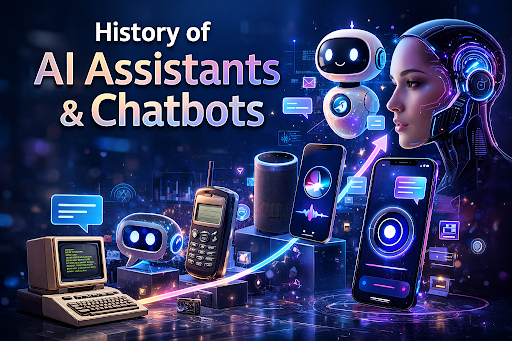
The history of AI assistants and chatbots is a fascinating chronicle of humanity’s quest to communicate with machines. What began as simple, scripted experiments in university laboratories has blossomed into a global ecosystem of intelligent entities that live in our pockets, homes, and workplaces. This evolution of AI assistants and chatbots reflects the broader progress of computer science, moving from rigid code to fluid, natural language processing.
As we look back at the history of AI assistants and chatbots, we see more than just technical milestones; we see the changing relationship between humans and technology. Today, conversational AI is no longer a novelty but a fundamental utility. Understanding the chatbot history in artificial intelligence helps us appreciate the staggering complexity behind the voices that tell us the weather or the text boxes that solve our banking issues. From the first line of code to the latest large language models, the growth of AI assistants continues to reshape the digital frontier.
Early Chatbot Experiments (1960s)
The true beginning of the history of AI assistants and chatbots can be traced back to the mid-1960s. During this era, the concept of Alan Turing Artificial Intelligence was being put to the test through early attempts at passing the Turing Test. In 1966, Joseph Weizenbaum at MIT created ELIZA, the world’s first famous chatbot. ELIZA utilized a script called “DOCTOR” to simulate a Rogerian psychotherapist by reflecting the user’s statements back at them as questions.
Despite its simplicity, ELIZA was a landmark in conversational AI history. It proved that humans were surprisingly willing to attribute deep understanding to a machine, a phenomenon now known as the “ELIZA Effect.” Shortly after, in 1972, Kenneth Colby created PARRY, a chatbot that simulated a person with paranoid schizophrenia. These early experiments were among the First AI Programs to demonstrate that language could be manipulated by algorithms to create the illusion of thought, even if the underlying technology was purely based on pattern matching without any real comprehension.
Rule-Based Chatbots and Early AI Assistants (1970s–1990s)
Following the initial excitement of the 1960s, the history of AI assistants and chatbots entered a period of refinement. During the 1970s and 80s, researchers focused on Expert Systems in Artificial Intelligence, which used vast “if-then” rule bases to provide specialized knowledge. While these weren’t conversational in the modern sense, they set the stage for how a virtual assistant AI development might store and retrieve information to help users.
In the 1990s, the Revival of Artificial Intelligence in the 1990s brought chatbots to the personal computer. One of the most recognizable, albeit controversial, figures in this era was Microsoft’s Clippy. While often remembered with a hint of humor, Clippy represented an early attempt at an “office assistant” that used basic heuristic triggers to offer help. Around the same time, the A.L.I.C.E. (Artificial Linguistic Internet Computer Entity) chatbot was released, using an XML-based language called AIML. This allowed for more complex rule-based conversations and was a significant step in the AI chatbot evolution, winning the Loebner Prize several times for its human-like interaction capabilities.
Rise of Intelligent Chatbots (2000s)
As the new millennium dawned, the history of AI assistants and chatbots began to benefit from the explosion of the internet. The availability of massive datasets and improved processing power allowed for the development of an intelligent chatbot system that didn’t just rely on hard-coded rules. This decade saw the rise of SmarterChild on platforms like AOL Instant Messenger (AIM) and MSN Messenger. SmarterChild was a pioneer in the history of AI assistants and chatbots because it provided practical utility—users could ask for movie times, weather updates, or sports scores.
This era marked the transition from purely “chatty” bots to functional assistants. Developers began integrating machine learning chatbots into web interfaces, allowing for more automated customer support. The chatbot technology of the 2000s started to move away from rigid scripts toward more flexible architectures that could handle variations in human phrasing. This period laid the essential groundwork for the virtual assistants that would soon become household names.
Voice Assistants and Smart Devices (2010s)
The 2010s represented a massive leap in the history of AI assistants and chatbots with the introduction of voice-activated interfaces. In 2011, Apple introduced Siri, bringing the concept of a personal assistant to the smartphone. Siri combined advanced Speech Recognition Artificial Intelligence History with natural language processing to perform tasks like setting reminders and sending texts.
The development of AI assistants accelerated rapidly as other tech giants entered the fray. Google launched Google Now (later Google Assistant), and Amazon introduced Alexa alongside the Echo smart speaker in 2014. These voice assistants transformed the home into a hub of conversational AI. They relied heavily on cloud computing and sophisticated deep learning to understand diverse accents and intents. The growth of AI assistants during this decade proved that the most natural interface for technology was not a keyboard or a mouse, but the human voice.
Modern Conversational AI Systems
Today, the history of AI assistants and chatbots has reached a pinnacle with the advent of generative AI. Modern conversational AI systems are no longer restricted to a list of pre-defined commands. Instead, they are powered by large language models (LLMs) that have read nearly the entire internet. This allows for a level of reasoning, creativity, and context-awareness that was previously thought to be science fiction.
These modern systems represent the ultimate AI chatbot evolution. They can write code, compose poetry, and engage in complex multi-turn debates. Unlike the rule-based systems of the past, today’s intelligent chatbot system understands the “why” behind a question, not just the keywords. This capability has moved us closer to the original vision of Early Machine Learning, where machines learn to adapt to us rather than forcing us to learn their specific syntax.
Applications of AI Assistants and Chatbots
The history of AI assistants and chatbots has led to their integration into almost every facet of Modern Artificial Intelligence Applications.
Customer Service
Automated customer support has been revolutionized by chatbots that can handle thousands of inquiries simultaneously. They provide instant resolutions for common problems, freeing up human agents for more complex issues.
Smart Homes
Voice assistants serve as the brain of the modern smart home, controlling lights, thermostats, and security systems through simple spoken commands.
Online Shopping
Virtual assistants in e-commerce help users find products, track orders, and even offer personalized style advice based on past purchases.
Healthcare
In medicine, chatbots provide preliminary symptom checking and mental health support, offering a bridge for patients who need immediate, low-cost guidance.
Education
AI tutors and language learning bots provide students with personalized feedback and practice, making high-quality education more accessible globally.
Future of AI Assistants and Chatbots
The future of the history of AI assistants and chatbots points toward “Proactive AI.” Instead of waiting for a command, future assistants will anticipate our needs based on our habits and schedules. We are also moving toward multimodal AI, where assistants can see through our cameras and hear through our microphones to provide real-time, context-aware assistance in the physical world.
As the evolution of AI assistants and chatbots continues, the focus will shift toward emotional intelligence. Future bots will be able to detect the user’s mood through vocal inflections or facial expressions, tailoring their responses with empathy. This will further blur the line between human and machine interaction, making our digital companions more effective and more human-like than ever before.
FAQs
What was the first chatbot in the history of AI assistants and chatbots?
ELIZA, created in 1966 by Joseph Weizenbaum, is widely considered the first chatbot. It used a simple script to mimic a psychotherapist and demonstrated the “ELIZA Effect.”
How do modern AI assistants differ from early chatbots?
Early chatbots were rule-based and relied on specific keywords. Modern assistants use large language models and machine learning to understand context, intent, and complex human reasoning.
Why did the 2010s see such a boom in voice assistants?
Improvements in cloud computing and deep learning allowed for much more accurate speech recognition, making it possible for devices like Alexa and Siri to understand natural human speech in real-time.
Are chatbots and AI assistants the same thing?
While the terms are used interchangeably, “chatbots” usually refer to text-based interfaces used for specific tasks (like customer service), while “AI assistants” are broader systems (like Google Assistant) that manage multiple tasks across different devices.
Conclusion
Reflecting on the history of AI assistants and chatbots, it is clear that we have come a long way from the simple echoes of ELIZA. The journey from basic pattern matching to the sophisticated, empathetic, and highly capable systems of today is a testament to the rapid development of AI assistants. This conversational AI history shows that our desire to communicate with technology is a driving force behind innovation. As we continue to refine the intelligent chatbot system, these digital entities will become even more indispensable, serving as our guides, our helpers, and our creative partners in an increasingly complex world.