Introduction
The history of computers is a fascinating journey of innovation, scientific discovery, and technological transformation. From simple mechanical calculators to powerful artificial intelligence systems, computers have completely changed how we live, work, and communicate.
Today, computers power everything — from smartphones and cloud computing to cybersecurity and data science. But this digital revolution began centuries ago with basic mathematical machines. Understanding the evolution of computers helps us appreciate how far information technology has advanced.
Early Mechanical Calculators: The Beginning of Computing
The development of computers started with the need to perform complex mathematical calculations.
In the 17th century, inventors began designing mechanical devices capable of addition and subtraction. One of the most important early pioneers was Charles Babbage, who designed the Analytical Engine in the 19th century.
The Analytical Engine is considered the first concept of a programmable computer. Although it was never fully built during his lifetime, its design included essential components found in modern computers, such as memory, processing units, and input/output systems.
This marked the true beginning of computer science.
The Theoretical Foundation of Modern Computing
While mechanical machines were developing, theoretical ideas were also shaping the future of computing.
In the 20th century, Alan Turing introduced the concept of a universal computing machine. His theoretical model, now known as the “Turing Machine,” proved that machines could perform any mathematical computation given proper instructions.
Turing’s work laid the foundation for modern computer algorithms, programming languages, and artificial intelligence.
Without this theoretical breakthrough, modern software development would not exist.
The First Electronic Computers
The real transformation in computer history came during the 20th century with the invention of electronic computers.
Early computers used vacuum tubes to process data. These machines were extremely large, expensive, and consumed massive amounts of electricity. However, they were capable of performing calculations much faster than humans.
A major breakthrough occurred in 1947 with the invention of the transistor. Transistors replaced vacuum tubes, making computers:
- Smaller
- Faster
- More reliable
- More energy efficient
This innovation accelerated the evolution of computer technology.
The Microprocessor Revolution
The 1970s introduced one of the most important developments in the history of computers: the microprocessor.
A microprocessor integrates the central processing unit (CPU) onto a single chip. This allowed manufacturers to build smaller and more affordable computers.
The microprocessor led to:
- Personal computers (PCs)
- Laptops
- Business computing systems
- Eventually smartphones
This era marked the beginning of widespread digital transformation.
The Rise of Personal Computers and the Internet
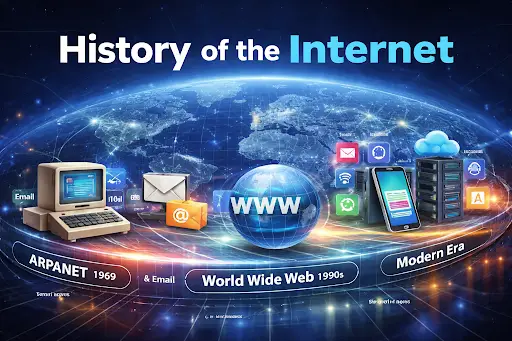
During the 1980s and 1990s, personal computers became common in homes and offices. At the same time, the development of the internet revolutionized global communication.
Computers were no longer just calculation machines — they became tools for:
- Education
- Business operations
- Software development
- Digital communication
- Online commerce
The combination of computers and the internet created the modern digital economy.
Modern Computing: Cloud, Cybersecurity, and Artificial Intelligence
Today, computer technology continues to evolve rapidly.
Modern computing includes:
- Cloud computing
- Big data processing
- Cybersecurity systems
- Mobile computing
- Artificial intelligence
Artificial intelligence (AI) represents the latest stage in computer evolution. AI systems use machine learning algorithms and data analysis to perform tasks such as speech recognition, automation, and predictive analysis.
In many ways, AI fulfills the early vision of computing pioneers who imagined machines capable of intelligent decision-making.
How Computers Shaped the Digital World
The evolution of computers has reshaped every industry, including healthcare, finance, education, engineering, and entertainment.
Computers have enabled:
- Faster communication
- Advanced medical research
- Secure online banking
- Global information sharing
- Remote work and digital collaboration
It is difficult to imagine modern life without computer systems.
Conclusion
The history of computers is a story of continuous innovation. From early mechanical calculators to powerful artificial intelligence systems, computers have transformed human civilization.
What began as simple mathematical tools evolved into complex digital machines that power the global economy. Each stage in computer development — mechanical devices, theoretical foundations, electronic systems, microprocessors, and AI — contributed to building the digital world we live in today.
As technology continues to advance, the future of computing promises even greater breakthroughs, including quantum computing and more advanced artificial intelligence systems.
Understanding the evolution of computers not only helps us appreciate modern technology but also prepares us for the next era of innovation.