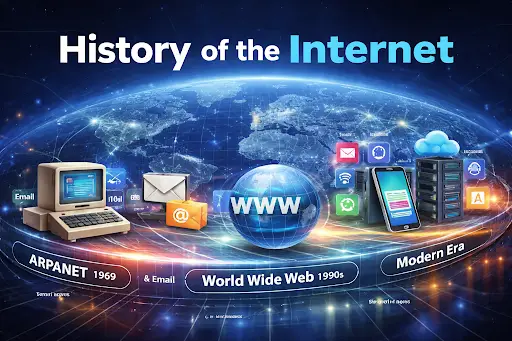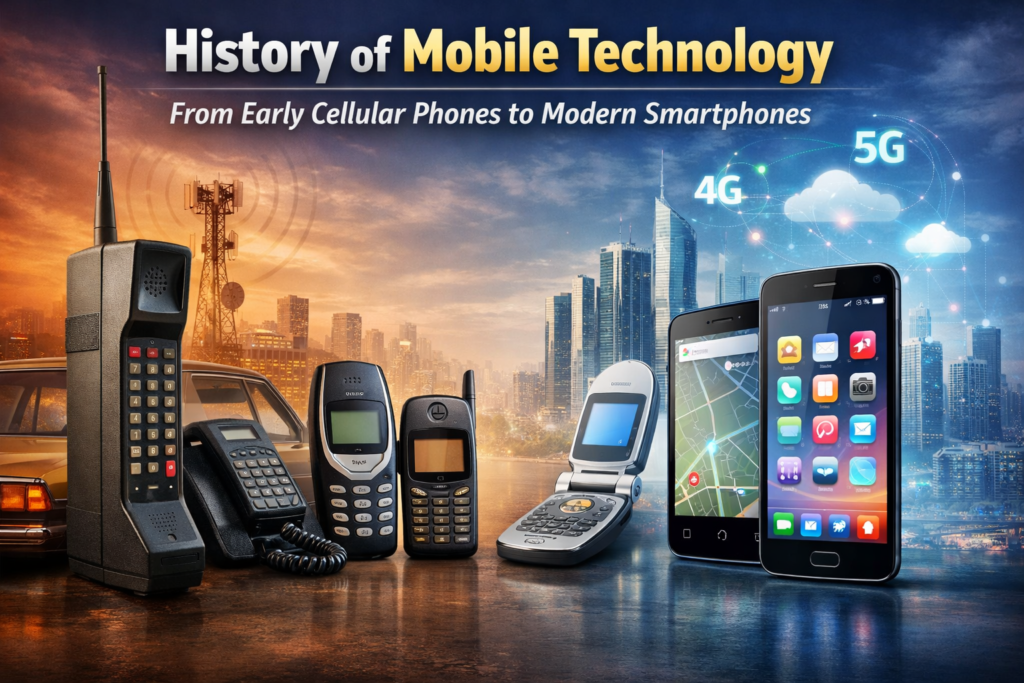
The History of Mobile Technology is a remarkable saga of human ingenuity, transforming from a luxury for the elite into an essential limb of modern existence. In less than half a century, we have moved from massive “brick” phones that could only make voice calls to pocket-sized supercomputers capable of streaming high-definition video and managing global finances. This evolution of mobile technology has not only changed how we communicate but has fundamentally reshaped our society, economy, and culture. Just as the History of Computers redefined data processing, the mobile revolution has redefined human connectivity on a global scale.
Early Wireless Communication (Pre-1970s)
Before the era of cellular networks, wireless communication technology was primarily the domain of military and emergency services. Early mobile communication relied on radio waves and was largely restricted to two-way radios used in ships, planes, and police cars. These systems were “half-duplex,” meaning only one person could speak at a time. The development of mobile phones was hindered by the massive size of the equipment required to transmit signals over long distances, often filling the entire trunk of a vehicle.
The Birth of Cellular Communication (1947–1973)
The cellular network history began conceptually at Bell Labs in 1947. Engineers realized that by dividing a geographic area into small “cells,” they could reuse frequencies and support thousands of users simultaneously. However, the technology to hand off a call from one cell to another as a user moved did not yet exist. It took decades of research and mobile technology development before the first successful hand-held call was made.
The First Mobile Phones (1973–1983)
On April 3, 1973, Martin Cooper of Motorola stood on a New York City street and made the first handheld mobile phone call to his rival at Bell Labs. The device used was the Motorola DynaTAC 8000X. This moment marked the true beginning of the History of Mobile Technology.
This “brick phone” weighed nearly 2.5 pounds, offered only 30 minutes of talk time, and took 10 hours to charge. It was a marvel of early mobile communication, despite its $3,995 price tag (equivalent to over $11,000 today).
First Generation (1G) Mobile Networks (1980s)
The 1980s saw the launch of the first generation (1G) of mobile networks. These were analog systems, such as AMPS (Advanced Mobile Phone System) in the United States and TACS in Europe. While 1G allowed for the first widespread commercial use of mobile phones, it had significant drawbacks: poor sound quality, no security (calls could be intercepted by scanners), and no data capabilities. This era focused strictly on voice, but it laid the groundwork for the mobile communication evolution that followed.
Second Generation (2G) and the Digital Revolution (1991)
The transition to 2G marked a pivotal shift in the History of Mobile Technology. Launched in Finland in 1991 under the GSM (Global System for Mobile communications) standard, 2G introduced digital encryption. This not only made calls private but also used the radio spectrum more efficiently, allowing more users on the network.
More importantly, 2G introduced the world to SMS (Short Message Service). The first text message was sent in 1992, changing the way a generation communicated. During this time, the History of Operating Systems began to play a role in mobile devices as simple interfaces were developed to manage contacts and messages.
The Rise of Feature Phones (1990s–Early 2000s)
The late 90s saw the development of mobile phones that were smaller, more affordable, and incredibly durable. Brands like Nokia and BlackBerry began to dominate the market. Feature phones introduced basic web browsing (via WAP), mobile games like “Snake,” and customizable ringtones.
The BlackBerry, in particular, became a status symbol for business professionals by offering mobile email. This period was a crucial stage in the evolution of smartphones, as manufacturers experimented with QWERTY keyboards and more complex software.
Third Generation (3G) and Mobile Internet (2001)
With the launch of 3G in 2001, the mobile phone history timeline moved toward data. 3G provided the bandwidth necessary for “mobile broadband.” For the first time, users could browse the web with speeds comparable to a home dial-up connection. Just as the History of Internet saw a boom with broadband, 3G allowed for the birth of mobile applications, video calling, and social media integration on the go.
The Smartphone Revolution (2007)
While smartphones existed before 2007, the launch of the iPhone changed the world forever. Apple combined a phone, an iPod, and an internet communicator into a single device with a multi-touch interface. Soon after, the Android operating system emerged, democratizing the technology across various manufacturers.
The history of smartphones is defined by the “App Store” model, which turned the phone into a multi-purpose tool for navigation, photography, and entertainment. This was the peak of mobile communication evolution, moving the focus away from the “phone” and toward the “smart” capabilities.
Fourth Generation (4G) and High-Speed Connectivity (2009)
As the evolution of smartphones continued, the need for speed became paramount. 4G LTE (Long Term Evolution) networks, launched around 2009, provided the high speeds required for the “App Economy.” 4G made it possible to stream Netflix, upload Instagram stories, and participate in high-quality video conferences without a Wi-Fi connection. It transformed the smartphone into a primary screen for many people around the world.
Fifth Generation (5G) and the Future of Mobile Technology (2019–Present)
We are currently in the midst of the 5G era. 5G is not just about faster phones; it is about “ultra-low latency.” This technology enables the Internet of Things (IoT), autonomous vehicles, and remote robotic surgeries. In the History of Mobile Technology, 5G represents the bridge between our handheld devices and a fully connected world. It offers speeds up to 100 times faster than 4G, allowing for instantaneous data transfer.
The Global Impact of Mobile Technology
The development of mobile phones has had a profound global impact. In developing nations, mobile technology has allowed millions to “leapfrog” traditional infrastructure. People who never had a landline phone or a traditional bank account now use mobile devices for banking (M-Pesa), education, and healthcare. The mobile communication evolution has become a tool for social empowerment and economic growth.
Frequently Asked Questions (FAQs)
Who invented the first mobile phone?
Martin Cooper of Motorola is credited with inventing the first handheld mobile phone and making the first public call in 1973.
What was the first smartphone in history?
The IBM Simon, released in 1994, is widely considered the first smartphone. It featured a touchscreen, email capabilities, and a calendar.
What is the main difference between 4G and 5G?
While both provide internet connectivity, 5G offers significantly higher speeds and much lower latency, meaning there is almost no delay in data transmission.
How has mobile technology affected the environment?
The production and disposal of mobile devices contribute to e-waste and require the mining of rare earth minerals. However, mobile technology also enables smart grids and remote work, which can reduce carbon footprints.
Conclusion
The History of Mobile Technology is a testament to how quickly a single invention can alter the course of human civilization. From the analog 1G networks that allowed us to talk to the 5G networks that connect billions of machines, the journey has been nothing short of miraculous. As we look toward the future, we see a world where mobile technology becomes even more integrated into our lives through augmented reality and advanced AI. The evolution of mobile technology is far from over; it is merely entering its next, most exciting chapter.