Introduction
The history of programming languages is a story of innovation, problem-solving, and continuous improvement. Today, millions of developers write code in languages like Python, Java, and C++. But programming did not start this way.
In the early days of computing, programming was extremely difficult. Computers could only understand numbers, and writing instructions required deep technical knowledge. Over time, new programming languages were developed to make communication between humans and machines easier.
Just like the history of computers shows the evolution of hardware, the history of programming languages reveals how software became more powerful, accessible, and intelligent.
Understanding this journey helps us see how modern technology was built step by step.
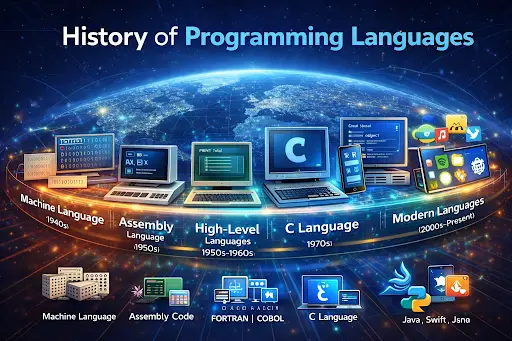
The First Stage: Machine Language (1940s)
The earliest computers did not have programming languages as we know them today. They operated using machine language, which is made up of binary numbers (0s and 1s).
Every instruction had to be written in binary code. This made programming:
- Slow
- Complex
- Error-prone
Even a small mistake could cause the entire system to fail.
Only highly trained experts could write machine code. It was powerful but extremely difficult to manage.
This limitation created the need for something better.
Assembly Language: A Step Toward Simplicity (1950s)
To make programming easier, assembly language was introduced.
Instead of writing long binary sequences, programmers could use short symbolic codes like:
ADD
SUB
MOV
These symbols were easier to remember than binary numbers.
Although assembly language was still closely tied to hardware, it reduced errors and improved productivity.
This marked the beginning of making programming more human-friendly.
The Birth of High-Level Programming Languages (1950s–1960s)
The real breakthrough in the history of programming languages came with the invention of high-level languages.
These languages allowed programmers to write instructions using words closer to English.
Some of the earliest high-level programming languages include:
- FORTRAN (1957)
- COBOL (1959)
FORTRAN was mainly used for scientific and engineering calculations.
COBOL was designed for business applications.
These languages changed everything.
They allowed more people to learn programming without needing to understand computer hardware deeply.
The Rise of Structured Programming and C Language (1970s)
In the 1970s, programming languages continued to improve. Developers wanted cleaner, more organized code.
This led to the development of structured programming.
One of the most important milestones during this period was the creation of the C programming language.
C became extremely influential because:
- It was powerful
- It was flexible
- It could be used to build operating systems
In fact, many parts of modern systems were built using C.
The development of programming languages during this era strongly influenced the evolution of operating systems and modern software architecture.
Object-Oriented Programming and Software Expansion (1980s–1990s)
As software projects became larger, programmers needed better ways to manage complexity.
This led to object-oriented programming (OOP).
Languages like:
- C++
- Java
introduced concepts such as:
- Classes
- Objects
- Inheritance
These ideas helped organize code into reusable components.
Java, in particular, became popular because of its “write once, run anywhere” approach.
This period marked the beginning of large-scale software development and enterprise applications.
The Internet Era and Modern Programming Languages (1990s–2000s)
With the growth of the Internet, new programming needs emerged.
Developers needed languages for:
- Websites
- Web applications
- Online systems
This led to the popularity of:
- JavaScript
- PHP
- Python
Python gained attention because of its simple and readable syntax. It made programming more accessible for beginners.
At the same time, programming became deeply connected with the growth of the Internet, which transformed global communication and business.
The demand for faster development and cleaner code continued to shape language design.
The Modern Era: Programming for AI, Cloud, and Mobile (2010–Present)
Today, programming languages are more powerful than ever.
Modern development focuses on:
- Artificial intelligence
- Cloud computing
- Mobile applications
- Data science
Languages like Python are widely used in AI and machine learning.
Swift is used for iOS development.
Kotlin is popular for Android development.
Programming languages now support advanced technologies that were once considered impossible.
The connection between programming and artificial intelligence has become especially important in recent years.
Modern tools allow developers to build intelligent systems that learn from data and make decisions.
Why Programming Languages Continue to Evolve
Programming languages change because technology changes.
New hardware, new business needs, and new user expectations push developers to improve languages.
Some reasons for evolution include:
- Better performance
- Improved security
- Easier readability
- Faster development
Each generation of programming languages solves problems created by the previous generation.
This continuous improvement is what keeps software development moving forward.
The Impact of Programming Languages on the World
The history of programming languages is not just about code.
It is about impact.
Programming languages have made possible:
- Mobile apps
- Online banking
- Video streaming
- Social media
- Artificial intelligence systems
Every digital service we use today depends on programming.
From small startups to global companies, software powers modern society.
Without programming languages, modern technology would not exist.
The Future of Programming Languages
Looking ahead, programming languages will likely become:
- More automated
- More intelligent
- Easier to learn
Low-code and no-code platforms are already changing how software is built.
Artificial intelligence may even assist in writing code automatically.
However, the core goal will remain the same:
Making communication between humans and computers simpler and more efficient.
FAQs: History of Programming Languages
What was the first programming language?
Machine language was the first form of programming, but FORTRAN is considered the first widely used high-level programming language.
Why were high-level languages created?
They were created to make programming easier and more accessible by reducing dependence on hardware-specific instructions.
Why is the C programming language important?
C influenced many modern programming languages and is still used in system-level programming.
Which programming language is most popular today?
Python is currently one of the most popular languages because of its simplicity and wide use in data science and artificial intelligence.
How are programming languages connected to modern technology?
Programming languages power software, operating systems, web platforms, and intelligent systems used worldwide.
Conclusion
The history of programming languages shows a clear pattern of growth and refinement. What began as complex binary instructions evolved into powerful and user-friendly languages that shape our digital world.
From machine code to modern AI-driven systems, programming languages have made technology more accessible and more powerful.
As technology continues to evolve, programming languages will adapt and improve. Understanding their history helps us appreciate how far we have come — and how much potential still lies ahead.