Introduction
Today, the Internet is part of almost everything we do. We use it to communicate, learn, work, earn and entertain ourselves. But have you ever wondered how it all started? Understanding the history of the Internet helps us see how a simple military project became the backbone of modern life.
The Internet did not appear overnight. It evolved over decades through innovation, experimentation, and the vision of brilliant scientists. Just like the brief history of artificial intelligence, the Internet’s journey is a story of gradual progress that changed the world forever.
Before the Internet: The Need for a Communication Networks
In the 1960s, computers were large, expensive machines. They were mostly used by government agencies, universities, and research labs. However, these computers worked independently and could not communicate with each other.
The United States Department of Defense wanted a way for computers to share information quickly and securely. This need led to the creation of the first network that would later become the Internet.
At that time, the main goal was simple: connect computers so researchers could share data without physically moving from one location to another.
ARPANET: The Beginning of the Internet
The real origin of the Internet begins with ARPANET, which stands for Advanced Research Projects Agency Network.
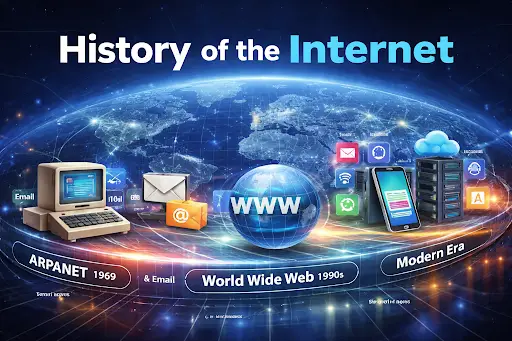
ARPANET was launched in 1969 by the Advanced Research Projects Agency (ARPA).
It connected four computers located at:
- UCLA (University of California, Los Angeles)
- Stanford Research Institute
- UC Santa Barbara
- University of Utah
The first message sent on ARPANET was supposed to be the word “LOGIN.”
However, the system crashed after sending only the first two letters: “LO”
This small moment marked the birth of Internet communication.
ARPANET proved that computers could successfully communicate over long distances.
The 1970s: Development of Internet Protocols
As more computers connected and communicated ARPANET, there was a need for a standard way for them to communicate.
In the 1970s, two scientists played a major role:
- Vint Cerf
- Robert Kahn
They developed TCP/IP (Transmission Control Protocol / Internet Protocol).
This technology allowed different networks to connect and communicate with each other.
TCP/IP became the foundation of the modern Internet.
On January 1, 1983, ARPANET officially adopted TCP/IP. This date is often considered the official birth of the Internet.
The 1980s: Expansion Beyond Military Use
During the 1980s, the Internet expanded beyond military use.
Universities and research institutions started connecting their computers.
This allowed scientists and students to:
- Share research
- Send messages
- Access remote data
Email also became popular during this time.
For the first time, people could communicate instantly across long distances.
This was a major turning point in the evolution of the Internet.
The 1990s: Birth of the World Wide Web (www)
Many people confuse the Internet with the World Wide Web (www), but they are different.
The Internet is the network.
The World Wide Web (www) is a service that runs on the Internet.
The Web was invented in 1989 by Tim Berners-Lee, a scientist working at CERN.
He created three important technologies:
- HTML (HyperText Markup Language)
- URL (Uniform Resource Locator)
- HTTP (HyperText Transfer Protocol)
These technologies made it possible to create websites.
For the first time, people could access information easily using web browsers.
This invention made the Internet useful for ordinary people.
The 1990s: Internet Becomes Public
The 1990s were the most important decade in Internet history.
In 1991, the World Wide Web (www) became publicly available.
Soon after, the first web browsers were created.
One of the first popular browsers was Mosaic.
This made browsing easy and user-friendly.
During this decade:
- Websites were created
- Online businesses started
- Email became common
- Search engines appeared
Companies like Yahoo and Amazon were founded.
The Internet was no longer just for scientists.
It became part of everyday life.
The 2000s: The Internet Changes the World
In the early 2000s, the Internet grew rapidly.
New technologies appeared, such as:
- Social media
- Online video
- E-commerce
Platforms like Facebook, YouTube, and Google transformed how people use the Internet.
People could now:
- Connect with friends
- Share videos
- Start online businesses
- Learn new skills
The Internet became a global platform.
It created new opportunities and led to the development of entirely new industries.
The Modern Internet Era
Today, the Internet connects billions of people.
It powers:
- Smartphones
- Smart homes
- Search engines
- Artificial intelligence
- Cloud computing
Modern innovations like AI development and intelligent systems depend heavily on the Internet.
Without the Internet, modern technology would not exist.
The Internet has become essential for:
- Education
- Healthcare
- Business
- Communication
It continues to grow every day.
Why the Internet Is Important
The Internet changed human history.
Here are some major impacts:
Communication
People can connect instantly anywhere in the world.
Education
Students can learn anything online.
Business
Companies can sell products globally.
Information Access
Knowledge is available to everyone.
The Internet made the world more connected.
Future of the Internet
The Internet continues to evolve.
Future technologies include:
- Faster connections (5G and beyond)
- Smart cities
- Artificial intelligence integration
- Virtual reality Internet
The Internet will become even more powerful.
It will continue shaping the future.
FAQ: History of the Internet
Who invented the Internet?
The Internet was developed by many scientists, but Vint Cerf and Robert Kahn played key roles.
When was the Internet invented?
The Internet officially began in 1983 when TCP/IP was adopted.
What was ARPANET?
ARPANET was the first computer network and the foundation of the Internet.
Who invented the World Wide Web?
Tim Berners-Lee invented the Web in 1989.
Conclusion
The history of the Internet shows how a simple research project grew into something that completely changed the world. What began as a small military network is now a global system that connects billions of people every day. It supports communication, education, business, and almost every part of modern life.
The Internet did not evolve alone. Its growth was closely connected with the history of computers, which provided the machines and processing power needed to make global networking possible.
Today, the Internet continues to expand with new technologies like cloud computing and artificial intelligence. Learning about its past not only helps us understand today’s digital world but also gives us insight into where technology is heading in the future.