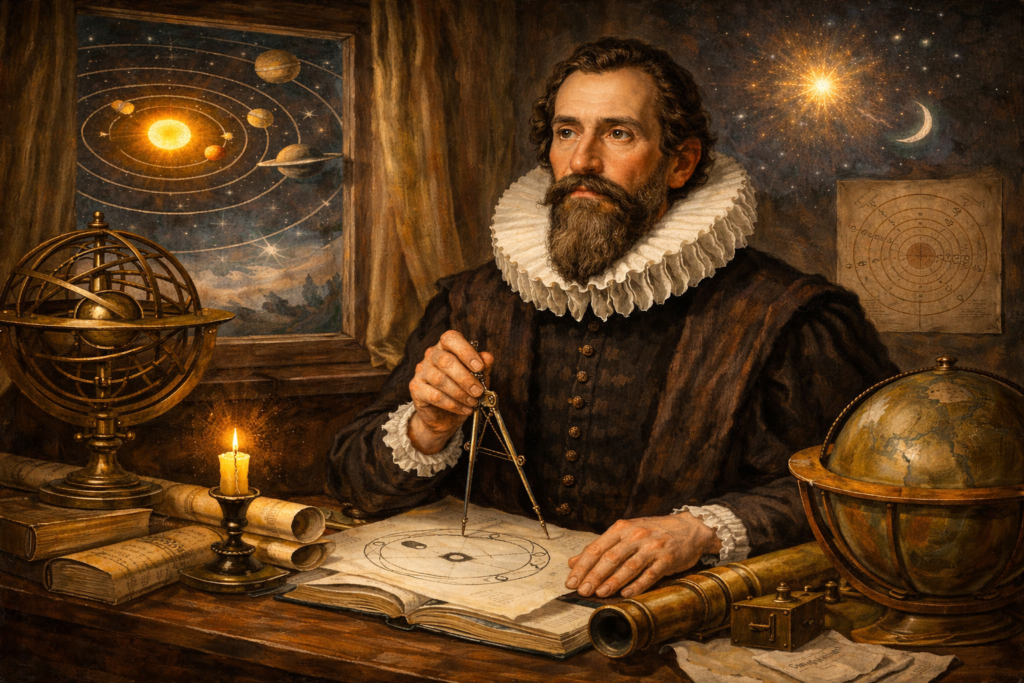
The history of astronomy is filled with remarkable scientists, but few had the lasting influence of johannes kepler discoveries. Johannes Kepler (1571–1630) was a German mathematician, astronomer, and natural philosopher whose groundbreaking work helped transform humanity’s understanding of the cosmos.
Before Kepler, many scholars believed that planets moved in perfect circles around Earth or the Sun. However, Kepler’s research revealed that planetary motion was far more complex and fascinating. Through careful observation, mathematical analysis, and collaboration with other scientists, he laid the foundation for modern astronomy.
Today, johannes kepler discoveries are considered some of the most important milestones in the scientific revolution. His work not only improved astronomical calculations but also paved the way for Isaac Newton’s theory of gravity.
This pillar article explores the life, education, and achievements behind johannes kepler discoveries, while briefly introducing his most important contributions that will be discussed in detail in related articles.
Early Life of Johannes Kepler
Johannes Kepler was born on December 27, 1571, in Weil der Stadt, a small town in present-day Germany. His childhood was far from easy. Kepler was born prematurely and suffered from poor health throughout his life.
His father was a mercenary soldier who often traveled and eventually disappeared during a military campaign. His mother, Katharina Kepler, had knowledge of herbal medicine and later became involved in a controversial witchcraft trial.
Despite these challenges, Kepler showed an extraordinary curiosity about mathematics and the stars from an early age. As a child, he was fascinated by celestial events such as comets and lunar eclipses.
These early experiences sparked a lifelong passion that would eventually lead to revolutionary johannes kepler discoveries.
Education and Academic Journey
Kepler’s academic abilities were recognized early by teachers, which allowed him to receive scholarships for advanced education. He attended several Protestant schools and eventually enrolled at the University of Tübingen in 1589.
At the university, Kepler studied theology, philosophy, and mathematics. His professors initially expected him to become a Lutheran minister. However, his deep interest in astronomy gradually changed his path.
During his studies, Kepler encountered the revolutionary copernicus solar system model, which proposed that the Sun—not Earth—was at the center of the universe. This idea fascinated Kepler because it provided a mathematical explanation for planetary motion.
Although the Copernican theory was controversial at the time, Kepler became one of its strongest supporters. His dedication to studying planetary motion would later lead to some of the most influential johannes kepler discoveries in scientific history.
Kepler’s Early Career in Astronomy
After completing his studies, Kepler accepted a position as a mathematics teacher in Graz, Austria, in 1594. While teaching, he also began conducting astronomical research and writing scientific works.
One of his earliest books, Mysterium Cosmographicum (The Cosmic Mystery), attempted to explain the structure of the universe using mathematical relationships between planetary orbits.
Although some of his early ideas were later proven incorrect, this work established Kepler as a promising young astronomer.
His career took a major turn when he began collaborating with the famous Danish astronomer Tycho Brahe. Brahe had collected some of the most precise astronomical observations ever recorded.
With access to Brahe’s data, Kepler was finally able to begin developing the theories that would become the core of johannes kepler discoveries.
Major Johannes Kepler Discoveries That Changed Astronomy
Johannes Kepler’s contributions transformed astronomy from philosophical speculation into a mathematical science. His discoveries helped scientists understand how planets move and how the universe operates.
Below are some of the most significant achievements associated with johannes kepler discoveries.
Kepler’s Three Laws of Planetary Motion
One of Kepler’s greatest achievements was identifying the mathematical rules that describe planetary motion. These laws explain how planets move around the Sun.You can explore this topic in detail in the article about kepler’s three laws of planetary motion.
Kepler’s Discovery of Elliptical Orbits
Before Kepler, astronomers believed that planets moved in perfect circles. Kepler discovered that planetary orbits are actually elliptical rather than circular.
This breakthrough is explained further in kepler’s discovery of elliptical orbits.
Kepler’s Contributions to Optics
Kepler was not only an astronomer but also a pioneer in the field of optics. His studies helped scientists understand how vision works and how lenses bend light.
His work eventually influenced the development of telescopes and modern optical science. You can learn more in kepler’s contributions to optics.
Kepler’s Rudolphine Tables
Kepler used Tycho Brahe’s observational data to create extremely accurate tables for predicting planetary positions.
These calculations greatly improved navigation and astronomical predictions. This achievement is discussed further in kepler’s rudolphine tables.
Kepler’s Observation of the 1604 Supernova
In 1604, Kepler carefully studied a bright new star that suddenly appeared in the sky. His observations challenged the ancient belief that the heavens were unchanging.
More about this discovery can be found in Kepler’s Observation of the 1604 Supernova.
Together, these achievements formed the foundation of modern astronomy and strengthened the scientific importance of johannes kepler discoveries.
Challenges and Personal Struggles
Kepler’s life was filled with difficulties. Religious conflicts in Europe forced him to move frequently, and he faced financial instability throughout much of his career.
One of the most dramatic episodes in his life involved his mother being accused of witchcraft. Kepler spent years defending her in court, eventually securing her release.
Despite these hardships, he continued to work tirelessly on astronomy and mathematics. His persistence allowed him to complete some of the most influential johannes kepler discoveries ever made.
Kepler’s Influence on Modern Science
The importance of johannes kepler discoveries goes far beyond astronomy. His work helped establish the idea that natural phenomena can be explained through mathematical laws.
Later scientists, including Isaac Newton, built upon Kepler’s research to develop the law of universal gravitation.
Kepler’s discoveries also improved navigation, calendar systems, and space science. Today, spacecraft missions and satellite calculations still rely on principles derived from johannes kepler discoveries.
FAQs About Johannes Kepler
Who was Johannes Kepler?
Johannes Kepler was a German astronomer and mathematician who lived from 1571 to 1630. He is best known for discovering the laws that describe planetary motion.
Why are johannes kepler discoveries important?
johannes kepler discoveries transformed astronomy by explaining how planets move around the Sun using mathematical laws. His work laid the foundation for modern physics and astronomy.
Did Kepler work with other scientists?
Yes, Kepler worked closely with Tycho Brahe, whose detailed observations helped Kepler develop his theories about planetary motion.
How did Kepler influence Isaac Newton?
Newton used Kepler’s laws of planetary motion to develop his theory of gravity, which explained why planets move the way they do.
What fields did Kepler contribute to besides astronomy?
Kepler also made important contributions to optics, mathematics, and scientific methodology.
Conclusion
Johannes Kepler’s work represents a crucial turning point in the history of science. His discoveries helped shift astronomy from philosophical speculation to precise mathematical analysis.
By building upon earlier ideas—including the insights of how ancient greek scientists changed modern science—Kepler helped humanity better understand the structure and motion of the universe.
Today, the legacy of johannes kepler discoveries continues to influence modern astronomy, physics, and space exploration. His relentless curiosity, powerful mathematical thinking, and dedication to truth made him one of the most brilliant scientists of the Scientific Revolution.
Kepler’s story reminds us that even in times of hardship, perseverance and intellectual courage can unlock the deepest secrets of the universe.