The story of johannes kepler optics discovery represents one of the most fascinating chapters in the history of science. While Johannes Kepler is widely celebrated for explaining planetary motion, his revolutionary work also transformed the science of vision, lenses, and telescopes.
During the early 17th century, scientists were still trying to understand how the human eye works and how light behaves when it passes through lenses. Many early theories were incorrect or incomplete. Through careful reasoning and experimentation, johannes kepler optics discovery provided groundbreaking insights that changed the science of vision forever.
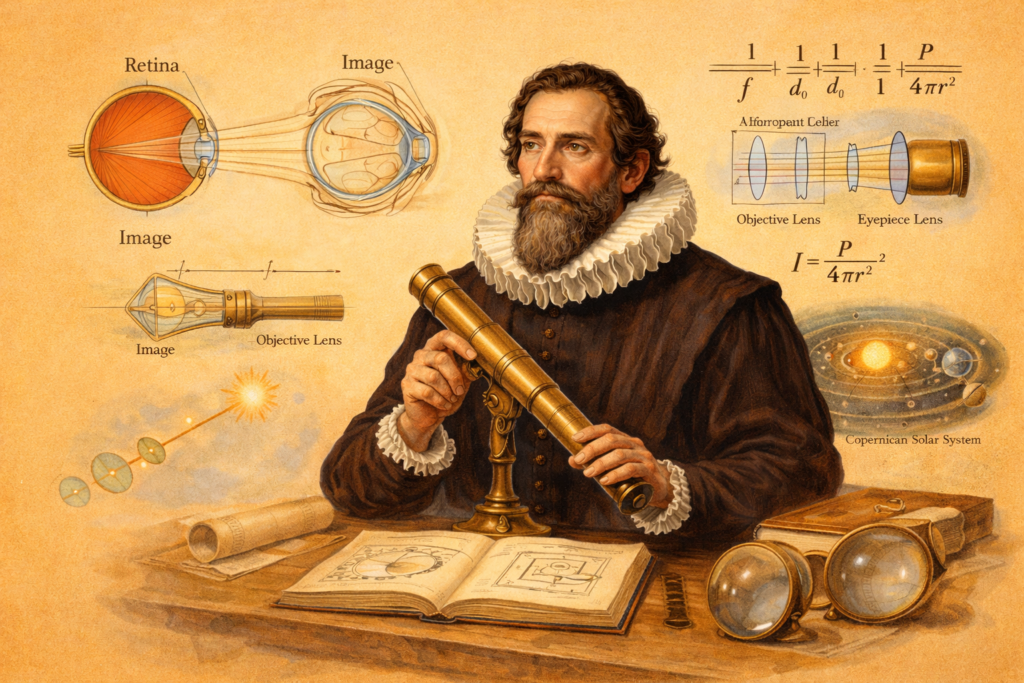
Kepler’s work showed that the eye functions like an optical instrument and that images form on the retina. He also designed an improved telescope using two convex lenses, creating what is now known as the Keplerian telescope.
Today, the principles behind johannes kepler optics discovery influence modern optical engineering, astronomy, microscopy, and imaging technology.
Beyond the Stars: Kepler’s Fascination with Light
Although johannes kepler is most famous for his work in astronomy, he was equally fascinated by the nature of light and vision. Kepler believed that understanding light was essential for understanding the universe itself.
During the Renaissance, optical physics history was still developing. Scholars had studied reflection and refraction, but many aspects of the science of vision remained mysterious.
Kepler’s curiosity pushed him beyond planetary motion. While developing Kepler’s Three Laws of Planetary Motion, he realized that astronomical observations depended heavily on accurate optics and telescope design.
This curiosity led him to study how light interacts with lenses and how images form in the human eye.
His groundbreaking work appeared in the book Dioptrice (1611), which became one of the most influential texts in the history of telescope design and optical physics.
Through his research, johannes kepler optics discovery helped scientists understand the behavior of refractive light theory and the mathematics behind optical systems.
Understanding Human Vision: The Retina as a Screen
Before Kepler’s research, many scholars believed that vision occurred when rays came out of the eyes and touched objects.
Kepler proved that this idea was incorrect.
Instead, he showed that light enters the eye and forms an image on the retina.
This insight became a cornerstone of johannes kepler optics discovery.
The eye works similarly to a camera:
- The cornea and lens focus incoming light.
- Light rays converge onto the retina.
- The retina acts like a projection screen where the image forms.
Mathematically, the focusing of light through a lens follows the lens equation:Where:
- f = focal length of the lens
- do = distance from object to lens
- di = distance from lens to image
This equation describes how lenses create images inside the eye.
The concept of retina and image formation later became fundamental in medical optics and visual science.
Thanks to johannes kepler optics discovery, scientists gained a clear understanding of how human vision operates.
The Invention of the Keplerian Telescope
One of the most revolutionary aspects of johannes kepler optics discovery was the design of a new telescope.
Early telescopes existed before Kepler, but their designs were limited. Galileo used a telescope that combined a convex objective lens with a concave eyepiece.
Kepler proposed a more powerful optical system.
His telescope used two convex lenses, creating a new design known as the Keplerian telescope.
This design significantly improved magnification and image clarity.
How the Keplerian Design Improved on Galileo’s Model
Galileo’s telescope produced upright images but had several limitations:
- Narrow field of view
- Limited magnification
- Distorted images
Kepler realized that using two convex lenses would allow for greater magnification.
In the Keplerian telescope:
- The objective lens forms a real image.
- The eyepiece magnifies this image.
Although the image appears inverted, the design produces a much wider field of view.
The magnification of a telescope can be calculated using:Where:
- M = magnification
- fo = focal length of objective lens
- fe = focal length of eyepiece lens
This improvement was a key part of johannes kepler optics discovery, and it helped transform telescope technology.
The Use of Two Convex Lenses for Higher Magnification
The use of convex and concave lenses became central to optical engineering after Kepler’s work.
In a Keplerian telescope:
- The objective lens collects light from distant objects.
- The light converges to form a real image.
- The eyepiece magnifies the image.
Because both lenses are convex, the telescope can achieve significantly higher magnification.
This design eventually became the standard for astronomical telescopes.
Modern refracting telescopes still follow principles derived from johannes kepler optics discovery.
Kepler’s optical research also influenced other areas of science, including the work that led to kepler’s rudolphine tables, which relied on precise observations.
The Inverse Square Law of Light Intensity
Another important idea connected to johannes kepler optics discovery is the relationship between distance and light intensity.
Kepler explored how light spreads through space and observed that brightness decreases as distance increases.
This relationship is described by the inverse square law:Where:
- I = light intensity
- P = power of the light source
- r = distance from the source
This means that if the distance from a light source doubles, the intensity becomes four times weaker.
The inverse square law plays a crucial role in astronomy, photography, and illumination engineering.
It also helps astronomers measure the brightness of stars and planets.
The understanding of light intensity laws was another powerful component of johannes kepler optics discovery.
Kepler’s Legacy in Modern Optical Engineering
The influence of johannes kepler optics discovery extends far beyond the 17th century.
Modern optical engineering relies on the principles Kepler helped establish.
His research contributed to several fields:
- telescope technology
- camera optics
- microscopes
- medical imaging
- space telescopes
Kepler’s discoveries also complemented his astronomical work. His research on planetary motion, explored in Kepler’s Discovery of Elliptical Orbits, revolutionized celestial mechanics.
His observations of cosmic events, including kepler’s observation of the 1604 supernova, helped challenge ancient beliefs that the heavens never change.
Together, these achievements show the remarkable range of Kepler’s scientific genius.
Frequently Asked Questions (FAQs)
What was Johannes Kepler’s contribution to optics?
Kepler discovered how images form on the retina and designed the Keplerian telescope using two convex lenses.
What is the Keplerian telescope?
A telescope design using two convex lenses that produces higher magnification and a wider field of view.
Why is Kepler important in vision science?
Kepler explained how the human eye focuses light onto the retina, forming images.
What book did Kepler write about optics?
Kepler published Dioptrice (1611), which became a foundational text in optical physics history.
How did Kepler influence modern telescopes?
Most refracting telescopes used today follow the optical design principles described in Kepler’s work.
Conclusion
The impact of johannes kepler optics discovery goes far beyond astronomy. By explaining how vision works and how lenses focus light, Kepler helped create the foundation of modern optical science.
His work connected multiple scientific fields—from astronomy and mathematics to optical engineering and imaging technology.
Kepler built upon earlier scientific traditions such as the copernicus solar system model, but his discoveries pushed science into a new era of precision and mathematical understanding.
Ultimately, his achievements also remind us how ancient greek scientists changed modern science, inspiring generations of thinkers to explore the geometry, physics, and mysteries of the universe.