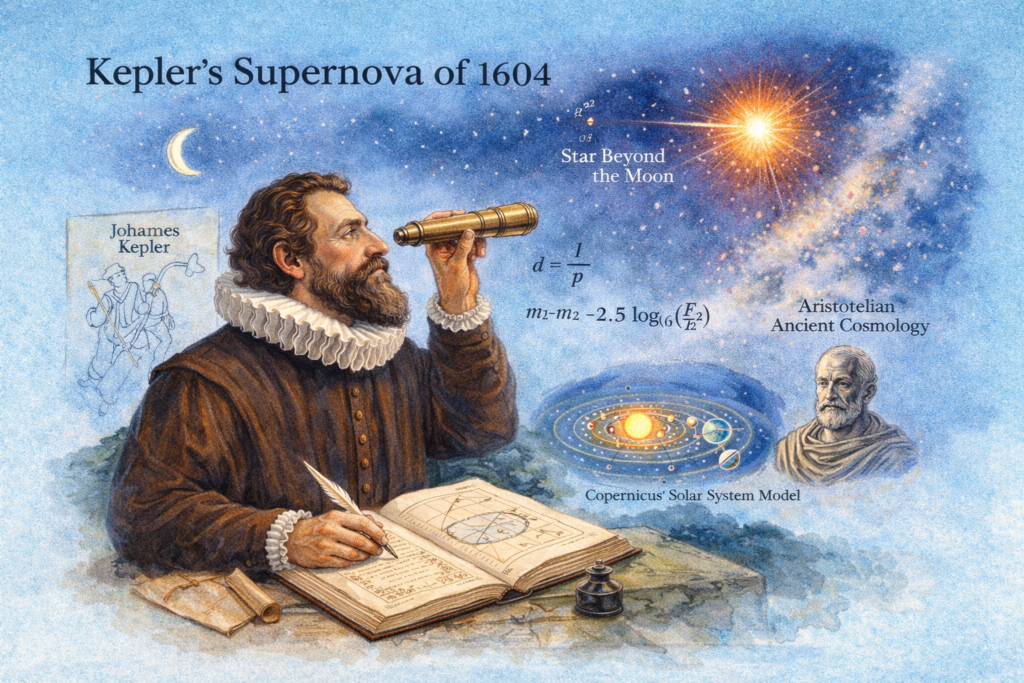
The appearance of kepler supernova 1604 remains one of the most dramatic and scientifically important celestial events in recorded history. In October 1604, astronomers across Europe noticed an extraordinarily bright new star suddenly appear in the constellation Ophiuchus. This event captured the attention of scientists, philosophers, and ordinary observers alike.
For centuries, ancient cosmology had taught that the heavens were perfect and unchanging. According to Aristotelian cosmology, stars were eternal objects fixed in a flawless celestial sphere. Nothing new could appear in the sky.
However, the sudden emergence of kepler supernova 1604 directly challenged this belief.
The brilliant astronomer johannes kepler carefully observed this mysterious new star and documented its brightness, position, and gradual fading. His detailed observations became one of the most important scientific records of a stellar explosion ever made.
Today, historians and astronomers recognize kepler supernova 1604 as a pivotal moment that helped dismantle ancient cosmology and usher in the modern understanding of the universe.
The Appearance of “Kepler’s Star” in Ophiuchus
On the evening of October 9, 1604, astronomers witnessed something extraordinary.
A bright star suddenly appeared near the foot of Ophiuchus, a constellation located close to the Milky Way. This star had not been visible before, yet it quickly grew brighter than many of the surrounding stars.
This remarkable celestial object became known as Kepler’s Star, the astronomical event now referred to as kepler supernova 1604.
Observers reported that the new star was nearly as bright as Jupiter and visible even during twilight. Such brightness indicated that a powerful stellar explosion had occurred.
The appearance of kepler supernova 1604 was not the first time a new star had been recorded. In 1572, Tycho Brahe had observed a similar event, now known as Tycho’s supernova.
However, Kepler’s careful observations and detailed astronomical record keeping made this event particularly significant.
Through systematic observation, Kepler recorded changes in brightness and color, providing valuable data about the behavior of stellar explosions.
These observations became a critical part of variable star history and the study of supernova phenomena.
Observations That Challenged Ancient Cosmology
The sudden appearance of kepler supernova 1604 raised profound questions about the nature of the universe.
Ancient philosophers had long argued that the heavens were perfect and immutable. According to Aristotelian cosmology, celestial bodies were made of a special substance called “aether” and were incapable of change.
But the appearance of a new star contradicted this idea.
If a star could suddenly appear, then the heavens were not eternal or unchanging.
This discovery forced scientists to reconsider centuries of philosophical assumptions.
The observation of kepler supernova 1604 therefore became a powerful challenge to Aristotelian cosmology and the myth of unchanging heavens.
Proving the Supernova Was Beyond the Moon
One of the most important scientific questions was determining whether the new star existed within Earth’s atmosphere or in the distant heavens.
To solve this problem, johannes kepler used a method based on parallax measurement.
Parallax occurs when an object appears to shift position relative to distant background objects as the observer moves.
The parallax angle can be approximated using:Where:
- p = parallax angle
- d = distance to the object
If the object were close to Earth, its position would change noticeably when observed from different locations.
Kepler carefully analyzed the position of kepler supernova 1604 relative to nearby stars and found no measurable parallax.
This meant the object was extremely distant—far beyond the Moon.
This discovery proved that the new star was part of the celestial realm itself.
Shattering the Belief in an Eternal, Unchanging Universe
The lack of parallax confirmed that kepler supernova 1604 existed among the fixed stars.
This realization shattered the long-held belief that the heavens were perfect and immutable.
If a new star could appear in the celestial sphere, then the universe must be dynamic and evolving.
This idea represented a profound shift in scientific thinking.
It supported the emerging heliocentric model described in the copernicus solar system model, which placed the Sun rather than Earth at the center of planetary motion.
The discovery of kepler supernova 1604 therefore played an important role in the broader transformation of astronomy during the Scientific Revolution.
Kepler’s Methods in Documenting the 1604 Event
Kepler approached the observation of kepler supernova 1604 with remarkable scientific discipline.
He carefully recorded:
- brightness changes
- color variations
- position relative to nearby stars
- duration of visibility
This methodical approach reflected Kepler’s broader scientific philosophy, which emphasized mathematical precision and empirical observation.
The same commitment to data analysis also guided Kepler’s work on kepler’s discovery of elliptical orbits, where he used precise planetary observations to uncover the true shape of planetary paths.
Kepler also compared the brightness of the supernova with known celestial objects. Astronomers today describe brightness using a magnitude scale, where:This relationship allows astronomers to compare the brightness of different stars.
Although the modern magnitude system was developed later, Kepler’s observations laid the groundwork for quantitative brightness measurement.
His dedication to astronomical record keeping ensured that kepler supernova 1604 became one of the best-documented stellar explosions of the early modern period.
The Scientific Significance of the “De Stella Nova”
Kepler later published his observations in a remarkable scientific work titled De Stella Nova (On the New Star).
This book described the appearance and behavior of kepler supernova 1604 in extraordinary detail.
The work provided one of the earliest scientific studies of a stellar explosion.
It also strengthened Kepler’s reputation as one of the most brilliant astronomers of his era.
During the same period, Kepler was developing his revolutionary theories about planetary motion. These discoveries eventually became known as kepler’s three laws of planetary motion.
Together, these achievements transformed the scientific understanding of the cosmos.
How Supernova Observations Paved the Way for Modern Cosmology
The observation of kepler supernova 1604 helped reshape the scientific understanding of the universe.
By demonstrating that stars could appear and disappear, Kepler showed that the cosmos was not static but dynamic.
This insight opened the door to modern astrophysics.
Today, astronomers understand that supernovae are the explosive deaths of massive stars. These explosions release enormous amounts of energy and create heavy elements that later form planets and life.
The careful documentation of kepler supernova 1604 therefore represents an early step toward modern cosmology.
Kepler’s broader scientific contributions including kepler’s contributions to optics and kepler’s rudolphine tables further advanced the mathematical and observational tools needed to study the universe.
Frequently Asked Questions (FAQs)
What was the Kepler supernova of 1604?
It was a bright stellar explosion observed in the constellation Ophiuchus in 1604 and carefully studied by Johannes Kepler.
Why was the supernova important?
The event challenged the ancient belief that the heavens were unchanging and helped transform cosmology.
Where did the supernova appear?
The supernova appeared near the foot of Ophiuchus and was visible for many months.
What book described the supernova?
Johannes Kepler documented the event in De Stella Nova, a major scientific work on celestial phenomena.
Can we still see the supernova today?
The explosion faded long ago, but astronomers can still observe the supernova remnant using modern telescopes.
Conclusion
The observation of kepler supernova 1604 stands as one of the most powerful turning points in the history of astronomy. By carefully documenting the sudden appearance of a new star, Johannes Kepler helped dismantle the ancient belief in a perfect and unchanging universe.
His work provided strong evidence that the cosmos evolves and changes over time.
This discovery complemented the revolutionary ideas emerging from the copernicus solar system model, while Kepler’s broader scientific achievements helped establish the foundations of modern astrophysics.
Ultimately, the story of kepler supernova 1604 reflects the long intellectual journey showing how ancient greek scientists changed modern science, inspiring generations of astronomers to explore the dynamic and ever changing universe.