kepler’s three laws of planetary motion represent one of the most revolutionary breakthroughs in the history of science. Before Johannes Kepler’s discoveries in the early 17th century, astronomers struggled to explain how planets moved through space. Many early models relied on complex circular motions that did not accurately match astronomical observations.
Kepler changed everything. By analyzing precise data from Tycho Brahe, he developed mathematical laws that explained planetary movement with remarkable accuracy. These laws became the foundation of modern orbital mechanics, celestial dynamics, and planetary physics.
Today, kepler’s three laws of planetary motion remain essential for understanding the laws of the cosmos. They help scientists calculate orbital periods, predict planetary positions, and guide spacecraft across the solar system.
In this article, we explore the meaning, mathematics, and impact of kepler’s three laws of planetary motion, one of the most powerful discoveries in scientific history.
Introduction to Kepler’s Three Laws of Planetary Motion
The story behind kepler’s three laws of planetary motion begins with a major scientific shift during the Renaissance. For centuries, astronomers believed Earth was the center of the universe. This geocentric idea dominated astronomy until new evidence began to challenge it.
One of the most important earlier theories was the copernicus solar system model, which proposed that the Sun sits at the center of the planetary system. Although Copernicus correctly identified the Sun as central, he still believed planetary orbits were perfectly circular.
Johannes Kepler studied the precise observations collected by Tycho Brahe and realized something extraordinary: the data did not fit circular orbits. Instead, planets followed a different geometric path.
These insights eventually led to Kepler’s Three Laws of Planetary Motion, which describe how planets move around the Sun through mathematical relationships.
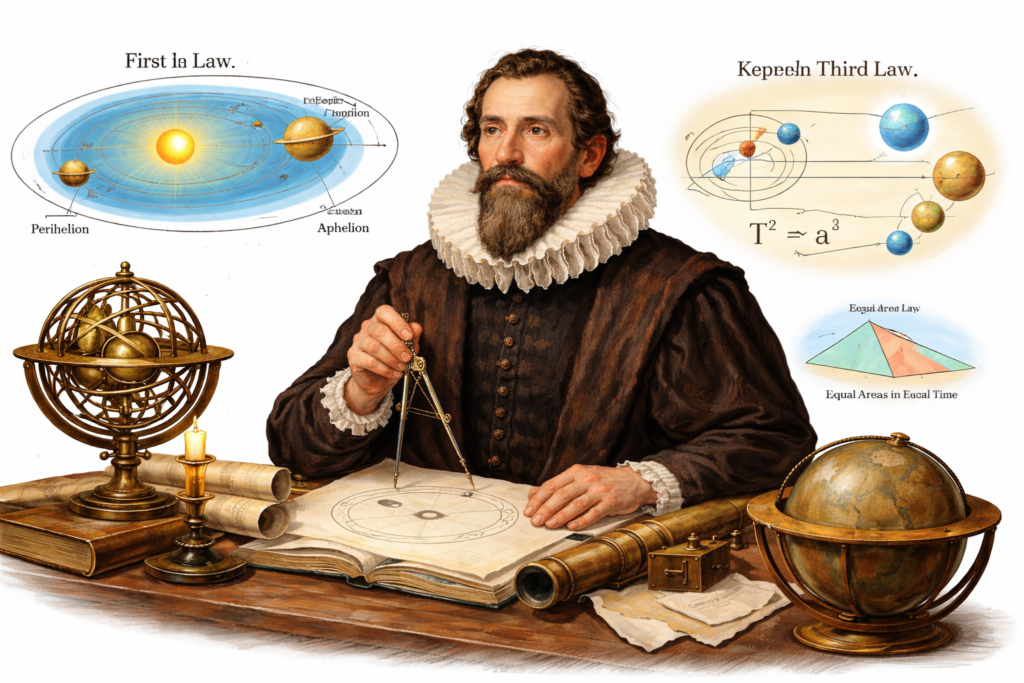
The three laws can be summarized as:
- Planets move in elliptical orbits with the Sun at one focus.
- Planets sweep out equal areas in equal time.
- The square of a planet’s orbital period is proportional to the cube of its semi-major axis.
These principles transformed astronomy from philosophical speculation into quantitative science.
The First Law: The Law of Ellipses
The first and most surprising of kepler’s three laws of planetary motion states that planets do not move in circles. Instead, they travel along elliptical paths.
Mathematically, an ellipse can be described by the equation:
Here:
- a represents the semi-major axis
- b represents the semi-minor axis
The ellipse determines the shape of the planetary orbit.
This discovery overturned centuries of belief that celestial motion must be perfectly circular. Kepler’s insight is discussed further in kepler’s discovery of elliptical orbits.
Breaking the Circle: Why Orbits Are Elliptical
Ancient astronomers believed circular motion represented perfection in the heavens. However, Tycho Brahe’s detailed observations of Mars revealed inconsistencies with circular models.
Kepler analyzed the data and realized that the orbit matched an ellipse instead.
This discovery was revolutionary because it simplified planetary motion and eliminated complicated epicycles used in earlier models.
In modern planetary physics, elliptical orbits are a natural result of gravitational influence between celestial bodies. The Sun’s gravity shapes the motion of planets, producing elliptical paths around it.
This insight marked a critical milestone in the history of planetary motion history.
Understanding Foci and the Sun’s Position
Every ellipse contains two focal points called foci.
In planetary motion:
- The Sun sits at one focus
- The other focus remains empty
This arrangement determines how the planet moves through its orbit.
If the distance between the planet and the Sun is r, the position of the planet varies continuously as it moves along the ellipse. The semi-major axis of the orbit is often measured in an astronomical unit (AU), where:
1 AU = average distance between Earth and the Sun.
Understanding elliptical geometry was essential for developing accurate orbital mechanics.
The Second Law: The Law of Equal Areas
The second principle of kepler’s three laws of planetary motion describes how planetary speed changes during an orbit.
Kepler’s Second Law states:
A line connecting a planet to the Sun sweeps out equal areas in equal time.
This rule describes the relationship between distance and velocity in celestial dynamics.
Planetary Speed and Distance from the Sun
Planets do not move at constant speed. Instead, their velocity depends on their distance from the Sun.
When the planet is closer to the Sun, gravitational attraction increases, causing it to move faster. When the planet moves farther away, gravitational influence weakens and the planet slows down.
Mathematically, this law relates to the conservation of angular momentum:
Where:
- L = angular momentum
- m = mass of the planet
- v = orbital velocity
- r = distance from the Sun
Because angular momentum remains constant, the planet must move faster when r decreases.
This elegant mathematical relationship is one reason kepler’s three laws of planetary motion remain central to orbital mechanics today.
Perihelion vs. Aphelion Dynamics
Two important points exist in every planetary orbit:
Perihelion – the closest point to the Sun
Aphelion – the farthest point from the Sun
At perihelion, planets move at maximum speed.
At aphelion, planets move at minimum speed.
These variations ensure that equal areas are swept in equal time.
Kepler’s careful mathematical reasoning made kepler’s three laws of planetary motion one of the earliest examples of scientific laws describing dynamic systems.
The Third Law: The Law of Harmonies
The third law reveals a remarkable relationship between the distance of a planet from the Sun and the time required to complete an orbit.
This rule is known as the harmonic law.
The Mathematical Relationship Between Distance and Time
Kepler’s Third Law can be written mathematically as:
Where:
- T = orbital period
- a = semi-major axis of the orbit
In practical form:
This means that planets farther from the Sun take much longer to complete their orbits.
For example:
Earth
T=1 year
a=1 AU
Mars
T≈1.88 years
a≈1.52 AU
The relationship holds across the solar system.
This harmonic law became a fundamental principle in celestial dynamics.
Calculating Orbital Periods Across the Solar System
Kepler’s third law allows astronomers to estimate orbital periods easily.
Example calculation:
If a planet has a semi-major axis of 4 AU, then:
This simple equation makes it possible to determine the orbital period of planets, asteroids, and even distant exoplanets.
The mathematical beauty of kepler’s three laws of planetary motion allowed scientists to predict planetary behavior with unprecedented accuracy.
Kepler used this knowledge to create kepler’s rudolphine tables, which greatly improved astronomical predictions.
The Impact of Kepler’s Laws on Modern Astrophysics
The influence of kepler’s three laws of planetary motion extends far beyond Kepler’s lifetime.
These laws became the foundation for Isaac Newton’s theory of universal gravitation. Newton later showed that Kepler’s observations could be explained through gravitational force.
Today, the laws are fundamental to many fields:
- orbital mechanics
- space mission planning
- satellite navigation
- planetary physics
- celestial dynamics
Modern spacecraft trajectories are still calculated using the principles behind kepler’s three laws of planetary motion.
Kepler’s broader scientific contributions extended beyond planetary motion. His research influenced optics and telescope design, which is explored in kepler’s contributions to optics.
He also studied cosmic events such as kepler’s observation of the 1604 supernova, which challenged ancient ideas about an unchanging universe.
Together, these achievements helped transform astronomy into a precise scientific discipline.
FAQs About Kepler’s Three Laws of Planetary Motion
What are kepler’s three laws of planetary motion?
They are three mathematical laws describing how planets orbit the Sun using elliptical paths, changing speeds, and harmonic relationships between distance and time.
Why were Kepler’s laws important?
They replaced incorrect circular models and provided accurate mathematical descriptions of planetary motion, forming the basis of modern astronomy.
How did Kepler discover these laws?
Kepler analyzed the precise astronomical observations of Tycho Brahe and applied mathematical reasoning to identify patterns in planetary motion.
Are Kepler’s laws still used today?
Yes. Modern orbital mechanics, satellite motion, and space missions rely heavily on the principles discovered in kepler’s three laws of planetary motion.
Did Kepler influence later scientists?
Absolutely. Isaac Newton used Kepler’s laws to develop the universal law of gravity.
Conclusion
The discovery of kepler’s three laws of planetary motion represents one of the most powerful turning points in the scientific revolution. Kepler combined observation, mathematics, and logical reasoning to reveal the hidden structure of planetary motion.
Although his work built upon earlier ideas such as the copernicus solar system model, Kepler’s mathematical laws transformed astronomy into a predictive science.
His discoveries also connect to a broader intellectual tradition stretching back to antiquity. The curiosity and philosophical foundations established by early thinkers remind us how ancient greek scientists changed modern science, inspiring generations of astronomers to search for deeper patterns in the universe.
Today, the legacy of Kepler’s work continues to guide astrophysics, planetary exploration, and our understanding of the laws of the cosmos.