The discovery known as newton law of universal gravitation stands among the greatest achievements in the history of science. Before Isaac Newton developed this revolutionary theory scientists believed that celestial motion and earthly motion were separate phenomena governed by different rules. Planets moved in the heavens while objects on Earth simply fell downward.
Newton revealed something extraordinary. The same invisible force responsible for an apple falling to the ground also controls the movement of planets moons and comets across the cosmos.
This insight became the foundation of newton law of universal gravitation, a theory that unified terrestrial and celestial mechanics into a single mathematical framework.
Through careful reasoning observation and mathematics Newton demonstrated that every object in the universe attracts every other object through gravitational force. This force depends on two key factors mass and distance.
The discovery of newton law of universal gravitation emerged from the broader body of isaac newton discoveries, which transformed physics astronomy and mathematics during the scientific revolution.
Introduction to Newton Law of Universal Gravitation
The concept behind newton law of universal gravitation explains how gravity works everywhere in the universe. Newton proposed that all objects with mass exert an attractive force upon each other.
The strength of this attraction depends on the masses of the objects and the distance separating them.
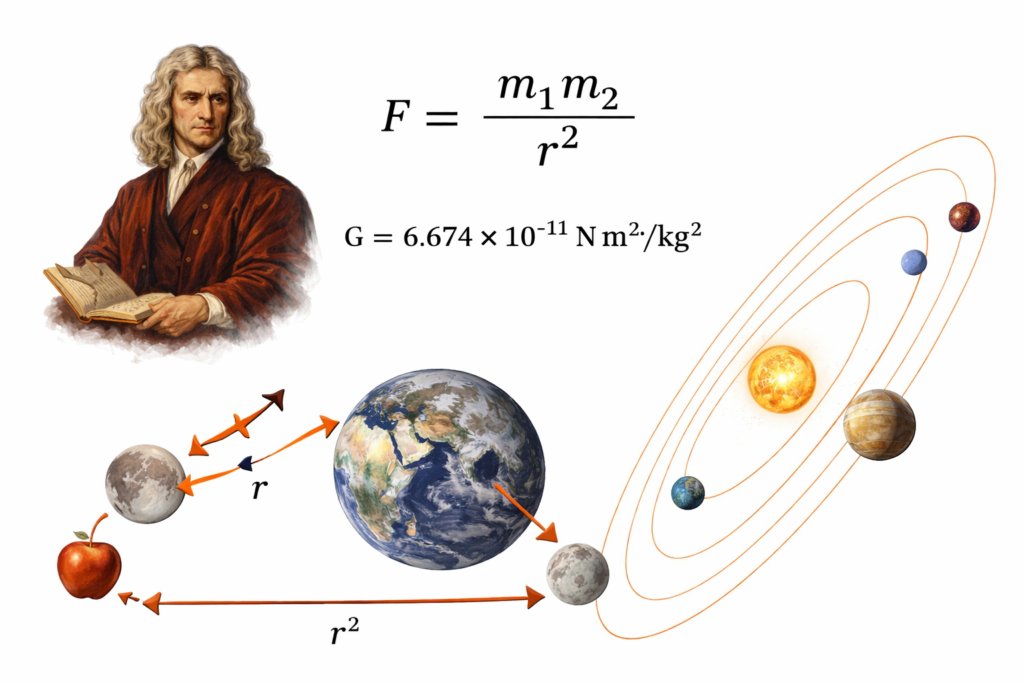
Newton expressed this relationship through a mathematical equation that remains central to classical physicsWhere:
F represents gravitational force
G represents the universal gravitational constant
m₁ represents mass of the first object
m₂ represents mass of the second object
r represents the distance between the centers of the objects.
This equation shows that gravity grows stronger as mass increases and weaker as distance increases.
The discovery of newton law of universal gravitation allowed scientists to explain planetary motion lunar orbits and the gravitational pull experienced on Earth.
The Apple and the Moon A Unified Theory of Force
One of the most famous stories about Newton involves an apple falling from a tree. Although the story may have been simplified over time it reflects an important scientific insight.
Newton wondered whether the same force that caused the apple to fall might also control the motion of the Moon.
If gravity pulls objects toward Earth then perhaps it also pulls the Moon toward Earth while the Moon continues moving sideways in orbit.
This idea created a unified theory of force that linked falling objects with celestial motion.
The Moon orbit around Earth can be explained by gravitational attraction combined with orbital velocity.
The concept of orbital velocity can be written asWhere:
v represents orbital velocity
G represents gravitational constant
M represents mass of the central body
r represents orbital distance.
This equation helps explain why the Moon continues orbiting Earth rather than falling directly into it.
The realization that gravity governs both apples and planets made newton law of universal gravitation one of the most powerful ideas in scientific history.
Understanding the Mathematics The Inverse Square Law
A key feature of newton law of universal gravitation is the inverse square law. This rule states that gravitational force decreases rapidly as distance increases.
If the distance between two objects doubles the gravitational attraction becomes four times weaker.
If the distance triples the force becomes nine times weaker.
This relationship arises from the r² term in the gravitational equation.
The inverse square law appears in many areas of physics including light intensity electromagnetic forces and gravitational fields.
The mathematical structure of newton law of universal gravitation allowed scientists to calculate planetary attraction force with remarkable precision.
Why Distance Matters More Than Mass
In the equation for newton law of universal gravitation both mass and distance influence gravitational strength.
However distance has a stronger effect because it appears in the denominator as r².
For example if the distance between two objects doubles the gravitational force becomes one fourth as strong.
In contrast doubling the mass only doubles the force.
This explains why planets that lie far from the Sun experience weaker gravitational pull compared to those closer to the Sun.
The mass and distance relationship plays a central role in celestial mechanics and the structure of planetary systems.
The Universal Gravitational Constant “G”
Another important element of newton law of universal gravitation is the universal gravitational constant represented by G.
Its approximate value isThis constant determines the overall strength of gravity in the universe.
Because the value of G is extremely small gravitational forces between ordinary objects are usually very weak.
However when massive bodies such as planets and stars interact the gravitational force becomes extremely powerful.
The introduction of the universal gravitational constant allowed scientists to calculate gravitational interactions throughout the cosmos.
How Gravitation Explains Planetary Orbits
Before Newton astronomer Johannes Kepler had already discovered patterns describing planetary motion.
However Kepler laws were observational descriptions rather than physical explanations.
Newton showed that Kepler laws emerge naturally from newton law of universal gravitation.
By combining gravitational attraction with motion principles Newton proved that planets follow elliptical orbits around the Sun.
These insights were described in the famous book newton’s principia mathematica, one of the most important scientific works ever written.
Newton calculations also demonstrated how gravity determines orbital velocity and the motion of satellites.
These ideas later became essential for space exploration and satellite technology.
The Impact of Gravity on Tides and Comets
The influence of newton law of universal gravitation extends far beyond planetary motion.
Gravity also explains tides on Earth oceans.
Tidal forces occur because the Moon gravitational pull affects different parts of Earth unevenly.
The side of Earth facing the Moon experiences stronger gravitational attraction than the opposite side.
This difference produces the tidal bulges responsible for ocean tides.
Newton theory also explained the motion of comets which travel in elongated orbits through the solar system.
By applying newton law of universal gravitation scientists were able to predict the return of famous comets such as Halley comet.
The understanding of gravitational fields also helped explain the motion of moons around planets.
These discoveries formed an essential part of Newton work in celestial mechanics.
From Newton to Einstein The Evolution of Gravitational Theory
Although newton law of universal gravitation accurately described gravity for centuries later scientists discovered that it was not the final theory.
In the early twentieth century Albert Einstein proposed a new explanation called general relativity.
Einstein suggested that gravity arises from the curvature of spacetime rather than a simple force acting across distance.
Despite this new understanding Newton theory remains extremely accurate for most everyday situations.
Engineers still rely on Newton gravitational equations when launching satellites or calculating planetary trajectories.
The influence of newton law of universal gravitation therefore remains central to modern science.
Newton research also connected with other scientific fields including optics through newton’s prism experiments and mechanics through newton’s three laws of motion.
Meanwhile his development of calculus led to the famous intellectual dispute known as newton calculus controversy.
Frequently Asked Questions (FAQs)
What is Newton law of universal gravitation?
Newton law of universal gravitation states that every object with mass attracts every other object with a force proportional to their masses and inversely proportional to the square of the distance between them.
Why is Newton gravitational law important?
The law explains planetary motion satellite orbits ocean tides and the behavior of objects falling toward Earth.
How did Newton discover gravity?
Newton combined mathematical reasoning with astronomical observations to develop a theory explaining both falling objects and planetary motion.
Does Newton gravitational law still apply today?
Yes the equation remains accurate for most practical calculations although Einstein relativity provides a more complete explanation of gravity.
What role did Newton play in the scientific revolution?
Newton unified earlier discoveries about motion astronomy and mathematics creating a comprehensive scientific framework.
Conclusion
The revolutionary theory known as newton law of universal gravitation changed humanity understanding of the universe. Newton demonstrated that the same gravitational force governing falling objects on Earth also controls the motion of planets moons and comets.
His work united terrestrial physics with celestial mechanics and provided a mathematical explanation for planetary motion.
The discoveries described in newton’s principia mathematica built upon earlier astronomical insights such as the copernicus solar system model while continuing the long intellectual tradition of how ancient greek scientists changed modern science.
Through these remarkable achievements Newton revealed that the universe operates according to universal laws that can be discovered through observation mathematics and reason.