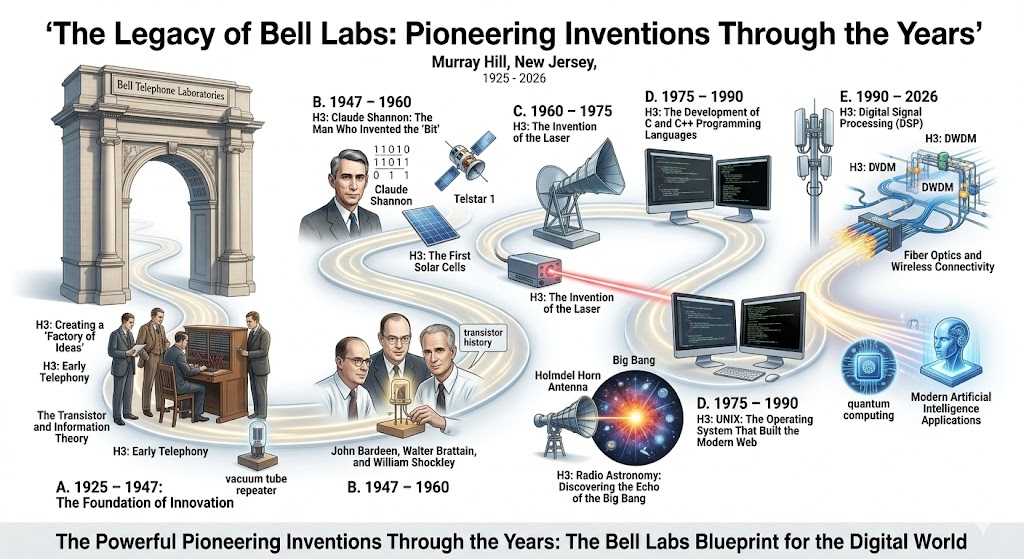
In the quiet corridors of Murray Hill, New Jersey, a group of scientists once gathered to solve a simple problem: how to make a phone call travel further. What they ended up doing was rewriting the blueprint of human civilization. The pioneering inventions through the years that emerged from Bell Telephone Laboratories—now Nokia Bell Labs—represent perhaps the greatest concentration of brilliance in industrial history. From the silicon chips in your pocket to the invisible radio waves of the Big Bang, the pioneering inventions through the years at this institution have shaped every facet of our digital existence.
Introduction
Bell Labs was never just a laboratory; it was a “Factory of Ideas” where the boundary between theoretical physics and practical engineering dissolved. Established as a joint venture between AT&T and Western Electric, its mission was to ensure the dominance of the American telephone network. However, the scope of their work quickly transcended telecommunications. To understand the pioneering inventions through the years, one must look at a culture that encouraged failure, prized fundamental research, and ultimately secured nine Nobel Prizes. This article explores how Bell Labs built the modern world, one breakthrough at a time.
A. 1925 – 1947: The Foundation of Innovation
Creating a “Factory of Ideas”: The Bell Labs Philosophy
The early success of Bell Labs was rooted in its unique R&D culture. Unlike most corporate labs that focused on short-term profits, Bell Labs allowed its scientists to chase “Blue Sky” ideas. They believed that if you gathered the world’s best physicists, mathematicians, and engineers in one building and gave them endless resources, the results would be revolutionary. This philosophy birthed the first wave of pioneering inventions through the years, establishing a template for modern innovation hubs like Silicon Valley.
Early Telephony: Improving the Global Voice Network
In its first two decades, the lab focused on the AT&T research legacy of signal clarity. They developed the vacuum tube repeaters that allowed voice signals to cross the Atlantic. But even in these early days, they were thinking bigger. They pioneered sound-on-film technology, effectively bringing “talkies” to the cinema, and conducted the first long-distance television transmissions. This era proved that telecommunications was the gateway to a broader multimedia future.
B. 1947 – 1960: The Transistor and Information Theory
The year 1947 marked the most significant turning point in the history of technology. On December 23, John Bardeen, Walter Brattain, and William Shockley demonstrated the point-contact transistor. This device replaced the bulky, fragile vacuum tube with a tiny solid-state component. Looking at the transistor history, we see the literal birth of the silicon age. Without this specific pioneering inventions through the years milestone, computers would still fill entire rooms and smartphones would be a physical impossibility.
Claude Shannon: The Man Who Invented the “Bit”
While the hardware was being revolutionized, Claude Shannon was revolutionizing the math behind it. In 1948, he published “A Mathematical Theory of Communication.” Shannon was the first to define “information” as a measurable quantity and introduced the world to the “binary digit” or bit. His work is the bedrock of the history of computer networking, providing the equations that allow us to compress data and transmit it across the globe without errors.
The First Solar Cells: Harnessing the Sun for Space
In 1954, Bell Labs researchers Gerald Pearson, Daryl Chapin, and Calvin Fuller created the first practical silicon solar cell. While initially too expensive for home use, these photovoltaics were perfect for the burgeoning space race. They powered the Telstar 1, the first communication satellites, which enabled the first live transatlantic television feed. It was a masterclass in how Bell Labs turned a material science discovery into a global communication triumph.
C. 1960 – 1975: Lasers and Communications
From Theory to Reality: The Invention of the Laser
The laser is perhaps one of the most versatile pioneering inventions through the years. In 1958, Bell Labs researchers Arthur Schawlow and Charles Townes published the theoretical principles of the “optical maser.” By the 1960s, Bell Labs was at the forefront of refining gas lasers and solid-state lasers. Today, this technology facilitates everything from grocery store scanners to the delicate surgeries that save lives, proving that the AT&T research legacy extended far beyond the telephone.
Radio Astronomy: Discovering the Echo of the Big Bang
In 1964, Arno Penzias and Robert Wilson were using a giant horn antenna in Holmdel, New Jersey, to track communication satellites. They kept hearing a persistent “hiss” that they couldn’t explain. After ruling out bird droppings and local interference, they realized they were hearing Cosmic Microwave Background Radiation—the afterglow of the Big Bang. This Nobel Prize-winning discovery turned Bell Labs into a temple of astrophysics, proving their pioneering inventions through the years could unlock the secrets of the universe itself.
D. 1975 – 1990: The Legacy of Bell Labs and the Software Revolution
The Development of C and C++ Programming Languages
As hardware became more powerful, the need for efficient code became paramount. Dennis Ritchie developed the C programming language at Bell Labs in the early 70s, followed later by Bjarne Stroustrup’s C++. These languages became the “lingua franca” of the digital world. Their impact on the history of programming languages is immeasurable; almost every major operating system and browser today is written in a descendant of these Bell Labs creations.
UNIX: The Operating System That Built the Modern Web
Ken Thompson and Dennis Ritchie didn’t just want a new language; they wanted a new way to interact with computers. They created UNIX, an operating system designed for multi-tasking and flexibility. The history of operating systems changed forever with UNIX, as its philosophy of “small, sharp tools” became the foundation for Linux, macOS, and the servers that power the internet.
E. 1990 – 2026: Fiber Optics and Wireless Connectivity
As we moved toward the new millennium, the pioneering inventions through the years shifted toward moving massive amounts of data at the speed of light.
Digital Signal Processing (DSP) and the Rise of Cell Phones
Bell Labs essentially invented the brain of the modern cell phone. Digital Signal Processing (DSP) chips allowed for the compression and clarity required for wireless mobile technology. This made the transition from analog to digital cellular networks possible, cementing the history of mobile technology as a Bell Labs-driven phenomenon.
DWDM: How Bell Labs Multiplied Fiber Optic Capacity
To handle the explosion of internet traffic, Bell Labs perfected Dense Wavelength Division Multiplexing (DWDM). This technology allows multiple “colors” of light to travel through a single optical fiber, each carrying its own stream of data. It effectively multiplied the capacity of the global internet by thousands of times without the need to dig up and lay new cables.
Today, as we look toward the future, Bell Labs continues to push into history of quantum computing and 6G networks. Their researchers are even refining modern artificial intelligence applications to optimize network traffic and discover new materials, ensuring that the pioneering inventions through the years never truly cease
Frequently Asked Questions (FAQs)
What is Bell Labs’ most famous invention?
While they have thousands of patents, the transistor is widely considered their most impactful invention, as it is the fundamental building block of all modern electronics.
How many Nobel Prizes has Bell Labs won?
As of 2026, Bell Labs researchers have been awarded nine Nobel Prizes for work ranging from the discovery of the Big Bang’s echo to the invention of the Charge-Coupled Device (CCD).
Who owns Bell Labs now?
After the breakup of AT&T and several corporate transitions, Bell Labs is currently owned by Nokia and operates as Nokia Bell Labs.
Did Bell Labs invent the internet?
Not directly, but they invented almost all the technologies that make the internet possible, including the history of computer networking protocols, UNIX, the C language, and fiber-optic amplifiers.
What is the “Bell Labs Philosophy”?
It is the idea of providing world-class scientists with a collaborative, multi-disciplinary environment and the freedom to pursue fundamental research without immediate commercial pressure.
Conclusion
The story of Bell Labs is a testament to what happens when human curiosity is given the space to breathe. From the foundation of the transistor history to the software that runs our lives, their pioneering inventions through the years have acted as the invisible scaffolding of the 21st century. They taught us that a phone company could discover the origin of the universe, and a group of researchers in New Jersey could invent the future. As we move into an era of AI and quantum reality, the spirit of Bell Labs remains the gold standard for how we solve the unsolvable.