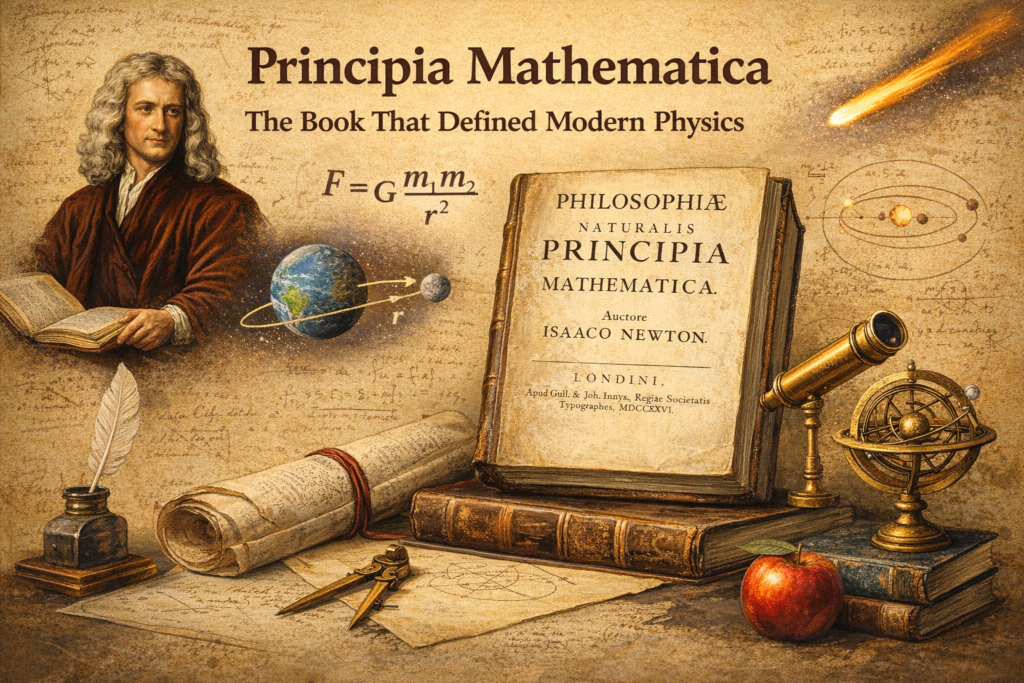
The principia mathematica book stands as one of the most influential scientific works ever written. Published in 1687 by Isaac Newton this remarkable text reshaped humanity understanding of the universe and created the mathematical foundation of classical mechanics.
Before the publication of the principia mathematica book scientists had many ideas about motion and planetary behavior but lacked a unified mathematical explanation. Astronomers had observed planetary motion and philosophers had speculated about natural forces yet no single framework connected these ideas together.
Newton solved this problem through a brilliant synthesis of mathematics observation and physics. In the principia mathematica book he explained how forces control motion both on Earth and in the heavens. Falling apples orbiting moons and moving planets all follow the same universal laws.
The impact of the principia mathematica book was enormous. It transformed the scientific revolution and established Newton as one of the greatest thinkers in history. The ideas presented in this book formed the backbone of isaac newton discoveries, shaping physics for more than three centuries.
Principia Mathematica The Most Important Scientific Book Ever Written
Many historians consider the principia mathematica book the most important scientific publication in history. Newton presented a systematic mathematical description of motion gravity and celestial mechanics.
The book unified two areas that had previously been studied separately. The motion of objects on Earth and the movement of celestial bodies in space were revealed to follow the same physical laws.
Within the pages of the principia mathematica book Newton introduced a framework now called Newtonian dynamics. This framework explains how forces cause acceleration and how motion changes over time.
One of the key principles appearing in the work is the relationship between force mass and accelerationThis equation describes how net force influences motion and forms the core of classical mechanics foundation.
The laws presented in the principia mathematica book remain fundamental to engineering physics and astronomy.
The Genesis of the Principia Edmond Halley Visit
The origin of the principia mathematica book is closely connected to a famous meeting between Isaac Newton and the astronomer Edmond Halley.
In 1684 Halley visited Newton at Cambridge University to discuss planetary motion. Astronomers were trying to understand why planets follow elliptical paths around the Sun.
Halley asked Newton whether mathematics could explain these orbital shapes.
Newton replied that he had already solved the problem years earlier but had misplaced his calculations.
Encouraged by Halley Newton began rewriting his work. Halley later financed the publication of the principia mathematica book and ensured its distribution across Europe.
Without Halley support the principia mathematica book might never have been published.
Structure of the Work Definitions and Axioms
The principia mathematica book is organized into three major sections often called books.
Each section builds upon mathematical definitions and physical principles.
At the beginning Newton introduced fundamental definitions such as mass motion and force. He also explained concepts like velocity and displacement which are essential to understanding motion.
Newton then presented axioms known today as newton’s three laws of motion. These laws describe inertia acceleration and action reaction forces.
Through these axioms Newton established the principles of force that govern movement in the universe.
The book then proceeds through detailed mathematical demonstrations showing how these laws apply to objects ranging from falling stones to orbiting planets.
The careful logical structure of the principia mathematica book allowed scientists to analyze complex physical systems with mathematical precision.
Book III The System of the World
The third section of the principia mathematica book is perhaps the most famous.
In this part Newton applied his mathematical theory to the structure of the solar system.
He demonstrated that the gravitational attraction between bodies explains planetary motion.
The equation describing gravitational attraction appears asWhere:
F represents gravitational force
G represents the universal gravitational constant
m₁ and m₂ represent masses
r represents the distance between objects.
This equation became known as newton’s law of universal gravitation and explained how planets orbit the Sun.
Through this analysis Newton proved that celestial mechanics follows predictable mathematical rules.
Proving the Solar System Through Math
The principia mathematica book demonstrated that Kepler laws of planetary motion could be derived from Newton theory of gravity.
Using mathematical reasoning Newton showed that planets travel in elliptical paths due to gravitational attraction between the Sun and each planet.
He also calculated orbital velocity and explained why moons orbit planets.
The concept of center of mass helped explain how two bodies interact gravitationally.
Through these calculations Newton revealed that the solar system operates according to precise mathematical laws.
These results provided powerful confirmation for the copernicus solar system model.
The success of these predictions showed the remarkable power of the principia mathematica book.
The Philosophical Legacy The Clockwork Universe
The ideas presented in the principia mathematica book influenced not only science but also philosophy.
Newton work suggested that the universe behaves like a giant mechanical system governed by predictable laws.
This view became known as the clockwork universe concept.
According to this perspective the cosmos operates according to mathematical principles that can be discovered through observation and reasoning.
The clockwork universe idea dominated scientific thinking for centuries and influenced Enlightenment philosophy.
The discoveries described in the principia mathematica book therefore shaped both science and intellectual culture.
Additional Contributions Described in the Principia
Although the principia mathematica book focuses primarily on motion and gravity it also connects with other scientific work by Newton.
His research in optics including newton’s prism experiments revealed that white light contains a spectrum of colors.
Newton also developed advanced mathematical techniques related to calculus which later sparked debates known as newton calculus controversy.
Together these achievements formed the broader framework of Newton contributions to science.
The influence of principia mathematica book therefore extends across physics mathematics and astronomy.
Why the Principia Remains Relevant 300 Years Later
More than three centuries after its publication the principia mathematica book remains a cornerstone of scientific knowledge.
Engineers still rely on Newton equations to design machines bridges and spacecraft.
Astronomers use Newton mechanics to calculate planetary orbits and satellite trajectories.
Even modern space missions depend on the mathematical principles described in the principia mathematica book.
Although later scientists such as Einstein introduced new theories of gravity the Newtonian framework remains extremely accurate for most everyday situations.
This enduring relevance demonstrates the brilliance of Newton insights.
Frequently Asked Questions (FAQs)
What is the Principia Mathematica book?
The principia mathematica book is a scientific work written by Isaac Newton in 1687 that explains the mathematical laws governing motion gravity and celestial mechanics.
Why is the Principia considered important?
It unified terrestrial physics and celestial mechanics into a single mathematical framework forming the foundation of classical mechanics.
What discoveries appear in the Principia?
The book introduced Newton laws of motion and the theory of universal gravitation which explain planetary motion and falling objects.
How did the Principia influence science?
It transformed physics astronomy and engineering by showing that natural phenomena follow mathematical laws.
Is the Principia still used today?
Yes many modern engineering and physics calculations still rely on the principles introduced in the principia mathematica book.
Conclusion
The principia mathematica book represents one of the greatest achievements in scientific history. Through this masterpiece Isaac Newton unified the laws governing motion gravity and celestial mechanics into a single mathematical framework.
The book demonstrated that the universe operates according to precise physical laws that can be understood through mathematics and observation.
These discoveries built upon earlier ideas such as the copernicus solar system model and continued the long intellectual tradition showing how ancient greek scientists changed modern science.
Through the enduring legacy of the principia mathematica book Newton transformed our understanding of the cosmos and laid the foundations for modern physics.