
Introduction
Ptolemy’s Almagest is one of the most influential books in the history of astronomy. Written by the Greek scholar Claudius Ptolemy in the 2nd century CE, this remarkable work became the foundation of astronomical knowledge for more than a thousand years. Through Ptolemy’s Almagest, scholars were able to understand planetary motion, map the stars, and study the structure of the universe.
The importance of Ptolemy’s Almagest lies in its systematic approach to studying the heavens. Combining mathematical models with careful observations, Claudius Ptolemy created a detailed explanation of celestial motion. This work represents one of the greatest achievements in ancient astronomy and remains a landmark in the history of astronomy.
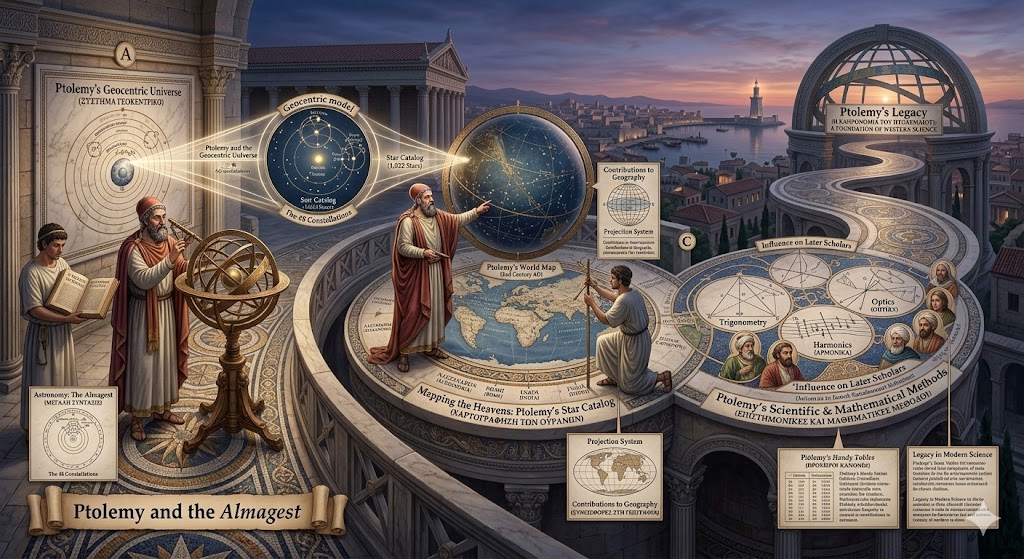
At the center of Ptolemy’s Almagest was the belief that Earth stood at the center of the universe. Although later discoveries challenged this idea, the Ptolemaic system provided accurate predictions of planetary movement for centuries.
The ideas presented in Ptolemy’s Almagest were closely connected with the broader history of Greek astronomy and the scientific tradition of Alexandria. Scholars studying the heavens relied on this text to understand planetary motion, star positions, and celestial mechanics.
To better understand Ptolemy’s broader achievements, you can also explore Ptolemy Contributions to Astronomy, which explains how his discoveries shaped scientific thought.
Historical Background
The development of Ptolemy’s Almagest took place in Alexandria, one of the most important intellectual centers of the ancient world. During this time, scholars gathered knowledge from earlier civilizations and refined it through observation and mathematics.
Claudius Ptolemy built upon earlier work from astronomers such as Hipparchus. By combining earlier observations with his own calculations, he created the sophisticated models described in Ptolemy’s Almagest.
Astronomy in Alexandria was highly advanced for its time. Scholars studied planetary movements, eclipses, and star positions using mathematical tools. Within this environment, Ptolemy’s Almagest emerged as a complete guide to understanding the cosmos.
The work reflects the best traditions of Greek astronomy, where logic, mathematics, and observation worked together to explain natural phenomena.
Structure of the Almagest
One of the reasons Ptolemy’s Almagest became so influential is its organized structure. The book is divided into thirteen sections that gradually explain different aspects of the universe.
These sections cover topics such as:
- The geometry of the celestial sphere
- Planetary motion
- Lunar and solar theories
- Eclipses
- Star positions
The detailed mathematical explanations in Ptolemy’s Almagest allowed astronomers to calculate planetary positions with remarkable accuracy.
By organizing astronomical knowledge into a structured system, Claudius Ptolemy transformed scattered observations into a complete scientific framework.
This systematic approach is why the influence of Almagest lasted for centuries and became central to the development of astronomy.
The System of Epicycles
A major feature of Ptolemy’s Almagest is the explanation of planetary motion using epicycles. The Ptolemaic system introduced the idea that planets move in small circles called epicycles while orbiting Earth along larger circles known as deferents.
This model helped explain the phenomenon known as retrograde motion, where planets appear to move backward in the sky.
The combination of epicycle and deferent allowed the system described in Ptolemy’s Almagest to predict planetary movements with surprising precision.
The model became widely known as the Ptolemaic system, which dominated astronomy for centuries.
To understand the core idea behind this system, readers can explore Geocentric Model Explained, which describes how Earth was placed at the center of the universe.
Star Catalog and Mapping the Sky
Another remarkable feature of Ptolemy’s Almagest is its extensive star catalog. Claudius Ptolemy recorded the positions and brightness of more than one thousand stars.
This catalog represents one of the most important achievements in ancient astronomy. It helped astronomers identify constellations and study the movement of stars across the sky.
The Ptolemy star catalog organized stars into forty-eight constellations. Many of these constellations are still used in modern astronomy.
Because of its precision and detail, the catalog played a key role in mapping the heavens. Scholars studying the sky relied on these observations for centuries.
To learn more about the importance of this catalog, see Star Catalog and Its Impact, which explores how star mapping shaped astronomy.
Influence in the Islamic Golden Age
The impact of Ptolemy’s Almagest did not remain limited to the Greek world. During the medieval period, scholars in the Islamic world translated the text into Arabic.
This period, known as the Islamic Golden Age astronomy, saw major scientific developments. Scholars carefully studied Ptolemy’s Almagest, improved astronomical instruments, and refined mathematical calculations.
The influence of Almagest became even stronger during this time. Observatories were built across the Islamic world, and astronomers used Ptolemy’s models to understand celestial movements.
Later, these Arabic translations were introduced into Europe, helping spark scientific learning during the Middle Ages.
You can learn more about this scientific transmission in Influence on Medieval Astronomy, which explains how Ptolemy’s ideas shaped medieval science.
Challenge to the Geocentric Universe
Despite its success, the system described in Ptolemy’s Almagest was eventually challenged. During the Renaissance, astronomers such as Copernicus proposed a new model in which the Sun was placed at the center of the solar system.
This heliocentric theory gradually replaced the geocentric model presented in Ptolemy’s Almagest.
However, it is important to remember that the Ptolemaic system represented the most advanced explanation of the universe available at the time.
For centuries, Ptolemy’s Almagest provided astronomers with a reliable method for predicting planetary positions.
Even when new theories appeared, the mathematical techniques developed in Ptolemy’s Almagest continued to influence scientific thinking.
Legacy of the Almagest
The lasting significance of Ptolemy’s Almagest lies in its role as a bridge between ancient and modern science.
The work preserved centuries of astronomical knowledge and organized it into a coherent scientific system. As a result, the history of astronomy cannot be understood without studying Ptolemy’s Almagest.
In addition to astronomy, Claudius Ptolemy also made important discoveries in geography and mathematics.
For example, his geographic research helped develop mapping techniques described in Contributions to Geography.
His scientific authority was so strong that his ideas remained dominant for more than a millennium. Because of this, historians often describe Ptolemy as an Authority for Centuries in the field of astronomy.
Frequently Asked Questions (FAQs)
What is Ptolemy’s Almagest?
Ptolemy’s Almagest is an ancient astronomical book written by Claudius Ptolemy that explains planetary motion and the structure of the universe.
Why was Ptolemy’s Almagest important?
The book organized centuries of astronomical knowledge and provided mathematical models to predict planetary movement.
What is the Ptolemaic system?
The Ptolemaic system is a geocentric model where Earth sits at the center of the universe and planets move in epicycles around it.
How many stars are in Ptolemy’s catalog?
The Ptolemy star catalog includes more than one thousand stars grouped into constellations.
When did the Almagest lose its authority?
The authority of Ptolemy’s Almagest began to decline during the Renaissance when heliocentric astronomy was introduced.
Conclusion
In the long story of scientific discovery, Ptolemy’s Almagest stands as one of the most remarkable achievements of ancient astronomy. Written by Claudius Ptolemy in Alexandria, the book provided a detailed mathematical explanation of the universe and guided astronomers for centuries.
Although later discoveries replaced the geocentric model, the scientific methods used in Ptolemy’s Almagest helped shape the development of astronomy.
By preserving earlier knowledge and expanding it through careful observation and mathematics, Ptolemy’s Almagest truly succeeded in mapping the heavens and leaving a lasting legacy in the history of science.