
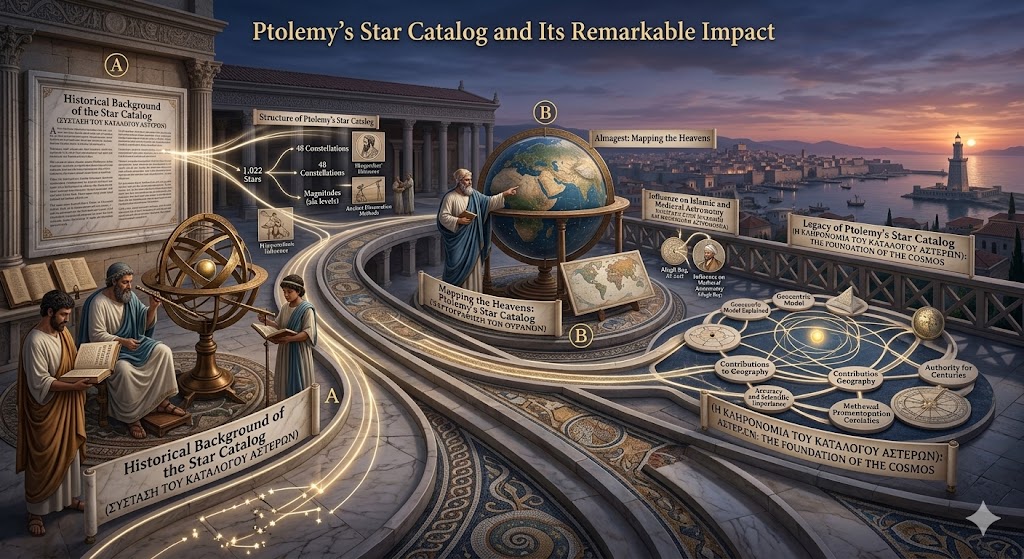
The history of humanity is written in the stars, but for nearly fifteen hundred years, that script was interpreted through a single, monumental work: Ptolemy’s Star Catalog. Produced in the 2nd century AD by the Greco-Egyptian polymath Claudius Ptolemy, this catalog was not merely a list of lights in the sky; it was a comprehensive map of the cosmos that defined the boundaries of the known universe. By cataloging over a thousand stars with unprecedented precision for his time, Ptolemy provided a framework that guided sailors, philosophers, and scientists through the Middle Ages and into the Renaissance.
Introduction
At the heart of ancient Greek astronomy lies the desire to impose order on the perceived chaos of the night sky. Ptolemy’s Star Catalog represents the pinnacle of this endeavor. Compiled as a central component of his larger work, the Almagest, the catalog served as a definitive reference point for astronomical observations. It bridged the gap between raw observation and mathematical theory, ensuring that the Ptolemy’s Star Catalog remained the Authority for Centuries in both the Western and Islamic worlds.
Historical Background of the Star Catalog
Claudius Ptolemy lived and worked in Alexandria, the intellectual capital of the Roman Empire, during the 2nd century AD. While he is often credited as the sole author, the history of astronomy suggests he built upon the foundations laid by earlier pioneers, most notably Hipparchus. Hipparchus had created a star catalog roughly three centuries earlier, but Ptolemy expanded, updated, and integrated these observations into a cohesive mathematical system.
The Ptolemy’s Star Catalog was revolutionary because it was the first to survive in a complete form, preserved through the fall of Rome and the rise of the Islamic Golden Age. It was during this time that Ptolemy Contributions to Astronomy were recognized as the gold standard for celestial navigation and timekeeping.
Structure of Ptolemy’s Star Catalog
The catalog is meticulously organized, listing 1,022 stars divided into 48 constellations. Each entry includes the star’s position in celestial coordinates (longitude and latitude) based on the ecliptic, as well as its “magnitude” or brightness. Ptolemy utilized a six-point scale for magnitude, a system so effective that a version of it is still used by modern astronomers today.
The Ptolemy’s Star Catalog categorized stars into three main groups:
- The Northern Constellations: Including Ursa Major and Cassiopeia.
- The Zodiacal Constellations: The twelve signs that track the path of the sun.
- The Southern Constellations: Including Orion and Centaurus.
Mapping the Heavens
To Ptolemy, mapping the heavens was an act of both science and philosophy. By providing coordinates for every visible star, he allowed future astronomers to track the movement of “wandering stars” or planets against a fixed background. This process of Almagest: Mapping the Heavens allowed for the calculation of planetary orbits, even if those calculations were based on the incorrect assumption that the Earth was the center of the universe.
The act of mapping was essential for the development of the Ptolemaic system. Without an accurate catalog of fixed points, the complex geometry of epicycles and deferents used in the Geocentric Model Explained by Ptolemy would have lacked the empirical data necessary to make even semi-accurate predictions.
Connection with the Almagest
The star catalog is found in Books VII and VIII of the Almagest, a thirteen-volume mathematical and astronomical treatise. The title Almagest actually comes from the Arabic al-majisṭī, meaning “The Greatest.” Within this context, the star catalog was not an isolated list but a tool used to demonstrate the stability of the heavens. Ptolemy used the data in the catalog to argue that the fixed stars maintain their positions relative to one another, a concept that supported his broader view of a structured, divine cosmos.
Accuracy and Scientific Importance
For a work produced without the aid of telescopes, the accuracy of the Ptolemy’s Star Catalog is nothing short of extraordinary. Ptolemy used instruments like the astrolabe and the armillary sphere to measure angles in the sky. While his data suffered from a consistent error in longitude due to an incorrect value for the precession of the equinoxes, the relative positions of the stars were accurate enough to be used for over a thousand years.
His Ptolemy astronomy discoveries regarding the brightness of stars and their distribution provided the first statistical look at the universe. This catalog turned astronomy from a series of myths into a rigorous mathematical discipline, heavily influencing the Contributions to Geography by allowing for the determination of latitude on Earth using the stars.
Influence on Islamic and Medieval Astronomy
Following the decline of the Roman Empire, the Almagest was translated into Arabic in the 8th and 9th centuries. Islamic astronomers like Al-Sufi and Ulugh Beg studied the Ptolemy’s Star Catalog with great intensity. They updated the magnitudes and positions, correcting some of Ptolemy’s errors while respecting the overall structure he created.
The Influence on Medieval Astronomy cannot be overstated. When the Almagest was translated back into Latin in the 12th century, it sparked a scientific revival in Europe. Medieval scholars viewed Ptolemy’s work as the ultimate truth, and his catalog was used to construct cathedral clocks and plan voyages of discovery.
Limitations and Later Developments
Despite its remarkable longevity, the Ptolemy’s Star Catalog had limitations. The most significant was the reliance on the geocentric view. Because Ptolemy believed the Earth was stationary, he could not account for the parallax of stars. Furthermore, as the centuries passed, the slight error in his calculation of precession meant that the “fixed” coordinates in the catalog began to drift away from the actual positions of the stars in the sky.
By the time of the Renaissance, astronomers like Tycho Brahe and Johannes Kepler began to produce new catalogs with higher precision instruments. However, even these pioneers used Ptolemy’s work as their primary point of comparison, proving that the Ptolemy’s Star Catalog was the foundation upon which the Scientific Revolution was built.
Legacy of Ptolemy’s Star Catalog
The legacy of Claudius Ptolemy lives on in every star chart used today. The 48 constellations he defined remain the core of the 88 constellations officially recognized by the International Astronomical Union. His method of magnitude remains the standard for measuring brightness. Beyond the technicalities, the catalog represents the first time humanity successfully created a permanent, scientific record of the night sky.
Frequently Asked Questions (FAQs)
How many stars are in Ptolemy’s star catalog?
The catalog contains 1,022 stars, organized into 48 distinct constellations.
What instrument did Ptolemy use to observe the stars?
Ptolemy used an armillary sphere, a model of objects in the sky consisting of a spherical framework of rings, and an astrolabe to measure the positions and altitudes of celestial bodies.
Did Ptolemy discover all the stars in his catalog?
No, many stars were known to ancient civilizations. Ptolemy synthesized his own observations with the earlier work of Hipparchus to create the most comprehensive record of his era.
Is the Ptolemaic star catalog still accurate today?
While the relative positions are impressive, the coordinates are no longer accurate for modern observation due to the precession of the equinoxes and Ptolemy’s initial mathematical errors.
Why was Ptolemy’s work so influential in the Islamic world?
Islamic scholars valued the mathematical rigor of the Almagest. They used Ptolemy’s data to improve navigation, determine prayer times, and advance the study of spherical trigonometry.
Conclusion
The Ptolemy’s Star Catalog is one of the most successful scientific documents in human history. It survived the rise and fall of empires, the transition of languages, and the shifting of religious paradigms. While we no longer view the Earth as the center of the universe, we still look up at the same constellations that Ptolemy mapped nearly two thousand years ago. His work reminds us that science is a continuous dialogue across time. By cataloging the heavens, Ptolemy gave us a mirror to our own curiosity and a map that led us, eventually, to the modern age of space exploration.