Introduction
In the history of human knowledge, few collections of writing have carried as much weight as The Hippocratic Corpus. This massive assembly of ancient Greek medical texts represents the moment humanity stepped out of the shadows of mysticism and into the light of rational inquiry. For the first time, the “sacred disease” (epilepsy) and other ailments were stripped of their supernatural labels and analyzed as biological phenomena. By documenting treatments, ethics, and anatomy, this collection became the bedrock upon which all subsequent Western and Islamic medicine was built. It didn’t just provide a set of cures; it provided a mindset—one that valued evidence over dogma and the patient over the ritual.
What Is the Hippocratic Corpus?
The Hippocratic Corpus is a library of approximately 60 to 70 early medical works written in Ionic Greek between the late 5th century BCE and the early 4th century BCE. While the collection bears the name of the legendary physician from Kos, most historians agree that it is not the work of a single man. Instead, it is a compilation of knowledge from various authors who belonged to the Hippocratic school of thought.
These texts are remarkably diverse, covering specialized topics such as pediatrics, surgery, and epidemiology. Because these works were preserved and copied for centuries, they allowed the teachings of Hippocrates: Father of Medicine to survive the fall of empires and the shifting tides of history, ensuring that his rational approach to healing reached every corner of the civilized world.
A New Approach to Medicine
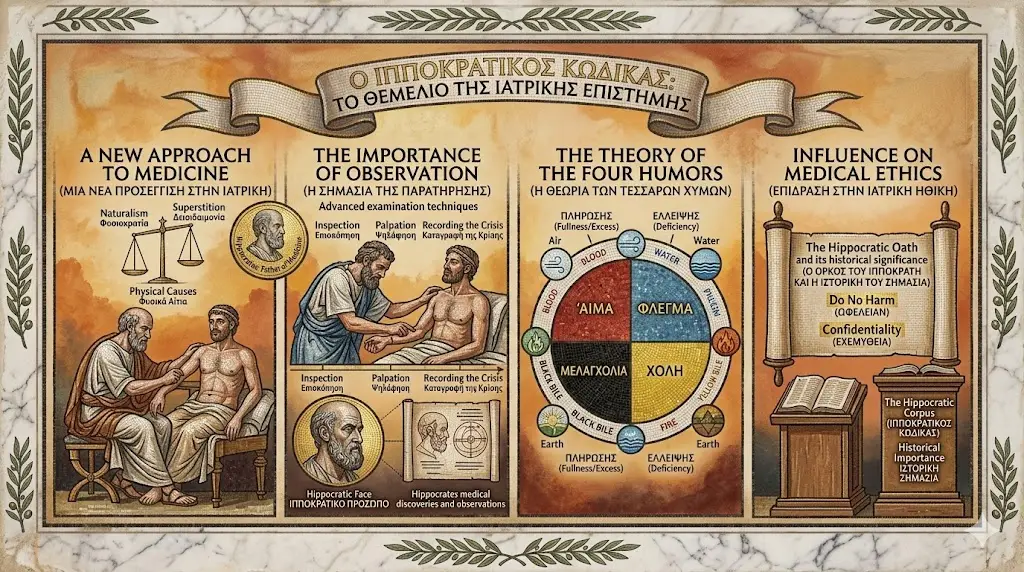
The primary reason The Hippocratic Corpus is considered the foundation of medical science is its radical rejection of the supernatural. Before these texts, a person suffering from a fever might be told they had angered a specific deity. The Corpus changed the conversation entirely by looking for physical causes.
It introduced the idea of “naturalism”—the belief that the physical world operates according to laws that can be understood. The authors argued that to cure a patient, a doctor must look at the climate, the quality of the water, and the patient’s diet. By searching for the cause of disease in the environment rather than the heavens, the writers essentially invented the scientific method as applied to human health.
The Importance of Observation
Central to the philosophy found within The Hippocratic Corpus is the art of clinical observation. The texts emphasize that a physician must be a silent, meticulous witness to the body’s struggle. This was the era where Hippocrates medical discoveries and observations were first codified into a repeatable system for future generations to study.
The Corpus taught physicians to look for specific signs, such as:
- The Hippocratic Face: A distinct facial appearance indicating that death is near.
- Succussion: A technique for detecting fluid in the chest by shaking the patient.
- The Crisis: Identifying the critical day in a fever when the patient would either recover or perish.
By recording these observations in case histories, the Corpus allowed doctors to learn from past experiences rather than relying on guesswork.
The Theory of the Four Humors
While much of the Corpus is praised for its accuracy, it is also the source of the “Humoral Theory,” which dominated medicine for nearly 2,000 years. The writers believed that health was a state of balance (eucrasia) among four primary bodily fluids: Blood, Phlegm, Yellow Bile, and Black Bile.
According to The Hippocratic Corpus, an illness was simply a sign that these humors were out of alignment. While modern germ theory has since replaced this model, the insistence that health depends on internal balance and external environment remains a vital concept in modern preventative medicine.
Influence on Medical Ethics
The Corpus did not stop at biological theories; it also addressed the moral character of the healer. It sought to professionalize medicine by creating a strict code of conduct. This is most famously expressed through the The Hippocratic Oath and its historical significance, which established the “do no harm” principle.
The ethical treatises in the Corpus argue that a physician should be modest, clean, and dedicated to the privacy of the household. These writings established medicine as a “calling” rather than just a trade, ensuring that the power of medical knowledge was always used for the benefit of the sick.
Historical Importance
The survival of The Hippocratic Corpus is a miracle of historical preservation. After the decline of Greek power, these texts were embraced by the Romans, most notably Galen. During the Middle Ages, they were translated into Arabic by scholars in Baghdad, who added their own brilliant commentaries.
When the Renaissance dawned in Europe, the Corpus was once again translated into Latin and Greek, sparking a renewed interest in anatomy and clinical practice. It provided the “language” of medicine. Even today, the way we structure a medical case study or organize a hospital ward can be traced back to the organizational principles found in these 2,400-year-old scrolls.
Frequently Asked Questions (FAQs)
Did Hippocrates write the entire Hippocratic Corpus?
No. Most scholars believe it is a collection of works by many different authors over several generations who all followed the “Hippocratic” method of rational medicine.
Why is the Hippocratic Corpus still studied?
It is studied for its historical value and the foundations of medical ethics it established, which still influence modern healthcare policies.
What is the most famous part of the Corpus?
The most famous part is undoubtedly the “Hippocratic Oath,” which sets the ethical standards for doctors worldwide.
How did the Corpus explain the cause of disease?
It rejected divine punishment and instead blamed environmental factors like “miasma” (bad air), poor diet, and imbalances in the body’s four humors.
Conclusion
The Hippocratic Corpus remains the most influential set of documents in the history of healthcare. It represents the moment our ancestors decided that the human body was not a mystery to be feared, but a system to be understood. By combining clinical rigor with a profound sense of moral duty, this collection of texts didn’t just teach us how to heal; it taught us how to be physicians. As we look toward the future of medicine, we find that we are still following the path first blazed by the writers of the Corpus: the path of observation, balance, and integrity.