Introduction
In the grand tapestry of scientific history, few written records have held as much authority for as long as Theophrastus’ Botanical Works. While the ancient world often blended natural observation with mythology and superstition, these treatises offered a radical departure toward empirical evidence and systematic organization. These books were not merely collections of plant names; they were the first true attempts to document the life cycles, anatomy, and environmental needs of the vegetable kingdom. By formalizing the study of flora, Theophrastus ensured that botany would forever be recognized as a distinct and vital branch of science.+1
The Two Major Botanical Works of Theophrastus
The intellectual foundation of botany rests primarily on two massive collections of writings. These texts functioned as both an encyclopedia of species and a theoretical manual on plant physiology. Together, they represent The First Scientific Study of Plants.
1. Enquiry into Plants (Historia Plantarum)
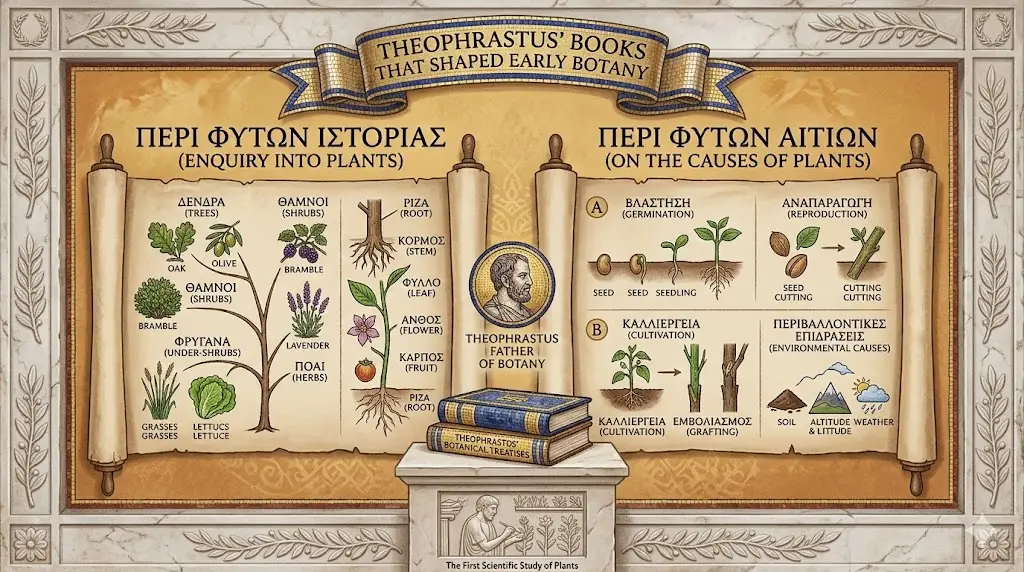
Historia Plantarum is perhaps the most famous of the two works. Spanning nine books, it serves as a comprehensive descriptive survey of the botanical world. In this text, Theophrastus documented over 500 species of plants, many of which were brought back from the far-reaching expeditions of Alexander the Great.+1
This work is where we first see the implementation of Theophrastus’ Plant Classification System. He categorized plants based on their growth forms—Trees, Shrubs, Under-shrubs, and Herbs. He also went into great detail regarding the geographical distribution of plants, noting which species thrived in Egypt versus those in the mountains of Greece. This was the first time in history that anyone had attempted to create a global map of plant life based on physical characteristics rather than human use.
2. On the Causes of Plants (De Causis Plantarum)
While Historia Plantarum was about “what” plants are, De Causis Plantarum was about “how” they work. This six-book series is more philosophical and physiological. It delves into the internal processes that drive plant life, such as:
- Generation and Reproduction: How plants grow from seeds, roots, or cuttings.
- Environmental Effects: How weather, soil quality, and water influence the health and flavor of crops.
- Cultivation Techniques: The science of grafting, pruning, and manuring.
In these pages, Theophrastus explored the “causes” of things, such as why some trees are evergreen while others shed their leaves. His focus on causality shifted the study of plants from passive observation to active inquiry.
Why These Books Were Revolutionary
Before Theophrastus’ Botanical Works were published, knowledge of plants was largely restricted to “Rhizotomists” (root-cutters) and herbalists. Their interests were purely practical: which plant heals a wound, and which one is poisonous?
Theophrastus’ books were revolutionary because they treated plants as biological subjects worthy of study for their own sake. He introduced a specialized vocabulary that we still use today. He was the first to use terms that distinguish between the “bark,” “wood,” and “pith” of a tree. Furthermore, he recognized that plants have different sexes and reproductive habits, a concept that wouldn’t be fully explored again until the modern era. His work proved that nature followed laws that could be observed, recorded, and predicted.
Influence on Later Scientists
The reach of these books extended far beyond the borders of ancient Greece. For nearly two thousand years, any scholar wishing to understand the natural world had to consult the works of Theophrastus: Father of Botany.
During the Islamic Golden Age, his treatises were translated into Arabic, influencing great polymaths who expanded upon his agricultural theories. Later, during the Renaissance, the rediscovery of the original Greek texts sparked a botanical revolution in Europe. Scientists like Andrea Cesalpino and eventually Carolus Linnaeus used Theophrastus as their primary reference point. Linnaeus, the architect of modern biological naming, famously cited Theophrastus as one of the few ancients who correctly understood the fundamental “genera” of plants.
The Lasting Legacy of Theophrastus’ Botanical Works
Today, while we have advanced tools like electron microscopes and DNA sequencing, the spirit of Theophrastus’ work remains at the heart of botany. His books taught us that the first step of science is to look closely and categorize accurately.
His legacy is not just in the facts he got right—such as the difference between monocots and dicots—but in his methodology. He insisted on evidence over dogma. He was willing to correct his theories when new plants were discovered. This intellectual honesty is the hallmark of the scientific method. The survival of his botanical works allowed the knowledge of the ancient world to bridge the gap into the modern era, ensuring that we didn’t have to start from scratch in our quest to understand the green world around us.
Frequently Asked Questions (FAQs)
How many plants did Theophrastus describe in his books?
He described and categorized over 500 different species, ranging from common Mediterranean crops to exotic plants from India and Ethiopia.
Which book is more important for classification?
Historia Plantarum (Enquiry into Plants) is the primary source for his classification system, as it focuses on the physical grouping of species.
Are these books still available to read today?
Yes, both Historia Plantarum and De Causis Plantarum have been translated into modern English and are widely studied by historians of science and botanists alike.
Why did Theophrastus’ work survive while many other ancient texts were lost? His works were considered so essential for medicine, agriculture, and philosophy that they were continually copied by hand in Byzantium and the Arab world, protecting them until the invention of the printing press.
Conclusion
Theophrastus’ Botanical Works represent more than just ancient literature; they are the blueprints for an entire field of science. By meticulously documenting the variety and mechanics of plant life, Theophrastus gave humanity the tools to master agriculture and medicine with a scientific mind. His books serve as a reminder that progress is built upon the careful preservation of knowledge. From the gardens of the Lyceum to the modern laboratories of today, the influence of the Father of Botany continues to grow, rooted deeply in the pages of his revolutionary treatises.