Introduction
The transition from using vegetation solely for survival to understanding it as a biological discipline represents one of the most significant shifts in human history. The first scientific study of plants emerged as a way to categorize the infinite variety of the natural world, moving beyond simple herbalism into a structured science. While ancient civilizations had deep knowledge of medicinal herbs, it was the formalization of botanical inquiry that allowed us to understand plant anatomy, reproduction, and environmental adaptation. This shift transformed the garden from a pantry into a laboratory, setting the stage for thousands of years of agricultural and medical progress.
Why Theophrastus Studied Plants
Theophrastus did not view plants as mere background scenery; he saw them as complex living organisms with their own internal logic. His motivation stemmed from a desire to complete the biological picture started by his mentor, Aristotle. While Aristotle focused heavily on the animal kingdom, Theophrastus recognized that a true understanding of nature required a deep dive into the “immobile” life forms that sustained all other creatures.
He sought to answer fundamental questions: How do plants grow? Why do some thrive in the shade while others perish? By conducting the first scientific study of plants, he aimed to identify the “essential nature” of flora. His work was not just about naming plants but about understanding the laws that governed their existence, a pursuit that earned him the title Theophrastus Father of Botany.
Observing the Structure of Plants
Theophrastus was a pioneer of plant morphology. He was the first to realize that plants have distinct organs that serve specific purposes, much like the hearts and lungs of animals. He meticulously observed the differences between various parts of the plant, such as:
- Roots: He distinguished between taproots and fibrous roots.
- Stems and Trunks: He noted the internal differences between wood and softer plant tissue.
- Leaves: He observed the patterns of leaf arrangement and shape.
- Flowers and Seeds: He was one of the first to describe the reproductive parts of a plant, noting how seeds were formed.
By looking at these structures, he moved botany away from mythology and toward anatomy. He noticed that the “flesh” of a fruit served a different purpose than the protective “bark” of a tree, leading to the conclusion that every part of a plant has a functional design.
Systematic Study and Classification
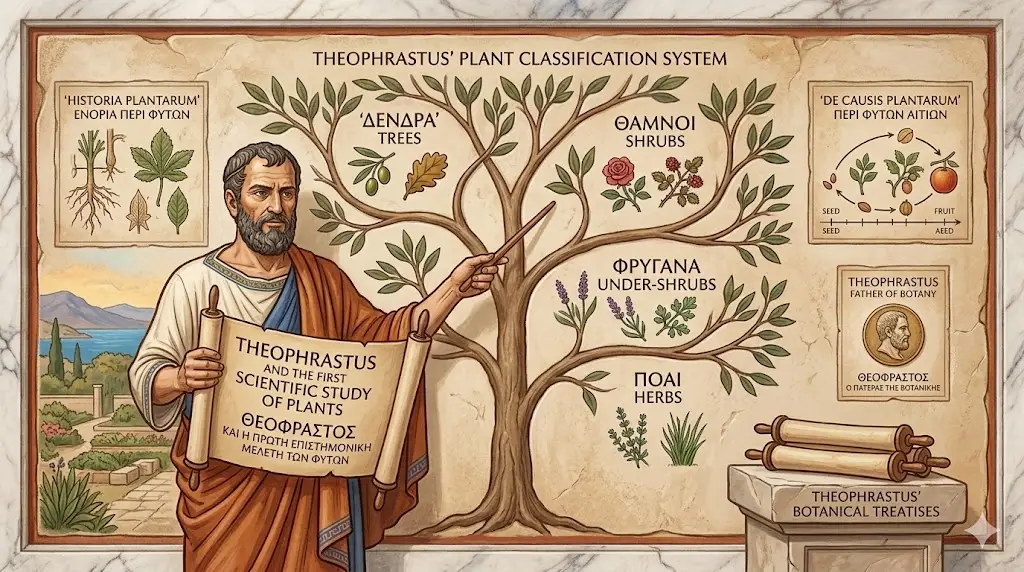
Before the modern era, there was no standard way to group plants. Theophrastus changed this by introducing Theophrastus’ Plant Classification System. He organized over 500 species into four primary categories based on their growth habits:
| Category | Description | Examples |
| Trees | Tall plants with a single woody trunk. | Oak, Olive, Pine |
| Shrubs | Multi-stemmed woody plants. | Rose, Bramble |
| Under-shrubs | Smaller, woody-based plants. | Rue, Lavender |
| Herbs | Non-woody plants that die back. | Thyme, Lettuce, Grasses |
He also categorized plants by their lifespan (annual, biennial, perennial) and by their habitat (wild versus cultivated). This systematic approach allowed scholars to communicate about specific plants using a shared language for the first time in history.
The Role of Observation in Early Botany
The hallmark of Theophrastus’ work was his refusal to rely on hearsay. In the first scientific study of plants, he insisted on direct observation. He spent vast amounts of time in the gardens of the Lyceum in Athens, watching plants throughout their entire life cycles.
He was particularly interested in “germination”—the process by which a tiny seed becomes a massive tree. He noted how moisture, soil quality, and sunlight affected growth. His observations were so precise that he even identified the difference between monocots (plants with one seed leaf) and dicots (plants with two), a distinction that remains fundamental in modern botany. This commitment to the “senses over theory” is what made his work truly scientific.
Written Works That Preserved His Knowledge
Theophrastus’ findings were codified in two monumental Theophrastus’ Botanical Treatises: Historia Plantarum (Enquiry into Plants) and De Causis Plantarum (On the Causes of Plants).
- Enquiry into Plants: This acted as an encyclopedia. It described the geographical distribution of plants, their parts, and their uses.
- On the Causes of Plants: This was more theoretical. It explored plant physiology, how plants respond to weather, and the processes of grafting and cultivation.
These texts were the most important botanical documents in existence for over 1,500 years. They were translated into Arabic during the Middle Ages and later into Latin, serving as the primary resource for Renaissance botanists.
Why Theophrastus Is Called the Father of Botany
Theophrastus earned this title because he was the first to treat plants as a subject of independent study. Before him, plants were studied as a sub-discipline of medicine (pharmacology) or farming. He elevated botany to a pure science.
He established the method of classification, the vocabulary of plant parts, and the importance of ecological context. Without his early work, the later breakthroughs of Linnaeus or even Darwin would have lacked a foundation. He proved that plants were not just passive objects, but dynamic organisms that reacted to their environment—a revolutionary concept at the time.
Frequently Asked Questions (FAQs)
How did Theophrastus differ from Aristotle in his studies?
While Aristotle applied his methods primarily to animals and logic, Theophrastus applied those same rigorous observational techniques to the plant kingdom, which Aristotle had largely ignored.
Did Theophrastus use a microscope?
No, he lived in the 4th century BCE. All his observations were made with the naked eye, which makes his discovery of seed-leaf differences even more impressive.
What are the most famous Theophrastus’ Botanical Treatises?
His two most famous works are Historia Plantarum and De Causis Plantarum, which together formed the basis of botanical science for centuries.
Conclusion
The first scientific study of plants by Theophrastus remains a cornerstone of the biological sciences. By looking at a simple herb or a towering oak tree and asking “how does it function?” he opened a window into the hidden life of the natural world. His legacy is found in every modern botanical garden, every agricultural advancement, and every scientific text that seeks to organize the beauty and complexity of life on Earth. Theophrastus taught us that even the smallest leaf is a world worth investigating.