Introduction
In the ancient world, plants were primarily viewed through the lens of utility—as food, medicine, or timber. However, the development of Theophrastus’ Plant Classification System marked a revolutionary shift in human thought. Instead of asking what a plant could do for humans, scholars began asking how the plant functioned within its own nature. This systematic approach provided the first logical framework for understanding the immense variety of the vegetable kingdom. By categorizing flora based on their physical characteristics and growth patterns, the foundation was laid for what we now recognize as the formal science of botany.
The Beginning of Scientific Plant Classification
The journey toward an organized study of life began at the Lyceum in Athens. While Aristotle was busy categorizing the animal kingdom, his most brilliant student was conducting The First Scientific Study of Plants. This wasn’t merely a hobby; it was a rigorous effort to apply the principles of observation and logic to the “silent” world of roots and leaves.
Before this era, botanical knowledge was scattered and often steeped in superstition. There was no unified language to describe how a rose differed from an oak beyond their obvious size. Theophrastus realized that to truly understand nature, one needed a hierarchy. He moved away from the “herbalist” approach—which grouped plants by their medicinal effects—and instead focused on their “essential” biological traits. This shift is why history remembers him as the Theophrastus Father of Botany, as he was the first to treat plants as organisms worthy of their own dedicated scientific discipline.
The Main Categories in Theophrastus’ Plant Classification System
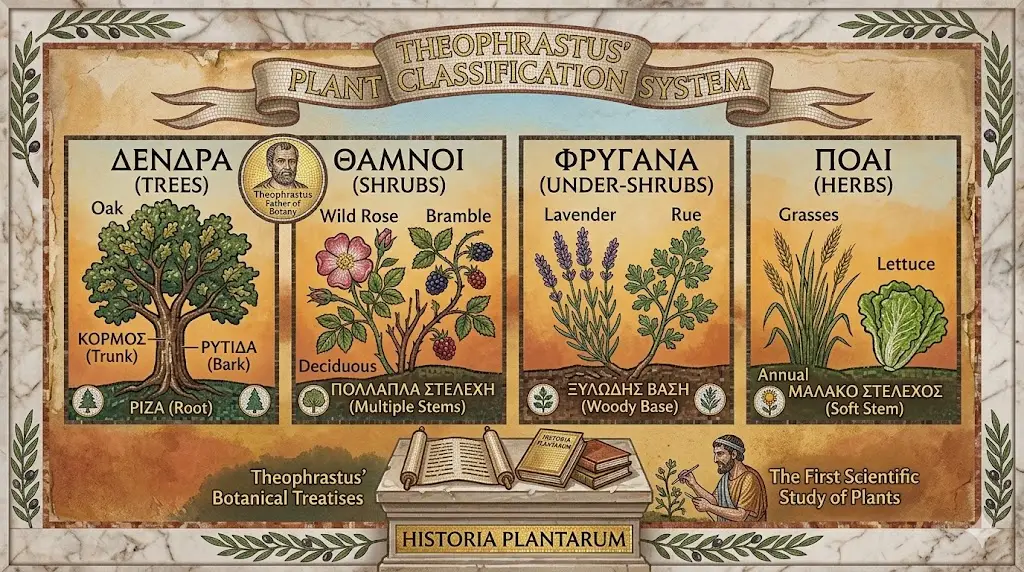
The core of Theophrastus’ Plant Classification System was based on “growth forms.” He observed that plants tended to follow specific structural blueprints. He divided the botanical world into four primary groups:
- Trees (Dendra): Defined as plants with a single, woody, perennial trunk. He further sub-divided these based on whether they were evergreen or deciduous and their habitat.
- Shrubs (Thamnoi): These were woody plants that produced multiple stems from the ground rather than a single trunk, such as the bramble or the rose.
- Under-shrubs (Phrygana): Smaller, woody-based plants that did not reach the height of a typical shrub, including many aromatic herbs like savory or rue.
- Herbs (Poai): Plants with soft, non-woody stems that often die back after a season, such as grasses and common garden vegetables.
Beyond these four pillars, he looked at internal anatomy. He discussed the difference between the “pith,” the “wood,” and the “bark,” and he was the first to distinguish between different types of root systems. He also categorized plants by their reproductive methods, noting that some grew from seeds, some from roots, and others from cuttings. This level of detail was unprecedented and remained the gold standard of botanical categorization for over a thousand years.
Why Theophrastus’ Classification Was Important
The importance of this system lies in its move toward objective science. By establishing Theophrastus’ Plant Classification System, he provided a “map” for the natural world.
- Predictive Power: By grouping plants with similar structures, he allowed future scientists to make predictions. If one “herb” had a certain type of seed, it was likely that a similar “herb” might share that trait.
- Standardization: It replaced local, often confusing names with categories based on physical reality.
- Ecological Awareness: Theophrastus didn’t just look at the plant in isolation; he studied how it related to its environment. He was one of the first to note that soil type, altitude, and climate directly influenced a plant’s classification.
His work was preserved in the famous Theophrastus’ Botanical Treatises, specifically Historia Plantarum. This work acted as the ultimate reference guide, ensuring that his systematic methods were not lost to time but instead became the bedrock of Western and Islamic botanical traditions.
The Legacy of Theophrastus in Botanical Science
The legacy of Theophrastus’ Plant Classification System is still visible in modern biology. While we have since moved toward genetic-based classification (phylogenetics), the basic vocabulary of botany—terms like perennial, annual, carpel, and vessel—either originated with him or was significantly refined through his work.
His influence stretched through the Middle Ages, where his texts were translated and studied by scholars from Baghdad to Salerno. Even the great Carl Linnaeus, who revolutionized taxonomy in the 1700s, referred to Theophrastus as one of the few ancient authors who truly understood the nature of plants. He proved that the vegetable kingdom was not a chaotic jumble of green, but a sophisticated, organized system that the human mind could decode.
Frequently Asked Questions (FAQs)
What is the difference between a shrub and an under-shrub in Theophrastus’ system? A shrub is a larger, multi-stemmed woody plant (like a rose bush), while an under-shrub is a smaller plant that is woody only at its base and often smaller in stature (like lavender or thyme).
How did Theophrastus identify the “parts” of a plant?
He used an analogical method, comparing the parts of plants to the parts of animals. He viewed roots as the “mouths” of the plant since they absorbed nourishment from the soil.
What are the primary Theophrastus’ Botanical Treatises?
His two most influential works are Historia Plantarum (Inquiry into Plants), which focuses on classification, and De Causis Plantarum (On the Causes of Plants), which focuses on plant physiology and growth.
Is Theophrastus’ system still used today?
While we now use more complex DNA-based systems, his four-tier classification (Trees, Shrubs, Under-shrubs, Herbs) is still frequently used by gardeners and landscape architects to describe plant habits.
Conclusion
Theophrastus’ Plant Classification System was the first great milestone in the history of botany. By moving away from the “useful” and toward the “observable,” he allowed us to see plants as biological individuals for the first time. His dedication to detail and his ability to see the patterns in nature transformed a world of leaves into a world of science. Every time we walk through a park and distinguish a tree from a shrub, we are unknowingly participating in the intellectual tradition started by the Father of Botany over 2,300 years ago.