The Turing Test Artificial Intelligence History represents one of the most influential ideas in the development of machine intelligence. Proposed by British mathematician Alan Turing in 1950, the Turing Test introduced a thought-provoking question: can machines think?
This question reshaped the entire artificial intelligence timeline and inspired decades of research into machine learning, natural language processing, and conversational AI systems. The idea behind the test was simple yet profound—if a machine could engage in conversation so convincingly that a human could not distinguish it from another human, then the machine could be considered intelligent.
From early rule-based chatbots like ELIZA to modern large language models and generative AI, the Turing Test Artificial Intelligence History reflects the evolving relationship between humans and machines.
Today, as conversational AI becomes increasingly sophisticated, the relevance of the Turing Test continues to spark debate among researchers, philosophers, and technologists.
What is the Turing Test?
Understanding the Turing Test Artificial Intelligence History requires examining the original concept introduced by Alan Turing. The test was designed as a way to evaluate machine intelligence based on behavior rather than internal mechanisms.
Instead of asking whether machines truly “think,” Turing suggested evaluating whether machines could convincingly imitate human conversation.
The Original Imitation Game Explained
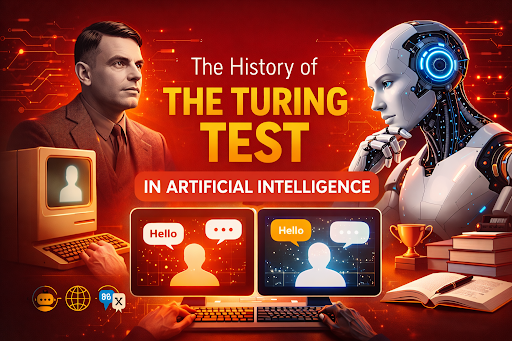
The Turing Test originated from a thought experiment known as the imitation game.
In this experiment, a human judge communicates through text with two unseen participants—one human and one machine. The judge asks questions and evaluates the responses. If the judge cannot reliably determine which participant is the machine, the machine is said to pass the test.
This approach introduced a practical framework for defining machine intelligence.
The Turing Test Artificial Intelligence History shows how this simple idea became one of the most widely discussed benchmarks in artificial intelligence research.
Although the imitation game focused primarily on conversation, it also influenced broader developments in natural language processing and AI reasoning systems.
These ideas later contributed to research described in Alan Turing Artificial Intelligence, where Turing’s philosophical ideas about computing and intelligence laid the foundation for modern AI.
Alan Turing and the Birth of Machine Intelligence
The origins of the Turing Test Artificial Intelligence History are closely tied to the life and work of Alan Turing, one of the most important figures in computer science.
Turing’s contributions to computing, cryptography, and theoretical mathematics shaped the early development of artificial intelligence.
Computing Machinery and Intelligence (1950)
In 1950, Alan Turing published a groundbreaking paper titled “Computing Machinery and Intelligence.”
In this work, Turing explored whether machines could exhibit intelligent behavior comparable to human thinking.
Rather than debating philosophical definitions of intelligence, Turing proposed the imitation game as a practical test.
The paper introduced key ideas that influenced the machine intelligence definition and inspired generations of AI researchers.
Turing also predicted that machines would eventually become capable of natural language conversation—a prediction that continues to influence the Turing Test Artificial Intelligence History today.
His ideas helped spark research that later emerged at the Dartmouth Conference, which officially launched artificial intelligence as a scientific field.
This moment marked the beginning of systematic research into machine reasoning, learning, and language processing.
Key Milestones in Turing Test History
The Turing Test Artificial Intelligence History includes several major milestones that illustrate how AI systems gradually improved their conversational abilities.
Over time, researchers developed increasingly sophisticated systems capable of simulating human dialogue.
Early Attempts: ELIZA and PARRY
One of the earliest attempts to create conversational machines was ELIZA, developed by Joseph Weizenbaum in the 1960s.
ELIZA simulated a psychotherapist using simple pattern-matching techniques. Although the system did not truly understand language, it often produced convincing responses.
For example, when a user typed:
“I feel sad.”
ELIZA might respond:
“Why do you feel sad?”
This simple conversational strategy created the illusion of understanding.
ELIZA became one of the earliest milestones in the Turing Test Artificial Intelligence History and influenced later developments in History of AI Assistants and Chatbots.
Another notable system was PARRY, created in the 1970s. PARRY simulated the behavior of a paranoid patient and was designed to interact with psychiatrists.
Although both ELIZA and PARRY relied on rule-based systems, they demonstrated that machines could engage in limited forms of conversation.
These experiments also highlighted the limitations of early AI systems.
The field would later experience setbacks during periods such as the AI Winters, when funding declined due to slow progress.
The Loebner Prize Era
In 1991, the Loebner Prize competition was established as an annual contest to evaluate chatbots based on the Turing Test.
Participants created conversational AI programs designed to convince judges that they were human.
Although no system has fully passed the Turing Test, the Loebner Prize significantly advanced research in conversational AI history.
Many chatbot developers used the competition to experiment with new techniques for natural language understanding.
These efforts contributed to progress in Evolution of Machine Learning Algorithms, where statistical models and machine learning techniques gradually replaced rule-based systems.
The Loebner Prize also helped popularize discussions about the Turing Test Artificial Intelligence History among researchers and the general public.
Modern AI and the Turing Test’s Relevance Today
The Turing Test Artificial Intelligence History entered a new phase with the rise of deep learning and large-scale neural networks.
Modern AI systems are capable of generating highly sophisticated language responses.
The Rise of Neural Networks and Modern Language Models
Advances described in The Rise of Neural Networks transformed how machines process language.
Deep neural networks enabled AI systems to learn linguistic patterns from massive datasets rather than relying on handcrafted rules.
These developments led to powerful systems capable of translation, summarization, and conversation.
Researchers also began training AI models using massive datasets described in Big Data and Artificial Intelligence Evolution, enabling machines to capture complex language structures.
Training approaches such as self supervised learning in artificial intelligence allow models to learn from unlabeled text data across the internet.
These innovations have dramatically accelerated progress in the Turing Test Artificial Intelligence History.
Generative AI and the Future of Conversational Intelligence
Modern generative AI models such as ChatGPT and Gemini demonstrate language capabilities that would have astonished early AI pioneers.
These systems rely on transformer architectures and massive neural networks capable of analyzing billions of words.
Their development is closely related to Large Language Models History, where increasingly powerful models have demonstrated remarkable conversational abilities.
While these systems may not truly “think,” they can generate human-like responses across a wide range of topics.
This raises new questions about whether the Turing Test remains the best measure of machine intelligence.
Some researchers argue that the test focuses too heavily on deception rather than genuine understanding.
Others believe it still provides valuable insight into human-machine interaction.
As AI technologies continue evolving, the Turing Test Artificial Intelligence History remains central to debates about machine cognition.
Many experts believe that breakthroughs in the Future of Artificial Intelligence Technology will eventually produce systems capable of passing even more advanced tests of intelligence.
Frequently Asked Questions (FAQs)
What is the Turing Test in artificial intelligence?
The Turing Test is a method proposed by Alan Turing to determine whether a machine can exhibit intelligent behavior indistinguishable from a human during conversation.
Why is the Turing Test important in AI history?
The Turing Test Artificial Intelligence History highlights how researchers have attempted to measure machine intelligence through human-like communication.
Has any AI passed the Turing Test?
While some systems have fooled judges in limited scenarios, no AI system has universally passed the Turing Test under rigorous conditions.
What role did ELIZA play in AI history?
ELIZA was one of the first conversational AI programs and demonstrated how machines could simulate human dialogue using simple pattern-matching techniques.
Are modern chatbots close to passing the Turing Test?
Modern generative AI systems produce highly convincing responses, but researchers still debate whether they truly understand language or simply generate patterns based on training data.
Conclusion
The Turing Test Artificial Intelligence History illustrates how a simple thought experiment shaped the evolution of artificial intelligence.
From Alan Turing’s original imitation game to modern conversational AI systems, the quest to build machines capable of human-like communication has driven decades of innovation.
Although the Turing Test remains controversial as a measure of intelligence, it continues to inspire research into natural language understanding, reasoning, and machine learning.
As AI technologies become more sophisticated, the line between human and machine conversation may continue to blur—bringing humanity closer to answering Turing’s original question: can machines truly think?