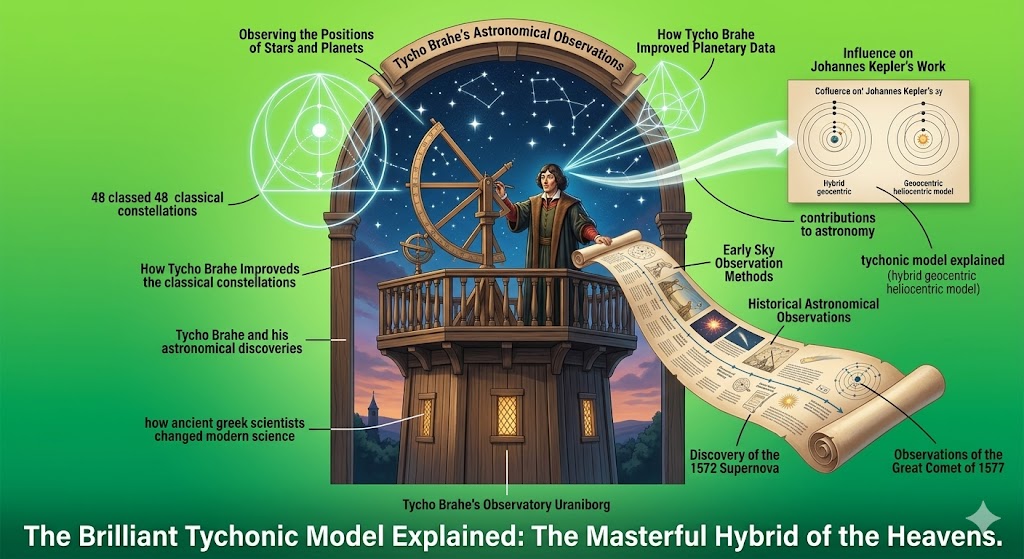
In the high-stakes theater of the Renaissance, the universe was a battlefield of ideas. On one side stood the ancient, comfortingly stable Earth-centered view, and on the other, the radical, sun-centered revolution. Amidst this chaos, the tychonic model explained a third way—a masterful compromise that sought to marry the mathematics of the future with the physics of the past. Created by the legendary Danish astronomer Tycho Brahe, this hybrid geocentric heliocentric model represents a fascinating chapter in human inquiry. By understanding the tychonic model explained, we see how one man attempted to preserve the stability of the Earth while acknowledging the undeniable logic of the Sun’s influence.
Introduction to the Tychonic Model
The tychonic model explained is perhaps the most sophisticated “middle ground” ever proposed in the history of science. Tycho Brahe was a man of immense ego and even greater data. He realized that the old Ptolemaic system was failing, yet he could not stomach the idea of a moving Earth. His solution was a stroke of geometric genius: he kept the Earth at the center of the universe but made all the other planets revolve around the Sun. This tychonic model explained a universe that satisfied both the religious requirements of a stationary Earth and the mathematical beauty of the copernicus solar system model. It was a bridge between two worlds, built on the most precise observations of the 16th century.
Background of the Geocentric and Heliocentric Debate
To truly get the tychonic model explained, one must understand the friction of the era. Since the time of the Greeks, the geocentric vs heliocentric debate had been simmering. The geocentric universe theory, championed by Aristotle and Ptolemy, was the standard. It argued that because we do not feel the Earth move, it must be stationary. However, by the mid-1500s, the copernicus solar system model had introduced a Sun-centered reality.
Copernicus’s idea was mathematically simpler but physically “absurd” to the people of the time. If the Earth moved, why didn’t birds fly off the trees? Why didn’t a dropped stone land miles away? Tycho Brahe sought to resolve this. He respected the math of the heliocentric view but clung to the physical “common sense” of the geocentric view. The tychonic model explained a way to have the best of both worlds without the “impossible” physics of a spinning Earth.
Structure of the Tychonic Model
In the tychonic model explained, the Earth sits at the absolute center of the universe. The Moon and the Sun revolve directly around the Earth. However, here is the twist: the other five known planets (Mercury, Venus, Mars, Jupiter, and Saturn) all revolve around the Sun.
This Tycho Brahe cosmological model created a “nested” system. While the Sun was the “center” for the planets, the Earth remained the “center” for the Sun. To the casual observer, this tychonic model explained a universe that looked and acted remarkably like the Copernican one, but without moving the Earth an inch. It was a masterpiece of Renaissance astronomy models, preserving the central importance of humanity while incorporating the new “Sun-centered” logic for the other planets.
How Planets Move in the Tychonic System
The way the tychonic model explained planetary motion was a direct response to the observational gaps of the time. In this system, the orbits of the planets (centered on the Sun) were allowed to intersect the orbit of the Sun (centered on the Earth).
Before Tycho, astronomers believed in “crystalline spheres”—solid, transparent shells that carried the planets. However, through tycho brahe’s astronomical observations, Tycho proved that comets passed through these areas. He concluded that the spheres did not exist. By removing these physical barriers, the tychonic model explained how orbits could cross each other without a collision. This was a radical departure from the classical astronomy tradition and a necessary step toward the fluid space we recognize in modern physics.
Differences Between the Tychonic and Copernican Models
While the tychonic model explained many of the same phenomena as the Copernican theory, the differences were profound:
- The Center: Copernicus had a sun centered solar system; Tycho had an Earth centered universe with a sun-centered sub-system.
- The Earth: In the copernicus’ heliocentric model, Earth is a planet in motion. In the Tychonic model, Earth is a stationary, unique entity.
- Stellar Parallax: This was the deciding factor for Tycho. If the Earth moved around the Sun, the positions of the stars should appear to shift (parallax). Because Tycho could not see this shift with his naked eye, the tychonic model explained that the Earth must be still.
[Image showing the concept of stellar parallax and why Tycho couldn’t detect it]
The tychonic model explained the “missing” parallax by keeping the Earth still, whereas Copernicus had to argue that the stars were simply too far away to see the shift—a claim Tycho found hard to believe.
Why Tycho Brahe Proposed the Tychonic Model
Tycho Brahe was the greatest observer of the pre-telescope era. At tycho brahe’s observatory uraniborg, he spent twenty years gathering data that was ten times more accurate than any before it. He proposed the Tychonic system because he was a “strict constructionist” of data.
He saw that the planets moved in ways that favored the Copernican math, but his measurements showed no evidence of Earth’s motion. Therefore, the tychonic model explained the data he could see while respecting the lack of data for what he couldn’t see. His work on how tycho brahe improved planetary data meant he couldn’t ignore the Sun’s role, but his commitment to observation kept him from accepting the Earth’s movement without proof.
Scientific Reception of the Tychonic System
For a brief period in the late 16th and early 17th centuries, the tychonic model explained the universe for a majority of the scientific community. It was particularly popular among Jesuit astronomers, who were skilled mathematicians but were forbidden by the Church from teaching that the Earth moved.
For these scholars, the tychonic model explained a way to do high-level science without conflicting with scripture. It was seen as the most “mighty” and “logical” choice because it saved the appearances of the sky without requiring a massive leap in physical intuition. During this time, the Tychonic system astronomy was the leading rival to the Copernican theory, proving that science often moves in increments rather than total leaps.
Decline of the Tychonic Model
The decline of the tychonic model explained began with the invention of the telescope. When Galileo saw the phases of Venus, it proved that Venus orbited the Sun—something the Tychonic model already predicted. However, as telescopes grew better, the sheer scale of the universe became apparent.
Eventually, the work of Johannes Kepler and Isaac Newton provided the final nail in the coffin. Kepler used the data from tycho brahe and his astronomical discoveries to prove that orbits were elliptical, and Newton provided the law of gravity that explained why things moved. Gravity showed that it was physically impossible for a massive Sun to revolve around a small Earth. While the tychonic model explained the geometry, it could not explain the physics of the “why.”
Historical Importance of the Tychonic Theory
Even though it was eventually proven wrong, the tychonic model explained a necessary path for the Scientific Revolution. It broke the “crystalline spheres” of the ancients and allowed astronomers to think about intersecting orbits. By studying how ancient greek scientists changed modern science, we see that they provided the geocentric foundation that Tycho eventually had to dismantle to make his hybrid work.
Tycho’s model proved that you could challenge parts of ancient authority while still searching for a stable truth. It was the training ground for Johannes Kepler, who took the tychonic model explained and the raw data from Uraniborg to finally unlock the secrets of the planets. Without this “brilliant” hybrid, the jump from Ptolemy to Newton might have been too great for the human mind to make in one go.
Frequently Asked Questions (FAQs)
1. What is the Tychonic model in simple terms?
The tychonic model explained a universe where the Earth is at the center, the Sun and Moon go around the Earth, and all other planets go around the Sun.
2. Why didn’t Tycho Brahe just believe in Copernicus?
Tycho could not detect “stellar parallax” (the shift of stars). He correctly reasoned that if the Earth moved, the stars should shift. Since he couldn’t see it, he concluded the Earth was still. He didn’t realize the stars were trillions of miles away.
3. Did the Tychonic model work for navigation?
Yes. For the level of technology available in the 1590s, the tychonic model explained the positions of the stars and planets just as accurately as the Copernican model.
4. How did Tycho Brahe’s data help Kepler?
Kepler used tycho brahe’s astronomical observations—specifically those of Mars—to realize that orbits were not perfect circles but ellipses. This eventually led to the modern heliocentric model.
5. Was the Tychonic model ever popular?
Yes, it was the preferred model for many scientists and the Catholic Church for nearly a century because it was mathematically sound but didn’t require the Earth to move.
Conclusion
The tychonic model explained a universe that was beautiful, complex, and ultimately, a transition. It serves as a reminder that science is not always a straight line from error to truth, but a series of brilliant compromises. Tycho Brahe was a giant of observation, and his contributions to astronomy provided the bridge that humanity needed to cross the gap between the ancient and modern worlds. By examining the tychonic model explained, we honor a time when the world was trying to find its footing among the stars. Tycho didn’t find the final answer, but he gave us the most accurate questions we had ever asked.