
Introduction
The question who created the sdlc is one of the most important topics in modern software development. The Systems Development Life Cycle is a structured process used to design, develop, test, and maintain software systems. It provides a clear framework that helps developers build reliable and efficient applications.
Understanding who created the sdlc requires exploring the early days of software development when projects often failed due to poor planning and lack of structure. Developers wrote code without defined processes, which led to delays, bugs, and system failures.
As software systems became more complex, engineers realized the need for a structured development approach. This led to the creation of SDLC, a methodology that organizes software development into clear stages such as planning, design, implementation, testing, deployment, and maintenance.
The development of SDLC is closely related to the history of software engineering, which explains how programming evolved into a disciplined engineering field.
Advancements in computing systems also influenced SDLC. Improvements in hardware and data handling made it necessary to manage large scale software projects effectively. These developments shaped the concept behind who created the sdlc and helped establish modern development practices.
Who Invented It
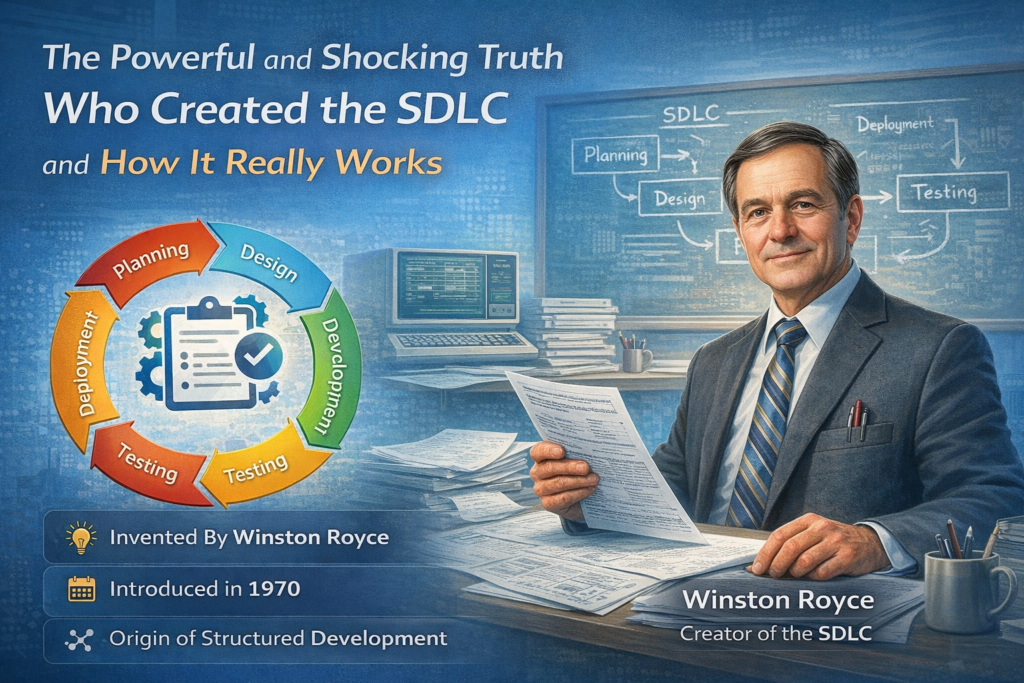
When discussing who created the sdlc, one of the most important figures is Winston Royce. He was a computer scientist who introduced the Waterfall Model in 1970.
Winston Royce described a structured approach to software development that divided the process into sequential phases. These phases included requirements gathering, design, implementation, testing, and maintenance.
Although Royce originally presented the Waterfall Model as an example of a flawed approach, his work became widely adopted and formed the foundation of the SDLC framework.
The contribution of Winston Royce plays a key role in answering the question who created the sdlc because it introduced the idea of organizing software development into distinct stages.
The evolution of SDLC was also influenced by earlier practices in systems analysis and design. These practices helped engineers understand user requirements and build systems that met specific needsThe concept is also connected with the history of sdlc, which documents how development methodologies evolved over time.
Through these innovations, SDLC became a standard approach used in software project management.
When It Was Invented
The concept of SDLC was formally introduced in 1970 when Winston Royce published his paper on software development processes.
The year 1970 is considered a major milestone in understanding who created the sdlc because it marked the beginning of structured software development.
During this period the software industry was facing significant challenges. Projects often exceeded budgets, missed deadlines, and failed to meet user requirements.
This period is sometimes referred to as the software crisis, which led to the need for better planning and development methodologies.
The introduction of SDLC provided a solution by defining clear stages and processes for software development.
The model introduced concepts such as feasibility study, system design, coding, testing, and maintenance. These stages helped developers manage projects more effectively.
The influence of SDLC also extended to project management tools such as Gantt charts, which helped teams track progress and milestones.
The year 1970 therefore represents a turning point in the story of who created the sdlc.
How It Worked
To understand who created the sdlc, it is important to understand how the SDLC process works.
SDLC divides software development into structured phases. Each phase has specific goals, deliverables, and outcomes.
The first phase is planning, where teams conduct feasibility study and define project objectives. This stage determines whether a project is viable.
The next phase is requirements gathering, where developers collect user needs and define system specifications.
The design phase follows, where system architecture and software structure are planned. This includes defining modules, interfaces, and workflows.
The implementation phase involves writing source code and developing the software system.
Testing is a critical phase where developers identify and fix errors through debugging. Quality assurance ensures that the system meets requirements.
Deployment is the stage where the software is released to users. After deployment the maintenance phase begins, where updates and improvements are made.
Modern SDLC models also include iterative development and prototyping approaches. These methods allow developers to refine systems continuously.
The SDLC process provides a clear framework that ensures software quality and reliability. These practices demonstrate how the concept behind who created the sdlc transformed software development.
Why It Was Important
The introduction of SDLC revolutionized software development.
Before SDLC existed projects were often chaotic and unpredictable. Developers worked without clear guidelines, leading to errors and delays.
Understanding who created the sdlc highlights how structured processes improved software quality and efficiency.
SDLC allowed teams to plan projects effectively and manage resources efficiently. It ensured that software systems were built according to user requirements.
The model also improved communication among developers, managers, and stakeholders.
SDLC introduced quality assurance practices that reduced bugs and improved system reliability.
The importance of SDLC extends to large scale projects such as enterprise systems, cloud platforms, and mobile applications.
The development of SDLC is closely connected with the history of devops, which focuses on collaboration and continuous delivery in modern software development.
Without SDLC it would be difficult to manage complex software systems in today’s digital world.
How It Evolved Today
SDLC has evolved significantly since its introduction in 1970.
Modern development practices include agile methodologies that focus on flexibility and collaboration. Agile development allows teams to adapt to changing requirements quickly.
DevOps practices integrate development and operations to improve efficiency and reduce deployment time.
Modern SDLC also includes models such as the spiral model and V model, which focus on risk management and quality assurance.
Cloud computing and distributed systems have transformed how software is developed and deployed.
Artificial intelligence and automation tools are now integrated into SDLC to improve testing and development processes.
The growth of modern computing systems supported by the Evolution of GPUs has enabled advanced applications and large scale data processing.
In the final stage of evolution, improvements in hardware driven by the evolution of transistors and enhanced data handling enabled by the rise of storage technology have made SDLC more efficient and scalable.
The journey that began with the ideas behind who created the sdlc continues to shape modern software development practices.
Frequently Asked Questions (FAQs)
Who created the SDLC?
Winston Royce is widely credited with introducing the structured approach that led to the development of SDLC.
What is SDLC?
SDLC is a structured process used to design, develop, test, and maintain software systems.
Why is SDLC important?
SDLC ensures that software projects are completed efficiently and meet quality standards.
What are the main phases of SDLC?
The main phases include planning, design, development, testing, deployment, and maintenance.
How has SDLC evolved?
SDLC evolved from the Waterfall Model to modern agile and DevOps methodologies.
The SDLC Revolution and Structured Software Development 1970 to Present
The story behind who created the sdlc represents a powerful transformation in software development history. From the introduction of structured processes to modern agile practices SDLC has become a cornerstone of software engineering.
The contributions of Winston Royce in 1970 provided a foundation for decades of innovation in software development.
Today SDLC continues to evolve with new technologies and methodologies that improve efficiency, scalability, and reliability.
The legacy of who created the sdlc reminds us that structured thinking and disciplined processes are essential for building high quality software systems.