Introduction
The question who invented computer networking is one of the most exciting and important topics in the history of technology. Computer networking is the foundation of the digital world because it allows computers to communicate, share information, and connect people across the globe. Without networking there would be no internet, cloud computing, online services, or global digital communication.
Understanding who invented computer networking requires exploring the early days of computer research when scientists attempted to connect separate machines so they could exchange information. In the early decades computers worked independently and could not communicate with each other. Engineers quickly realized that connecting computers could dramatically improve collaboration and data sharing.
Early networking research was supported by universities and government organizations that wanted to develop systems capable of exchanging data across long distances. The development of networking also depended on improvements in hardware and electronics made possible through the evolution of transistors. These smaller and faster electronic components allowed computers to become more powerful and capable of supporting network communication.
Another key technological development was the rise of storage technology which enabled computers to store and transfer large amounts of information between systems. As data storage expanded networking became increasingly valuable because information could be shared instantly between connected machines.
The story of who invented computer networking reveals a fascinating journey of innovation, collaboration, and technological breakthroughs that eventually led to the global internet we use today.
Who Invented It
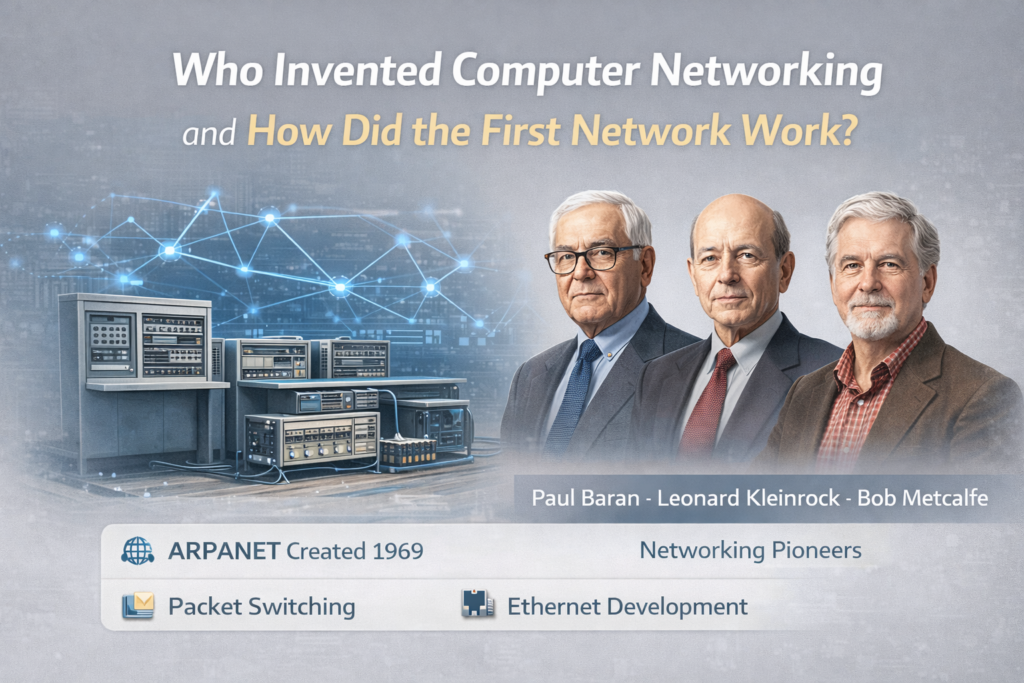
The answer to who invented computer networking involves several pioneers who contributed to early networking technology. One of the most influential innovators was Paul Baran, an engineer who worked on the concept of packet switching during the nineteen sixties.
Packet switching allowed information to be divided into small pieces called packets that could travel across different routes in a network. This revolutionary concept made data transmission more reliable and efficient. It became one of the fundamental principles behind computer networking.
Another important contributor to who invented computer networking was Leonard Kleinrock, a scientist whose research on network communication and queueing theory helped make packet switching practical.
These ideas led to the creation of ARPANET, the first operational computer network that connected research institutions across the United States. ARPANET became a critical milestone in the history of computer networking and demonstrated that computers could successfully communicate through a network.
In addition, Bob Metcalfe played an important role in networking development by inventing Ethernet technology. Ethernet made it possible for computers within the same building or local area network to communicate efficiently.
These innovators collectively helped answer the historical question who invented computer networking and created the foundation for modern digital communication systems.
When It Was Invented
The first successful computer network was created in 1969 when ARPANET connected computers at several American universities. The year 1969 represents a major milestone in the story of who invented computer networking.
The first connection was established between the University of California Los Angeles and the Stanford Research Institute. This connection allowed researchers to send data between computers using packet switching technology.
This event marked the birth of network communication and demonstrated that computers could communicate across long distances.
Throughout the nineteen seventies researchers expanded ARPANET and added more nodes to the network. Each node represented a computer connected through communication links.
Advances in electronics driven by the evolution of transistors allowed networking hardware to become smaller, faster, and more reliable.
Networking systems also began to rely on improved data storage technologies supported by the rise of storage technology, which enabled networks to manage larger amounts of information.
The year 1969 therefore became a defining moment in the timeline of who invented computer networking.
How It Worked
Understanding who invented computer networking also requires understanding how early networks functioned.
The first networks relied on packet switching technology. When a computer sent information the data was divided into smaller packets. Each packet traveled through the network independently before being reassembled at the destination computer.
Network devices such as routers and switches directed these packets across communication paths. Routers determined the best route for transmitting data while switches connected devices within local networks.
Early networks used hubs and network interface cards to connect computers. A network interface card allowed a computer to communicate with the network infrastructure.
Each device connected to the network had a unique MAC address that allowed network equipment to identify it.
Communication across networks also depended on transmission technologies such as modems and fiber optics. Fiber optic cables allowed data to travel long distances at extremely high speeds.
Networking engineers also developed different network topology structures such as star topology and mesh topology. These structures determined how computers were connected within the network.
Data communication across networks required careful management of bandwidth and latency. Bandwidth referred to the amount of data that could be transmitted while latency measured the time required for data to travel between devices.
These technologies illustrate how the concept behind who invented computer networking evolved into a powerful communication system used worldwide.
Why It Was Important
The invention of computer networking transformed the way computers operate and interact with each other.
Before networking existed computers functioned independently and could not share information easily. Data had to be transferred manually using physical storage devices.
The innovations described in who invented computer networking changed this dramatically by allowing computers to communicate instantly across networks.
Networking technology made it possible to build large scale computing systems that could share resources and collaborate on complex tasks.
Businesses gained the ability to connect offices across cities and countries. Universities could collaborate on scientific research using shared computing resources.
Networking also played a central role in the development of the internet which transformed global communication.
The growth of network infrastructure also contributed to the development of large scale computing facilities documented in the history of data centers.
As networks expanded new technologies such as intranet and extranet systems allowed organizations to create private communication platforms.
The revolutionary impact of networking technology demonstrates why the question who invented computer networking remains an essential part of computing history.
How It Evolved Today
Computer networking has evolved dramatically since the early ARPANET experiments.
Today modern networks connect billions of devices including computers, smartphones, servers, and smart home systems.
Wireless networking technologies such as Wi Fi allow devices to connect without physical cables. Wi Fi technology made networking accessible to homes and businesses around the world.
High speed fiber optic networks now transmit massive amounts of data across continents.
Networking infrastructure also includes advanced security systems designed to protect data from cyber threats. The growth of networking security is closely related to the history of cybersecurity.
Modern networks support emerging technologies such as cloud computing, artificial intelligence, and the Internet of Things where everyday devices communicate automatically.
The continued expansion of global communication networks also relies on powerful hardware components influenced by the Evolution of GPUs, which support high performance computing and network processing tasks.
These technological advances demonstrate how the innovations behind who invented computer networking continue to influence modern communication systems.
Frequently Asked Questions (FAQs)
Who invented computer networking?
Computer networking was pioneered by scientists such as Paul Baran, Leonard Kleinrock, and Bob Metcalfe, whose research led to packet switching and Ethernet technology.
What was the first computer network?
ARPANET was the first operational computer network and connected research institutions in 1969.
What is packet switching?
Packet switching is a method of sending data across networks by dividing information into smaller packets that travel independently.
What devices are used in computer networking?
Networking devices include routers, switches, hubs, and network interface cards that connect computers and manage data transmission.
Why is networking important?
Computer networking allows devices to share data, communicate instantly, and access global information resources.
The Networking Revolution That Connected the Digital World
The story behind who invented computer networking represents one of the most revolutionary moments in computing history. Early pioneers developed innovative communication systems that allowed computers to share information across networks.
From the first ARPANET connection in 1969 to modern global networks that connect billions of devices the evolution of networking has transformed society.
Today networking technology powers the internet, cloud computing, online education, digital commerce, and countless other innovations.
The visionary ideas of networking pioneers continue to influence modern communication systems and drive the expansion of digital connectivity.
The answer to who invented computer networking reminds us that collaboration, innovation, and technological curiosity can reshape the world.