Introduction
The medical profession is unique in that it is governed not just by law and science, but by a profound moral compass that has remained largely intact for over two millennia. At the heart of this ethical framework is the Hippocratic Oath and its historical significance. Created at a time when medicine was transitioning from a world of superstition to one of rational inquiry, the Oath provided a sacred bond between the healer, the patient, and society. It established that a physician’s power must be checked by an unwavering commitment to humanity, ensuring that medical knowledge is used exclusively to preserve life and alleviate suffering.
What Is the Hippocratic Oath?
The Hippocratic Oath is a solemn pledge traditionally taken by physicians upon entering the medical profession. While the exact origins of the text are debated, it is widely attributed to the school of Hippocrates: Father of Medicine. In its original Greek form, the Oath was an invocation to the gods—Apollo, Asclepius, Hygieia, and Panacea—witnessing the doctor’s promise to uphold specific professional standards.+1
The Oath was likely a rite of passage for students within the Hippocratic guild on the island of Kos. It wasn’t just a list of rules; it was a defining document that transformed the “healer” from a wandering craftsman into a professional member of a disciplined body. It acted as a companion piece to The Hippocratic Corpus, providing the moral soul to the clinical techniques described in those medical scrolls.
Key Principles of the Hippocratic Oath
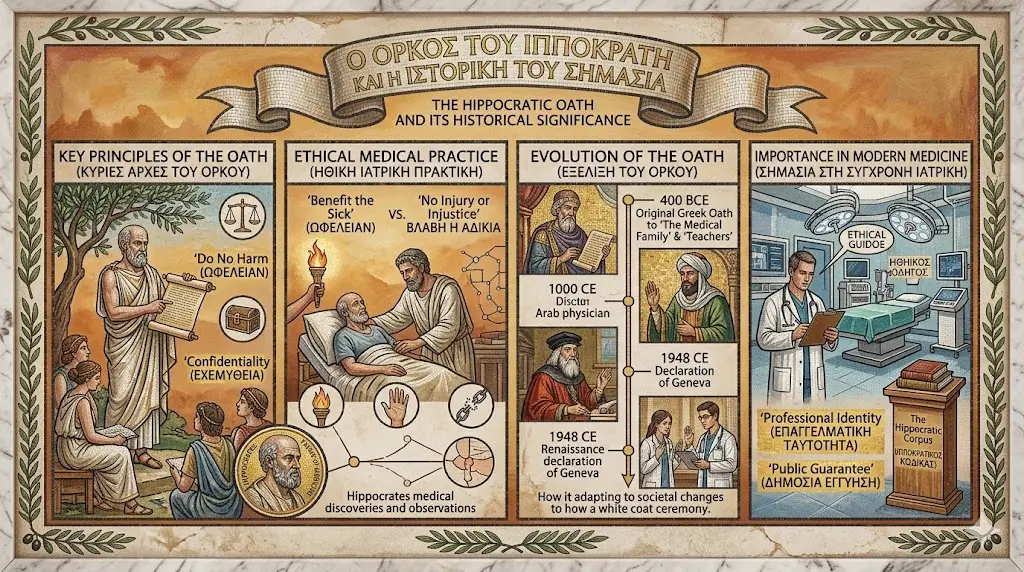
The historical weight of the Oath rests on its core pillars, many of which remain the standard for bioethics in the 21st century. These principles emerged from the same era as Hippocrates medical discoveries and observations, reflecting a deep understanding of human vulnerability.
1. Do No Harm
The most famous principle associated with the Oath is primum non nocere, or “first, do no harm.” While this exact Latin phrase appeared later, the original Greek text explicitly forbids the physician from administering “deadly drugs” or performing procedures beyond their competence. This was a revolutionary concept in the ancient world, where a “doctor” could easily be a poisoner for hire. By removing the possibility of harm, the Oath established the physician as a safe haven for the sick.
2. Patient Confidentiality
The Oath includes a strict promise of secrecy: “Whatsoever I shall see or hear in the course of my profession… I will never divulge.” This is the ancestor of modern HIPAA laws. Hippocrates recognized that for a doctor to truly understand an illness, the patient must be able to speak freely without fear of social or legal repercussions. This trust is the bedrock of the clinical relationship.
3. Ethical Medical Practice
Beyond treatment, the Oath addresses the personal conduct of the doctor. It prohibits sexual relationships with patients and their family members, emphasizing that the physician’s entry into a home is a sacred trust. It also warns against “mischief” and corruption, ensuring that the physician remains focused solely on the recovery of the ill.
4. Respect for Teachers and Knowledge
The original Oath begins with a section on the “Medical Family.” It requires the student to treat their teacher as a parent and to share their knowledge with the next generation for free. This ensured that medical wisdom was preserved and passed down through a lineage of dedicated practitioners rather than being sold as a trade secret.
Evolution of the Oath
The Hippocratic Oath and its historical significance are not found in its stagnation, but in its ability to adapt. Throughout the centuries, the Oath has been modified to reflect changing societal values. In the Middle Ages, the references to Greek gods were often replaced with Christian or Islamic invocations.
In 1948, following the horrors of the medical experiments during World War II, the World Medical Association adopted the Declaration of Geneva. This “modernized” Oath stripped away ancient prohibitions—such as those against surgery or certain reproductive procedures—while reinforcing the humanitarian commitment to treat all patients regardless of race, religion, or political affiliation. Today, most medical schools use a version that emphasizes the “art” of medicine as much as the science.+1
Importance in Modern Medicine
Why do we still talk about an ancient Greek pledge in an age of robotic surgery and genomic mapping? The answer lies in the human element of healthcare. While Hippocrates medical discoveries and observations have been updated by modern technology, the emotional and ethical needs of a patient remain identical to those in 400 BCE.
In modern medicine, the Oath serves as:
- A Professional Identity: It marks the transition from a student to a practitioner with life-altering responsibilities.
- A Public Guarantee: It assures society that doctors are governed by a code that transcends personal profit or political pressure.
- An Ethical Guide: In complex situations involving end-of-life care or genetic ethics, the core principle of “benefit the sick” remains the ultimate North Star.
Frequently Asked Questions (FAQs)
Do all doctors take the original Hippocratic Oath today?
No. Most modern medical schools use a revised version, such as the Declaration of Geneva or a version written by Louis Lasagna in 1964, which is more relevant to contemporary legal and social standards.
Does the original Oath really forbid surgery?
Yes. The original text says, “I will not use the knife, even upon those suffering from stone, but will leave this to those who are trained in it.” This was likely because, in ancient times, surgery was a separate, highly dangerous craft often practiced by barbers rather than physicians.
What is the ‘Declaration of Geneva’?
It is a modern humanitarian version of the Hippocratic Oath adopted after WWII to ensure that doctors never again participate in crimes against humanity or unethical human experimentation.
How does the Oath relate to ‘The Hippocratic Corpus’?
While The Hippocratic Corpus provides the clinical “how-to” of ancient medicine, the Oath provides the “why.” One is a textbook of science; the other is a manual of morality.
Conclusion
The Hippocratic Oath and its historical significance endure because they address a fundamental truth: medicine is a power that can be used for immense good or catastrophic evil. By tethering medical skill to a moral anchor, the Father of Medicine ensured that the history of healing would be a history of compassion. Whether recited in ancient Greek under an olive tree or in English at a modern university graduation, the Oath remains the ultimate promise of the physician—to serve as a guardian of life, a protector of privacy, and a beacon of hope for the suffering.