Imagine standing on a Greek island over 2,200 years ago, looking at the sky without a telescope, a computer, or even a simple lens. Most people of that era saw the Sun and Moon as divine entities or small discs of light orbiting a flat, stationary Earth. However, one man saw a giant geometric puzzle. How Aristarchus Measured the Distance to the Sun and Moon is not just a story of ancient history; it is the story of the birth of trigonometry and the first time humanity truly grasped the staggering scale of our solar system.
The Visionary: Aristarchus of Samos
To appreciate the magnitude of this feat, we must look at the man behind the math. Aristarchus of Samos was an ancient Greek astronomer and mathematician who lived in the third century BCE. While others were content with philosophical explanations for the heavens, he sought physical dimensions. He was a pioneer who refused to accept that the universe was small. His curiosity eventually led to Aristarchus’ Ideas regarding the true structure of the cosmos, which challenged every religious and scientific belief of his time.
The Half-Moon Method: A Stroke of Genius
The primary tool used in How Aristarchus Measured the Distance to the Sun and Moon was the observation of the Moon during its first or third quarter—the phase we call the “half-moon.”
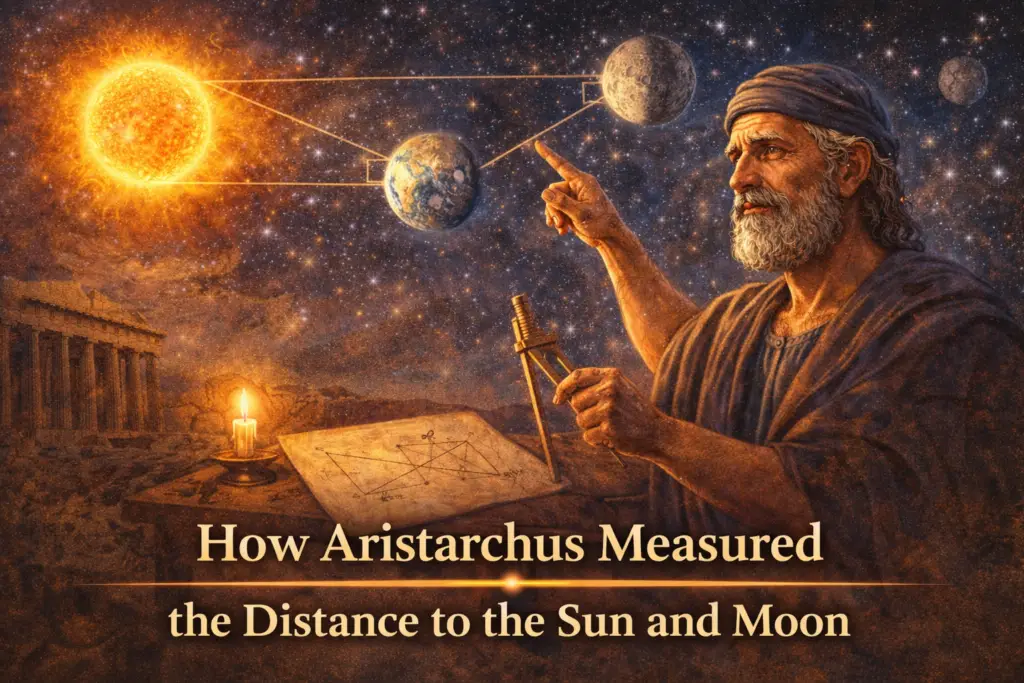
Aristarchus realized a fundamental geometric truth: when the Moon is exactly half-illuminated by the Sun, the Earth, Moon, and Sun must form a perfect right-angled triangle. In this alignment, the 90-degree angle is located at the Moon.
By observing the Moon at this precise moment, Aristarchus sought to measure the angle between the Moon and the Sun as seen from Earth. If he could determine this angle (let’s call it angle alpha), he could use basic trigonometry to calculate the ratio of the distance to the Moon versus the distance to the Sun.
The Mathematical Strategy
The brilliance of the strategy lay in its simplicity. Aristarchus measured the angle between the Sun and the half-moon to be 87°. Using this, he calculated that the Sun must be between 18 and 20 times farther away from the Earth than the Moon is.
While his measurement was technically inaccurate (the actual angle is about 89.85°, making the Sun 400 times farther away), the logic was flawless. The discrepancy occurred because it is nearly impossible for the human eye to detect the exact moment the Moon is perfectly “half” full, and measuring angles of that precision without modern instruments was impossible.
However, this calculation led him to an even bigger realization. If the Sun was 20 times farther away, and it appeared to be the same size as the Moon in the sky (which we see during a total solar eclipse), then the Sun must also be 20 times larger in physical diameter than the Moon. This was the first time anyone had proven that the Sun was a massive body, far larger than the Earth.
Determining the Sizes of the Sun and Moon
Aristarchus didn’t stop at distances. He utilized lunar eclipses to determine the actual sizes of these celestial bodies compared to the Earth.
During a lunar eclipse, the Earth passes between the Sun and the Moon, casting a shadow on the lunar surface. Aristarchus observed that the width of the Earth’s shadow was roughly twice the diameter of the Moon. Through a series of complex geometric proportions, he estimated that the Moon’s diameter was about one-third that of the Earth.
By combining this with his distance ratio, he concluded that the Sun was much larger than the Earth. This specific discovery is what likely birthed Aristarchus’ Heliocentric Theory. He reasoned that it was physically absurd for a massive object like the Sun to revolve around a smaller object like the Earth. Therefore, the Earth must be the one in motion.
Why This Discovery Was Important
The impact of How Aristarchus Measured the Distance to the Sun and Moon cannot be overstated. It represents the first “Cosmic Distance Ladder.”
- Shift in Perspective: It moved humanity away from a small, Earth-centered universe to a vast, Sun-centered system.
- Foundation of Trigonometry: His work “On the Sizes and Distances of the Sun and Moon” is one of the earliest examples of applying geometry to physical space.
- Scientific Method: He used observable data and logical deduction rather than myth, laying the groundwork for future giants like Copernicus and Galileo.
Challenges and Limitations of Ancient Observation
We must remember that Aristarchus was working in a vacuum of technology. He lacked a clock to time the phases of the moon precisely and a transit circle to measure degrees with high accuracy.
His estimate that the Sun was only 20 times further away was “wrong” by modern standards, but in the context of 270 BCE, it was a revolutionary expansion of the known world. Before him, many believed the Sun was only a few miles away or perhaps the size of a large city. Aristarchus proved it was a world-sized entity.
Influence on the Scientific Revolution
For centuries, the geocentric model of Ptolemy dominated the world, and Aristarchus’ Ideas were largely ignored because they were too radical. However, during the Renaissance, Nicolaus Copernicus studied the ancient Greeks.
Copernicus was inspired by the fact that an ancient Greek had already mathematically suggested that the Earth moved. Without the initial spark of How Aristarchus Measured the Distance to the Sun and Moon, the transition to modern astronomy might have taken many more centuries.
Frequently Asked Questions (FAQs)
What angle did Aristarchus measure between the Sun and the Moon?
He measured an angle of 87 degrees. The true angle is 89.85 degrees. This small error in measurement led to a large error in the calculated distance, but the method itself was perfect.
How did he know the Sun was larger than the Earth?
By measuring the Earth’s shadow during a lunar eclipse and comparing it to the Moon, he realized the Sun had to be much larger than the Earth to cast such a shadow over that distance.
Why did people reject his theory for 1,800 years?
Mainly because of “stellar parallax.” Ancient astronomers argued that if the Earth moved, the stars should appear to shift. Because the stars are so far away, this shift is invisible to the naked eye, leading them to believe the Earth was stationary.
What instruments did Aristarchus use?
He likely used a gnomon (a vertical rod) and a scaphe (a sundial with a bowl-shaped face) to measure shadows and angles, alongside simple geometric sight-lines.
Conclusion
The legacy of How Aristarchus Measured the Distance to the Sun and Moon is a testament to the power of human reason. He didn’t need a spaceship to travel to the stars; he used the laws of triangles to reach them. While his numbers weren’t perfect, his courage to look at the universe as a measurable, physical space changed the course of science forever. He was the first to realize that we live in a massive solar system where we are not the center, but a participant in a grand celestial dance around a giant star.