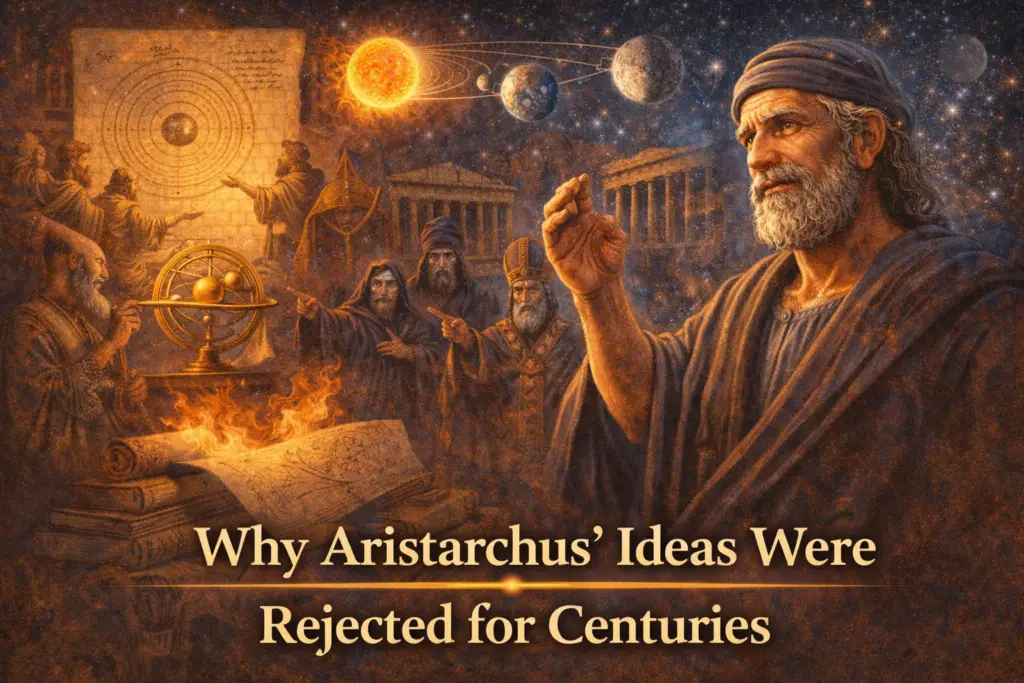
History is often written by the victors, and in the world of ancient science, the “victors” were those whose theories aligned with common sense and the prevailing philosophical status quo. While we today celebrate the brilliance of the heliocentric model, it is a staggering historical fact that the truth remained hidden in plain sight for nearly two millennia. Understanding Why Aristarchus’ Ideas Were Rejected requires us to step back into a world where the Earth felt solid and unmoving, and where the heavens were seen as a perfect, divine realm.
The Visionary Ahead of His Time
In the 3rd century BCE, a mathematician named Aristarchus of Samos proposed a universe that looked remarkably like our modern one. He argued that the Earth was not the center of the universe but was instead a planet that rotated on its axis and revolved around a stationary Sun. This was the birth of Aristarchus’ Heliocentric Theory, a concept so radical that it wouldn’t be fully accepted until the time of Copernicus and Galileo, eighteen hundred years later. Despite the mathematical elegance of his work, the ancient world simply wasn’t ready to let go of the Earth as the heart of all creation.
Dominance of the Geocentric Model
The most significant hurdle Aristarchus faced was the overwhelming success of the Geocentric (Earth-centered) model. This system was backed by the two most influential thinkers of antiquity: Aristotle and, later, Claudius Ptolemy.
Aristotle’s physics dictated that the Earth was made of “heavy” elements (earth and water) that naturally fell toward the center of the universe. In contrast, the heavens were made of “ether,” a weightless, divine substance. To the Greeks, it was physically impossible for a massive, heavy Earth to be hurtling through space. Furthermore, the Geocentric model was highly intuitive. When you stand outside, you do not feel the Earth spinning at 1,000 miles per hour, nor do you feel it orbiting the Sun. You see the Sun rise and set. For the average person and the scholar alike, their senses told them the Earth was still.
Lack of Observational Proof: The Parallax Problem
Perhaps the most “scientific” reason Why Aristarchus’ Ideas Were Rejected was the absence of a phenomenon known as stellar parallax.
If the Earth truly moved in a giant circle around the Sun, astronomers argued that the positions of the stars should change relative to one another as we viewed them from different sides of our orbit. Because the stars are trillions of miles away, this shift is so microscopic that it cannot be seen with the naked eye. Aristarchus correctly countered that the stars were simply too far away for the shift to be noticed. However, to the ancient mind, the idea of a universe that vast was unthinkable. They chose the simpler explanation: the stars didn’t move because the Earth didn’t move.
Philosophical and Religious Opposition
In ancient Greece, science was not yet separated from philosophy and religion. The Sun-centered model was not just a mathematical disagreement; it was seen as a threat to the cosmic order. The Stoic philosopher Cleanthes even suggested that Aristarchus should be charged with impiety for “setting in motion the hearth of the universe.”
The Earth was seen as the stable home of humanity, and moving it into the chaotic heavens felt like an affront to the gods. This cultural bias created a “mental ceiling” that prevented even the most brilliant minds from entertaining Aristarchus’ Ideas as anything more than a mathematical curiosity.
The Mathematical Complexity of Ptolemy
By the 2nd century CE, Claudius Ptolemy had perfected the Geocentric model. To explain why planets sometimes appear to move backward in the sky (retrograde motion), he introduced “epicycles”—circles within circles. While incredibly complex and technically “wrong,” Ptolemy’s system worked for the time. It could predict eclipses and planetary positions with enough accuracy for sailors and farmers. Because it worked and fit the existing philosophical framework, there was no practical “need” to switch to a heliocentric view.
Challenging the Scale of the Universe
Another reason for the rejection was the sheer scale required by the heliocentric model. Through his work, How Aristarchus Measured the Distance to the Sun and Moon, he proved that the Sun was significantly larger than the Earth.
Logically, Aristarchus realized that the larger body should be at the center. However, this required the universe to be millions of times larger than previously thought. Ancient Greeks preferred a “closed,” small, and manageable universe. The vacuum and vastness suggested by Aristarchus were terrifying and seemed unnecessary to explain the world around them.
The Influence of Authority
Once the Geocentric model became the “official” science of the Roman Empire and, later, was integrated into the theology of the Christian Church, it became almost impossible to challenge. Authority took the place of inquiry. For centuries, scholars spent their time translating and admiring Aristotle and Ptolemy rather than questioning the fundamental premises of their work. The “Age of Authority” meant that Why Aristarchus’ Ideas Were Rejected was no longer a matter of evidence, but a matter of tradition.
FAQs
Why did Aristarchus think the Sun was at the center?
He realized through his geometric calculations that the Sun was much larger than the Earth. He believed it was more logical for the smaller object to revolve around the larger one.
What is stellar parallax?
It is the apparent shift of a star’s position against a distant background as seen from opposite sides of Earth’s orbit. Because stars are so far away, this shift wasn’t measured until the 19th century.
Who finally proved Aristarchus was right?
Nicolaus Copernicus revived the theory in the 1500s, but it was Galileo’s telescope observations and Kepler’s mathematical laws of planetary motion that finally proved the heliocentric model.
Did Aristarchus’ work influence Copernicus?
Yes. Copernicus was aware of Aristarchus of Samos and actually mentioned him in an early draft of his work, recognizing that the “Sun-centered” idea had ancient roots.
Conclusion
The story of Why Aristarchus’ Ideas Were Rejected is a powerful lesson in the psychology of discovery. It shows us that having the right answer is not enough; the world must also be ready to hear it. For 1,800 years, humanity clung to a comfortable, Earth-centered illusion because it fit our senses, our religions, and our egos. Aristarchus’ failure to convince his peers was not a failure of his math, but a testament to how difficult it is to change a fundamental worldview. Today, we remember him not as a failure, but as the “Copernicus of Antiquity”—the man who saw the truth long before the rest of the world was ready to open its eyes.