Introduction
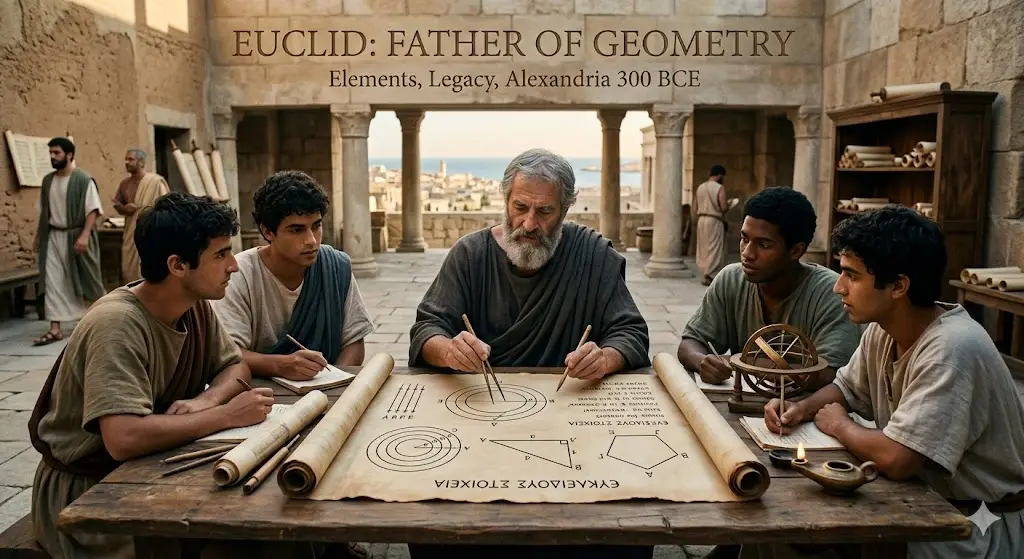
Euclid, often called the Father of Geometry, was a Greek mathematician whose work laid the foundation for modern mathematics. Born around 300 BC in Alexandria, Egypt, Euclid’s influence has spanned more than two millennia, shaping how we understand geometry, logic, and mathematical proofs. His systematic approach to mathematics through logical reasoning and rigorous proofs established principles that are still taught in classrooms worldwide.
The cornerstone of his work, Elements of Geometry, remains one of the most influential textbooks in history. Through his discoveries and theories, Euclid revolutionized mathematics and influenced science, philosophy, and architecture.
Early Life and Historical Context
Details about Euclid’s personal life are sparse, but historical accounts place him in Alexandria during the reign of Ptolemy I. Alexandria was a hub of learning, housing the famous Library of Alexandria, which attracted scholars from across the Mediterranean.
Euclid’s education in this intellectual environment allowed him to absorb knowledge from earlier mathematicians like Pythagoras, Eudoxus, and Theaetetus. By systematizing the existing knowledge of geometry, Euclid created a comprehensive framework that would endure for centuries.
Euclid’s Elements: The Foundation of Geometry
Euclid’s most famous work, Elements of Geometry, is a compilation of 13 books covering topics from plane geometry to number theory. It introduced a structured approach to mathematics using:
- Definitions
- Postulates
- Axioms
- Propositions (Theorems)
This framework allows mathematicians to derive complex theorems from a small set of assumptions. The Elements became the standard geometry textbook for over 2,000 years, illustrating Euclid’s lasting impact.
Euclid’s Work in Number Theory
Beyond geometry, Euclid contributed significantly to number theory, exploring concepts like:
- Prime numbers
- Greatest common divisors (GCD)
- Perfect numbers
He introduced the Euclidean Algorithm, a method still used today to calculate GCD efficiently. His work in number theory not only influenced mathematics but also laid groundwork for modern cryptography.
Euclid’s Contributions to Logic and Proofs
Euclid emphasized logical reasoning and structured proofs, which became a cornerstone of scientific methodology. His approach involved:
- Starting from clearly defined axioms and postulates
- Using deductive reasoning to derive theorems
- Ensuring every proposition is proven based on previously established truths
This method influenced not just mathematics but philosophy and the scientific method for centuries.
Euclid’s Postulates and Axioms Explained
One of Euclid’s most influential contributions is his postulates and axioms, which form the foundation of geometry. Among the famous ones are:
- A straight line can be drawn connecting any two points.
- A finite straight line can be extended indefinitely.
- A circle can be drawn with any center and radius.
- All right angles are equal.
- The parallel postulate (unique in leading to modern non-Euclidean geometries).
These postulates influenced not only mathematics but also astronomy, architecture, and engineering.
How Euclid Influenced Modern Mathematics
Euclid’s methods and discoveries shaped modern mathematics in multiple ways:
- Standardizing mathematical notation
- Inspiring Renaissance mathematicians like Kepler and Newton
- Influencing the development of non-Euclidean geometry
- Laying the groundwork for algebra and calculus
Euclid’s Legacy in Science and Architecture
Euclid’s impact extended beyond mathematics:
- Architecture: His geometric principles influenced the design of temples, amphitheaters, and monuments.
- Science: His logical approach inspired scientific methods used by Galileo and Newton.
- Education: Euclid’s Elements remained the main teaching text for geometry until the 20th century.
The enduring impact of Euclid’s legacy is seen in classrooms, laboratories, and architectural marvels worldwide.
Frequently Asked Questions (FAQs)
1. Why is Euclid called the Father of Geometry?
Euclid is called the Father of Geometry because he organized and systematized geometric knowledge in his famous work Elements of Geometry. His logical structure of definitions, axioms, and proofs became the foundation of classical geometry.
2. What is Euclid’s most important work?
Euclid’s most important work is the Elements, a 13-book mathematical treatise that shaped the study of geometry and mathematics for over 2,000 years.
3. What are Euclid’s postulates?
Euclid’s postulates are basic assumptions that form the foundation of geometry. They include principles about straight lines, circles, right angles, and the famous parallel postulate.
4. Did Euclid contribute to number theory?
Yes, Euclid made significant contributions to number theory, including the Euclidean Algorithm for finding the greatest common divisor and early studies of prime numbers.
5. How did Euclid influence modern mathematics?
Euclid influenced modern mathematics by introducing a logical proof-based system. His deductive reasoning method became essential in geometry, algebra, calculus, and scientific research.
6. Where did Euclid live and work?
Euclid lived and worked in Alexandria, Egypt, around 300 BC during the reign of Ptolemy I.
7. Is Euclidean geometry still used today?
Yes, Euclidean geometry is still taught worldwide and used in engineering, architecture, physics, and computer science.
8. What is the significance of the parallel postulate?
The parallel postulate later led to the discovery of non-Euclidean geometry, which became essential in modern physics, including Einstein’s theory of relativity.
Conclusion
Euclid’s life and work demonstrate the power of systematic reasoning and logical structure. His Elements of Geometry, contributions to number theory, and emphasis on logic and proofs have shaped the foundations of mathematics and science for over two millennia.
By creating a comprehensive framework for understanding the world through geometry, Euclid influenced his contemporaries and left a legacy that continues to guide modern science, architecture, and education.
His discoveries remind us that careful observation, logical reasoning, and structured thinking can create knowledge that stands the test of time.