Introduction
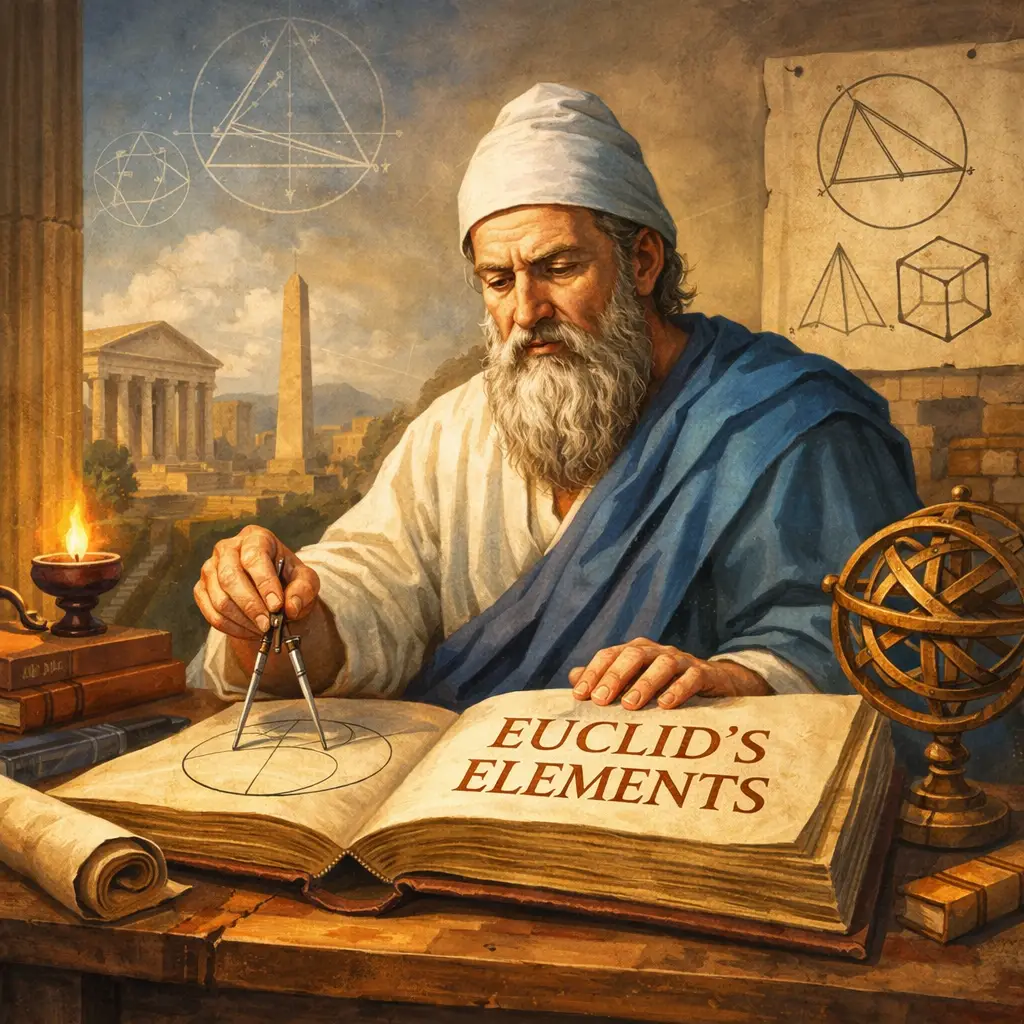
In the history of human thought, few documents have exerted as much influence as Euclid’s Elements. Written around 300 BCE, this monumental work did not just teach people how to measure shapes; it taught them how to think. By shifting mathematics away from mere calculation and toward a system of rigorous Logic and Proofs, Euclid created a blueprint for scientific inquiry that remains the standard over two millennia later. Often cited as the most successful and influential textbook ever written, its pages laid the foundation of geometry and provided a structured world where truth could be proven beyond a shadow of a doubt.
Who Was Euclid?
Little is known about the life of the Euclid mathematician. Most historians agree that he lived in Alexandria, Egypt, during the reign of Ptolemy I. He likely led the mathematical school at the Great Library of Alexandria, where he gathered the fragmented mathematical knowledge of his predecessors—such as Pythagoras, Eudoxus, and Thales—and synthesized it into a single, coherent system. Today, he is universally celebrated as Euclid: Father of Geometry, a title earned not just for discovering new truths, but for organizing the laws of space into a logical masterpiece.
What Is Euclid’s Elements?
Euclid’s Elements is a collection of 13 books that systematically explore Euclid geometry principles. While it is best known for plane and solid geometry, the work also covers vast areas of what we now call Number Theory.
The beauty of the “Elements” lies in its economy. Euclid doesn’t ask you to believe anything based on authority; he asks you to accept five simple starting points and then builds the entire universe of mathematics from there. This approach transformed ancient Greek mathematics from a collection of “rules of thumb” used by builders into a high-level philosophical pursuit.
The Logical Structure of Euclid’s Elements
The genius of Euclid was his method. He pioneered the “axiomatic method,” a way of building a complex system from simple, undeniable truths.
1. Definitions
Euclid begins by defining the basic building blocks of his world. A point is “that which has no part.” A line is “breadthless length.” By establishing these terms early, he ensures that the reader and the author are always speaking the same language.
2. Postulates (Basic Assumptions)
Euclid proposed five Postulates and Axioms that served as the starting point for all his work. These were assumed to be true without proof because they were self-evident.
- To draw a straight line from any point to any point.
- To produce a finite straight line continuously in a straight line.
- To describe a circle with any center and distance.
- That all right angles are equal to one another.
- The famous “Parallel Postulate”: If a line falls on two lines such that the inner angles are less than two right angles, the two lines will eventually meet.
3. Theorems and Proofs
Once the foundations were set, Euclid moved to Euclid mathematical proofs. Every theorem (or “proposition”) in the book is derived logically from those five postulates. This was revolutionary; it meant that if you accepted the starting points, you must accept the conclusion.
The 13 Books of Euclid’s Elements
A common misconception is that the Elements is only about triangles and circles. In reality, it is a comprehensive summary of all mathematical knowledge of that era.
Books 1–4: Plane Geometry
These books are the core of Euclid geometry. Book 1 famously ends with the Pythagorean Theorem. Book 2 deals with geometric algebra, Book 3 focuses on the properties of circles, and Book 4 explores how to construct regular polygons inside and outside circles.
Books 5–6: Ratios and Proportions
Book 5 introduces a theory of proportions applicable to all types of magnitudes, a vital tool for comparing lengths, areas, and volumes. Book 6 applies this theory specifically to plane geometry, establishing the rules for “similar” shapes.
Books 7–9: Number Theory
Euclid was a master of Number Theory. In these books, he explores prime numbers, greatest common divisors, and the Euclidean Algorithm. He famously proved that there are infinitely many prime numbers, a proof that is still taught in modern universities for its elegance.
Book 10: Irrational Numbers
Often considered the most difficult part of the Elements, Book 10 classifies irrational magnitudes. This was a response to the “crisis” in Greek math when it was discovered that the square root of 2 could not be expressed as a simple fraction.
Books 11–13: Solid Geometry
The final three books move from the flat page into three-dimensional space. Book 11 deals with planes and lines in space, Book 12 uses the “method of exhaustion” to find volumes, and Book 13 concludes with the construction of the five Platonic Solids.
Why Euclid’s Elements Was Revolutionary
Before Euclid, geometry in ancient Greece was disorganized. If a builder in Athens and a surveyor in Alexandria disagreed on an area, there was no final arbiter of truth. Euclid’s Elements provided that arbiter. It was revolutionary because it decoupled truth from observation. You didn’t need to measure a triangle with a string to know its angles added up to 180 degrees; you could prove it with a pen and paper. This was the birth of pure science.
Influence of Euclid’s Elements on Education
For over 2,000 years, an education was not considered complete without a thorough study of Euclid. Great thinkers like Abraham Lincoln, Isaac Newton, and Albert Einstein all studied the Elements to sharpen their minds. Lincoln, in particular, famously carried a copy of Euclid in his saddlebag while traveling as a lawyer, believing that if he couldn’t “demonstrate” his legal arguments with the same clarity as Euclid’s propositions, he wasn’t doing his job.
Euclid’s Elements and Modern Mathematics
While we now recognize “Non-Euclidean” geometries (like those used in Einstein’s theory of relativity), Euclid’s Elements remains the foundation of 99% of our daily lives. From architecture and engineering to computer graphics and GPS navigation, Euclid geometry is the math of the physical world we inhabit. Modern mathematics still utilizes his axiomatic method, proving that his Influence on Mathematics is as strong today as it was in Alexandria.
Euclid’s Lasting Legacy
Euclid’s Legacy is not just found in the shapes we draw, but in the way we argue. He taught the world that claims must be backed by evidence and that those evidences must follow a logical chain. Every time a scientist publishes a paper or a programmer writes a line of code, they are using the spirit of Euclid.
Frequently Asked Questions (FAQs)
Is Euclid’s Elements still used today?
Yes, it is still used as a secondary source in many geometry classes, and the logic it teaches is the basis for all modern mathematical curriculum.
What is the difference between an axiom and a postulate?
In Euclid’s time, an “axiom” was a general truth applicable to all sciences (e.g., “things equal to the same thing are equal to each other”), while a “postulate” was a specific assumption used in geometry.
Are all 13 books about geometry?
No. Books 7 through 9 are focused entirely on Number Theory, and Book 10 deals with irrational numbers.
Who translated Euclid’s Elements?
The work was translated into Arabic during the Islamic Golden Age and later into Latin during the 12th century, which helped trigger the Renaissance in Europe.
Conclusion
Euclid’s Elements is more than just a history of geometry; it is a monument to human reason. By organizing the chaos of the physical world into a series of logical steps, Euclid gave us the tools to build cities, navigate oceans, and understand the stars. As we move further into the digital age, the “Father of Geometry” remains relevant, reminding us that no matter how complex the world becomes, it is built on a foundation of simple, undeniable truths.