Introduction
When we think of the giants who built the world we live in, we often look toward inventors and explorers. However, the true architect of the modern intellectual world was a man who worked with a straightedge and a compass in ancient Alexandria. Understanding how Euclid influenced modern mathematics requires looking beyond simple shapes and lines; it involves recognizing the birth of a rigorous way of thinking. Before Euclid, math was a collection of practical tips. After Euclid, it became a disciplined search for eternal truths. Every time a student writes a formal proof or a scientist develops a new theory, they are standing on a foundation laid down over 2,300 years ago.
Euclid’s Systematic Approach to Mathematics
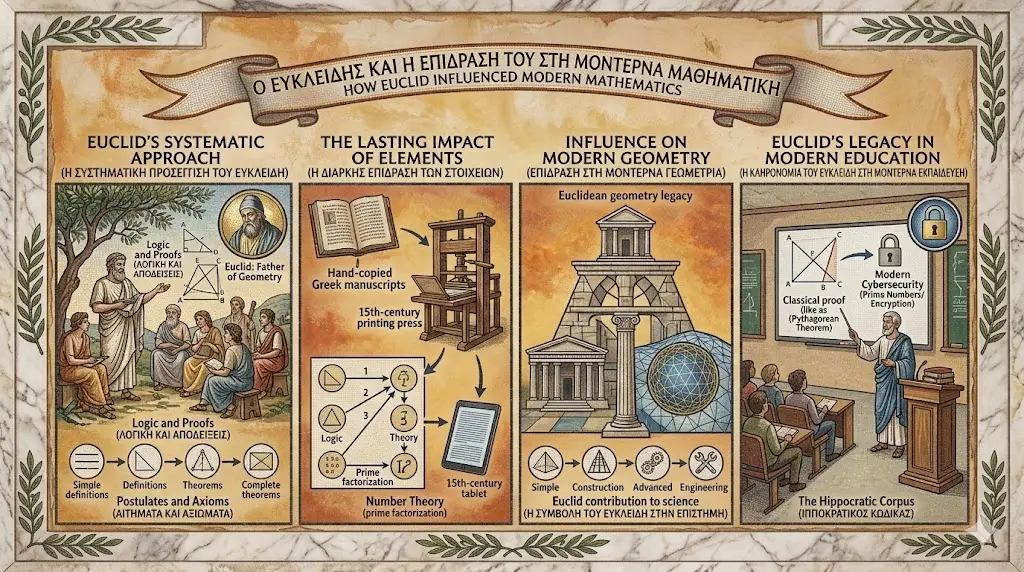
The core of Euclid’s influence on mathematics lies in his ability to organize chaos. Before he wrote his masterwork, mathematical knowledge was scattered across the Mediterranean. Euclid’s genius was not necessarily in discovering every theorem himself, but in creating a Euclid mathematical system where every idea followed another in a perfect, logical chain.
By starting with the most basic building blocks, Euclid: Father of Geometry ensured that mathematics would be accessible and reproducible. He didn’t just give us the “what”; he gave us the “how.” This systematic approach turned a craft into a science. It allowed future mathematicians to trust the work of those who came before them, as long as the logic held up.
The Lasting Impact of Euclid’s Elements
The Elements of Geometry is arguably the most successful textbook in human history. For centuries, it was the second most printed book in the Western world, trailing only the Bible. The Euclid Elements impact is seen in its longevity; it was used as the primary text for teaching mathematics until the early 20th century.
Its impact was not just mathematical but psychological. It taught generations of thinkers that the universe was governed by laws that could be understood by the human mind. The Postulates and Axioms found in the Elements provided a starting point for all Western rationalism. By proving that a small set of simple assumptions could explain the complexity of the physical world, Euclid gave humanity the confidence to explore even deeper mysteries.
Euclid’s Role in Developing Mathematical Proofs
The most significant way how Euclid influenced modern mathematics was through the invention of the formal proof. Before him, if a mathematician found a pattern, they might simply state it as a fact. Euclid insisted on Logic and Proofs. He demanded that every claim be justified by a deductive argument.
This Euclid proof method changed the standard of truth. In most fields, truth is a matter of evidence and probability. In mathematics, thanks to Euclid, truth is absolute. A proof that was valid in 300 BCE remains just as valid today in Islamabad or New York. This high bar for certainty is what makes mathematics the “queen of the sciences”—the only field where you can reach a conclusion that is 100% certain.
Influence on Modern Geometry
While we have since discovered “Non-Euclidean” geometries that describe the curvature of space-time, Euclidean geometry importance remains at the center of our daily lives. Whether you are building a house, designing a bridge, or creating a 3D video game, you are using the principles Euclid defined.
The Euclid geometry legacy is seen in the very way we perceive space. We live in a world of parallel lines, right angles, and circles. Modern engineering and architecture are essentially the practical application of the first four books of the Elements. Even the most advanced computer graphics rely on “Euclidean space” to render the images we see on our screens every day.
Euclid’s Influence on Scientific Thinking
The Euclid contribution to science goes far beyond the classroom. His deductive method became the template for the Scientific Revolution. Figures like Isaac Newton and Johannes Kepler modeled their own works after the structure of the Elements. They believed that if they could find the “axioms” of physics, they could deduce the movements of the planets with the same certainty that Euclid deduced the properties of a triangle.
This shift in the history of modern mathematics provided the language for the Enlightenment. It encouraged philosophers to seek “self-evident truths” in ethics and politics, directly mirroring the Postulates and Axioms of geometry. The idea that we can use reason to solve the problems of the world is a direct descendant of the Euclidean method.
Euclid’s Influence on Modern Education
For over two millennia, studying Euclid was synonymous with a “liberal arts” education. The goal was not necessarily to make every student a mathematician, but to teach them how to think clearly. This tradition continues today. When high school students are asked to perform “Two-Column Proofs,” they are participating in a tradition that stretches back to ancient Alexandria.
The Euclid’s Legacy in education is the belief that the study of geometry sharpens the mind. It teaches students to distinguish between an assumption and a proven fact, to follow a complex argument to its conclusion, and to value precision in language. These are the same skills required for law, medicine, and computer programming.
Why Euclid’s Work Still Matters Today
You might wonder why a 2,300-year-old book still matters in the age of Artificial Intelligence. The answer is that AI, at its core, is a system of logic. The algorithms that power our modern world are digital descendants of the Euclidean algorithm.
Furthermore, Euclid’s work in Number Theory remains the bedrock of modern cybersecurity. His proofs regarding prime numbers are used today to encrypt our emails and secure our bank accounts. Every time you make a secure online purchase, you are using the Number Theory that Euclid explored in Books VII through IX of the Elements.
Frequently Asked Questions (FAQs)
Did Euclid discover all the math in the Elements?
No. He was a great synthesizer who took the work of previous mathematicians like Pythagoras and Eudoxus and organized it into a single, logical system.
Is Euclidean geometry still “true” even after Einstein?
Yes. While Einstein showed that on a cosmic scale space can be curved (Non-Euclidean), for almost everything on Earth—from building a skyscraper to navigating a ship—Euclidean geometry is perfectly accurate.
Why is Euclid called the “Father of Geometry”?
He is called this because he was the first to create a comprehensive, axiomatic system where geometry was built from the ground up through logical proofs.
What is the “Parallel Postulate”?
It is Euclid’s fifth postulate, which essentially states that parallel lines will never meet. It is the most famous postulate because, for centuries, people tried to prove it from the other four, eventually leading to the discovery of Non-Euclidean geometry.
Conclusion
The story of how Euclid influenced modern mathematics is the story of how humanity learned to think. By providing a clear, logical structure for understanding the world, Euclid gave us more than just formulas; he gave us a method for achieving certainty. From the foundations of Number Theory to the heights of modern physics, Euclid’s Legacy is woven into the fabric of our civilization. As we look toward the future, we continue to rely on the same Logic and Proofs that he first demonstrated in the sands of Alexandria. He taught us that the truth is not something to be feared or guessed at—it is something that can be proven.