Introduction
Euclid’s Postulates and Axioms form the foundation of classical geometry and mathematical reasoning. More than two thousand years ago, the Greek mathematician Euclid created a structured mathematical system that organized geometry into logical steps. His work established the core rules that mathematicians still use today.
The principles introduced by Euclid became the basis of what we now call euclidean geometry principles. These ideas were presented in his famous book Elements, which is considered one of the most influential works in the history of mathematics.
Euclid’s system begins with simple assumptions known as axioms and postulates. From these starting points, he built a logical framework that allowed mathematicians to prove complex theorems. This method became the standard for mathematical thinking and proof writing.
Understanding Euclid’s Postulates and Axioms helps us see how geometry developed and why it remains essential in mathematics, science, and engineering.
What Are Axioms in Euclid’s Geometry?
Axioms are basic truths that are accepted without proof. In Euclid’s system, they are general principles that apply not only to geometry but also to logical thinking in mathematics.
These statements may seem obvious, but they are essential because they provide the starting point for all mathematical reasoning. The concept of euclid axioms in geometry helped establish a logical foundation that mathematicians could rely on.
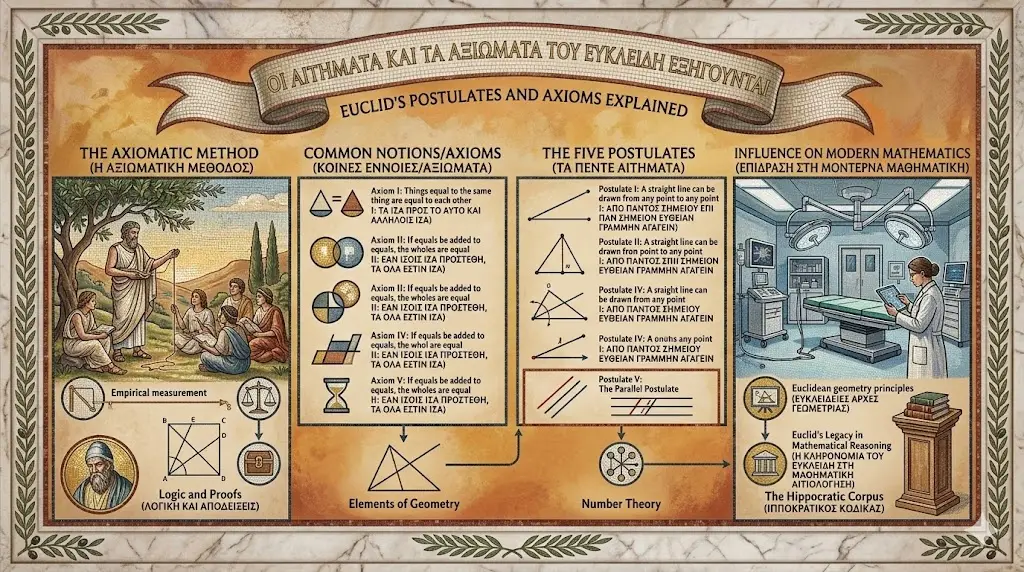
Some of Euclid’s most famous axioms include:
- Things equal to the same thing are equal to one another.
- If equals are added to equals, the results are equal.
- If equals are subtracted from equals, the results remain equal.
- The whole is greater than the part.
These statements may appear simple, but they allow mathematicians to construct logical arguments step by step. By relying on such universal truths, Euclid ensured that every mathematical proof could be built on solid ground.
The introduction of axioms was an important moment in the history of euclidean geometry because it showed that mathematics could be based on logical assumptions rather than observation alone.
What Are Postulates?
While axioms are general truths, postulates are assumptions specifically related to geometry. They describe the basic behavior of geometric objects such as points, lines, and circles.
Euclid proposed five postulates that define the fundamental structure of geometry. These statements form the basis of euclid geometry rules and explain how shapes behave in a flat space.
The five postulates are:
- A straight line can be drawn between any two points.
- A straight line can be extended indefinitely.
- A circle can be drawn with any center and radius.
- All right angles are equal.
- If a line crosses two lines and the interior angles on the same side are less than two right angles, the two lines will meet on that side when extended.
These simple statements form the foundation of euclid mathematical principles. From them, Euclid was able to prove hundreds of geometric theorems in his work.
The structure of these postulates demonstrates how mathematics can grow from a small set of logical assumptions into a vast system of knowledge.
Why Euclid’s Postulates Were Revolutionary
Euclid’s approach to mathematics was revolutionary because he organized knowledge into a logical system based on proofs. Before Euclid, many mathematical ideas existed, but they were not arranged in a consistent structure.
In the history of euclidean geometry, Euclid’s method of starting with axioms and postulates and then building proofs became a new standard for mathematical thinking.
His work also influenced other areas of mathematics beyond geometry. For example, the logical reasoning used in his system inspired studies in Number Theory, where mathematicians explore the properties of numbers.
The emphasis on structured reasoning also shaped the development of Logic and Proofs, which later became essential tools in modern mathematics and computer science.
By introducing a clear system of reasoning, Euclid showed that mathematics could be both logical and universal.
The Famous Fifth Postulate
Among Euclid’s five postulates, the fifth one became the most famous and controversial. It is commonly known as the parallel postulate.
The parallel postulate meaning can be understood as follows: through a point not on a given line, only one line can be drawn parallel to the original line.
For centuries, mathematicians tried to prove this statement using the other four postulates. However, they eventually discovered that it could not be proven in that way.
This discovery led to the development of non-Euclidean geometry, where different versions of the fifth postulate are used. These new geometries later played a crucial role in physics and cosmology.
Despite these developments, Euclid’s original system remains the foundation of classical geometry and continues to be taught in schools worldwide.
Influence on Modern Mathematics
The influence of Euclid’s work extends far beyond geometry. His logical approach to mathematics shaped the way mathematicians organize knowledge and construct proofs.
The system introduced in euclid elements geometry became the model for many mathematical textbooks written over the centuries.
Today, Euclid’s ideas still influence fields such as:
- Architecture and engineering
- Physics and astronomy
- Computer graphics
- Navigation and mapping
His work also contributed to the broader Influence on Mathematics, inspiring generations of scholars to explore new mathematical ideas.
The logical structure developed by Euclid continues to guide mathematicians when they develop new theories and proofs.
Euclid’s Legacy in Mathematical Reasoning
Euclid’s greatest contribution may not be a single theorem or formula, but rather his method of reasoning. By organizing mathematical knowledge into definitions, axioms, postulates, and proofs, he created a clear framework for understanding mathematics.
This system is why Euclid is often called Euclid: Father of Geometry.
His influence can be seen in the continued study of geometry as well as in other areas of mathematics. Even modern mathematical fields still follow the logical structure that Euclid introduced.
The importance of Euclid’s work is also reflected in the lasting impact of his writings. Many historians and mathematicians refer to his work when discussing Euclid’s Legacy in science and education.
Through his logical method and mathematical clarity, Euclid shaped the way humans think about numbers, shapes, and reasoning.
Frequently Asked Questions (FAQs)
What are Euclid’s postulates?
Euclid’s postulates are five basic assumptions about geometric objects such as lines and circles. These assumptions form the basis of classical geometry.
What is the difference between axioms and postulates?
Axioms are general truths accepted without proof, while postulates apply specifically to geometry and describe properties of geometric objects.
Why is Euclid important in mathematics?
Euclid organized mathematical knowledge into a logical system based on axioms and proofs. This method became the foundation of modern mathematics.
What is the parallel postulate?
The parallel postulate states that through a point outside a line, exactly one parallel line can be drawn. It is one of the most important ideas in geometry.
Where were Euclid’s ideas written?
Euclid wrote his mathematical ideas in a famous book called Elements of Geometry, which became one of the most influential textbooks in history.
Conclusion
Euclid’s Postulates and Axioms represent one of the most important developments in the history of mathematics. By establishing a system based on logical assumptions and structured proofs, Euclid transformed geometry into a scientific discipline.
His work laid the foundation for the development of euclidean geometry principles and influenced mathematical thinking for centuries. From simple axioms to complex theorems, Euclid showed how knowledge can grow through logical reasoning.
Even in the modern world, the ideas introduced in Euclid’s work remain relevant. Students, mathematicians, and scientists continue to rely on the logical structure he created.
The lasting importance of Euclid’s work demonstrates why he is remembered as one of the greatest mathematicians in history.