The Software Development Life Cycle (SDLC) has been a cornerstone of how software is created and maintained. Its evolution has been crucial to improving efficiency, quality, and collaboration in software development. In this article, we will explore the history of SDLC, from its early days to the present, and how it shaped modern software development practices.
Early Days: The Origins of SDLC (1950s–1970s)
In the earliest days of computing, software was written without a structured process. Programs were built in a largely ad-hoc manner, with little attention paid to standardization or repeatability. This led to significant issues with software quality and scalability.
The Waterfall Model (1970s)
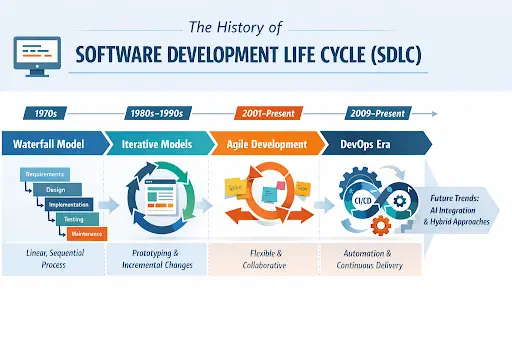
The first structured approach to software development emerged in the 1970s, often attributed to Dr. Winston W. Royce, who introduced the Waterfall Model. The Waterfall model was one of the earliest SDLC frameworks and became the foundation for future development methodologies.
This model featured a linear, sequential flow of development activities—where each phase depended on the completion of the previous one. The phases typically included:
- Requirements Gathering
- System Design
- Implementation (Coding)
- Testing
- Deployment
- Maintenance
The Waterfall Model’s rigid structure made it ideal for projects with clear and well-defined requirements. However, it was not without its flaws. One of the main criticisms of the Waterfall model was its inability to accommodate changes once a phase was completed. As a result, software development was often delayed, and projects were prone to budget overruns.
The Evolution of SDLC Models (1980s–1990s)
As software projects grew in complexity and size, it became clear that a more flexible approach was necessary. The limitations of the Waterfall model led to the development of alternative methodologies in the 1980s and 1990s.
Iterative and Incremental Models (1980s)
In response to the limitations of Waterfall, iterative and incremental models emerged. These models allowed for feedback and revisions during the development process. One of the key ideas was that software should be developed in smaller portions, or “increments,” rather than all at once.
The Iterative Model allowed developers to repeat and refine stages of development through several iterations. Each cycle would build upon the last, refining functionality and adding new features based on user feedback. This model was particularly useful for projects where requirements were expected to evolve over time.
Prototyping Model (1990s)
In the early 1990s, the Prototyping Model became more widely adopted. This approach emphasized the creation of an initial prototype—a working version of the software—early in the development process. The prototype was then refined based on feedback, allowing users to interact with it and suggest changes.
The Prototyping Model improved user involvement and satisfaction since stakeholders could see a working model and request changes before full-scale development took place. However, it did have challenges, such as the potential for scope creep, where additional features were constantly added to the prototype.
The Agile Revolution: A New Era (2001–Present)
In 2001, the Agile Manifesto introduced a radical shift in how software development was approached. Agile development emphasized flexibility, collaboration, and the ability to respond to changes quickly.
Agile Methodology (2001)
Agile methodologies focus on delivering small, incremental updates to software rather than a complete product in one go. Unlike the rigid Waterfall model, Agile encourages flexibility, allowing changes in requirements at any stage of development.
The Agile methodology is based on several principles, including:
- Customer collaboration over contract negotiation
- Responding to change over following a plan
- Individuals and interactions over processes and tools
- Working software over comprehensive documentation
Agile revolutionized the SDLC process by promoting faster delivery times, better customer satisfaction, and greater adaptability. Many modern SDLC frameworks, such as Scrum and Kanban, were born out of Agile principles.
Scrum and Kanban (2000s)
Scrum and Kanban are two popular Agile frameworks that have become widely used in software development. Scrum organizes work into sprints, which are short, time-boxed periods during which specific tasks are completed. Kanban, on the other hand, focuses on visualizing the workflow and continuously improving the development process.
These Agile frameworks have reshaped the SDLC landscape, especially in environments that require rapid development cycles, such as startups and tech companies. They emphasize collaboration, iterative work, and quick adaptations to changing requirements.
Modern Impact: DevOps and Continuous Delivery (2009–Present)
The latest stage in the evolution of SDLC has been heavily influenced by DevOps and the emphasis on continuous delivery.
DevOps: Bridging Development and Operations
DevOps emerged in the late 2000s as a way to integrate development and operations teams more closely. Unlike traditional SDLC models, which separated development and operations into silos, DevOps encourages a collaborative culture across the entire software lifecycle.
DevOps emphasizes:
- Automation of testing, deployment, and monitoring
- Continuous integration (CI) and continuous delivery (CD) for faster, more frequent releases
- Improved collaboration between developers, quality assurance, and IT operations teams
The rise of cloud computing and containerization technologies like Docker has also contributed to the success of DevOps by making deployment and scaling easier.
Future Outlook: What’s Next for SDLC?
As technology continues to advance, the SDLC is evolving further. The future of software development will likely see a blend of AI-assisted development, hybrid methodologies, and an increased focus on user-centric development.
AI and Automation
Artificial intelligence and machine learning will continue to reshape SDLC by assisting in areas such as testing, code generation, and bug fixing. Tools like GitHub Copilot already use AI to assist developers by suggesting code based on natural language prompts. As AI becomes more integrated into the SDLC, it will reduce the time developers spend on routine tasks, allowing them to focus on more complex problems.
Hybrid Methodologies
The future of SDLC may also involve a hybrid approach, where teams combine elements of Agile, DevOps, and traditional models to best suit their project needs. This flexibility will allow teams to select the most effective tools and methods for each project phase, rather than being tied to a single framework.
Increased Focus on Security and Privacy
With growing concerns about data security and privacy, future SDLC models will likely incorporate security-first strategies. This involves building security into every phase of development, from design to deployment. DevSecOps, which integrates security into the DevOps pipeline, will become more commonplace.
Frequently Asked Questions (FAQs)
1. What is the Software Development Life Cycle (SDLC)?
SDLC is a structured approach to software development that defines phases such as planning, design, development, testing, and maintenance.
2. How did the Waterfall Model impact software development?
The Waterfall Model introduced a linear, step-by-step process that provided structure to development but lacked flexibility for changes.
3. What is the difference between Agile and DevOps?
Agile focuses on iterative development, while DevOps integrates development and operations for faster, automated delivery.
4. How did SDLC evolve over time?
SDLC evolved from Waterfall to iterative models, then to Agile, and now to DevOps, with each phase improving efficiency and adaptability.
5. What are the future trends in SDLC?
The future of SDLC includes AI integration, hybrid methodologies, and an increased focus on security and privacy in software development.
Conclusion
The History of Software Development Life Cycle shows how software creation has evolved from rigid and slow processes to more dynamic, iterative models. With the rise of Agile, DevOps, and AI-driven development, the SDLC continues to adapt to the demands of modern software development. Understanding this evolution is crucial for anyone interested in the future of software engineering.