Introduction
When discussing the great mathematicians of ancient history, the name Eratosthenes stands out as one of the most influential scholars of the classical world. Living during the 3rd century BCE, he made remarkable discoveries that shaped mathematics, geography, and scientific thinking. His mathematical insights not only helped explain complex numerical patterns but also supported major scientific achievements, including calculating the Earth’s Circumference.
Although many people recognize him for his work in geography, his Mathematics Contributions were equally groundbreaking. From developing the famous Sieve of Eratosthenes to applying mathematical reasoning in scientific measurements, he helped build a strong foundation for later mathematical studies.
Working at the legendary Library of Alexandria, Eratosthenes had access to the greatest knowledge of his time. This intellectual environment allowed him to explore numbers, geometry, and astronomy with remarkable creativity. His work demonstrates why many historians describe him as a thinker Ahead of His Time.
In this article, we will explore how Eratosthenes influenced mathematics and why his ideas still matter today.
Who Was Eratosthenes?
Eratosthenes was born around 276 BCE in Cyrene, an ancient Greek city located in present-day Libya. From an early age, he displayed a deep curiosity about science, philosophy, and mathematics.
He later studied in Athens, one of the most important intellectual centers of the ancient world. There he learned from leading philosophers and mathematicians before eventually being invited to Egypt to work at the famous Library of Alexandria.
As the chief librarian, he was responsible for managing thousands of scrolls containing knowledge from across the ancient world. This position gave him access to information about mathematics, astronomy, geography, and philosophy.
Using this knowledge, he produced groundbreaking research that helped shape both mathematics and science.
The Famous Sieve of Eratosthenes
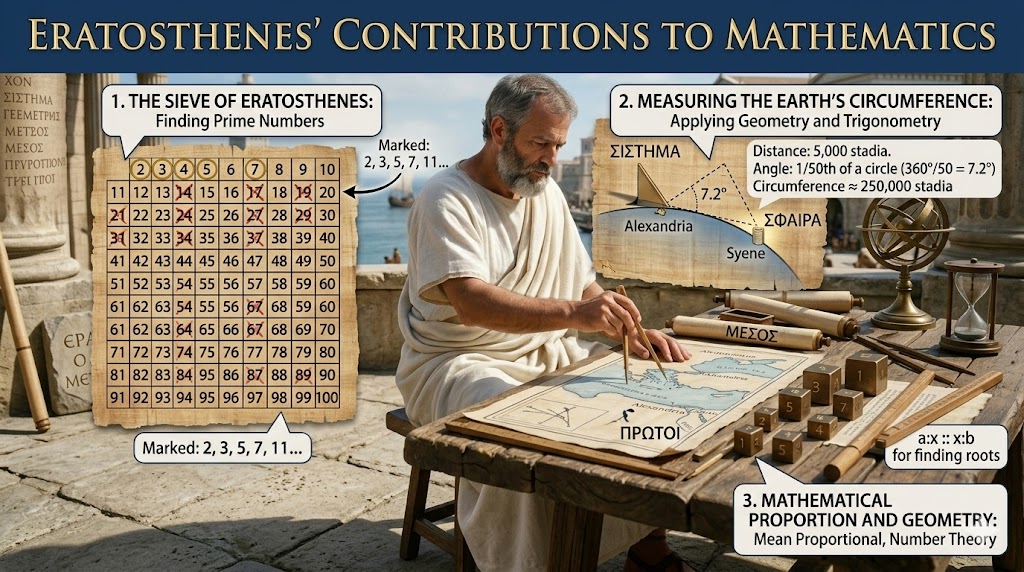
One of the most well-known mathematical achievements of Eratosthenes is the Sieve of Eratosthenes, a simple yet powerful algorithm used to identify prime numbers.
Prime numbers are numbers greater than 1 that cannot be divided evenly by any number other than themselves and 1. Examples include 2, 3, 5, 7, and 11.
The Sieve of Eratosthenes works by systematically eliminating multiples of numbers from a list until only prime numbers remain.
How the Method Works
- Write down a list of numbers starting from 2.
- Circle the first number (2), which is prime.
- Cross out all multiples of 2.
- Move to the next uncrossed number (3) and repeat the process.
- Continue this pattern.
By the end, the numbers that remain uncrossed are prime numbers.
Even today, computer scientists and mathematicians still use variations of this algorithm because it is efficient and easy to understand.
This discovery alone places Eratosthenes among the most important contributors to early number theory.
Mathematics Behind Measuring the Earth
Another example of his mathematical brilliance appears in his famous calculation of the Earth’s Circumference.
Although this achievement is often discussed in geography, it relied heavily on geometry and mathematical reasoning.
Eratosthenes observed that in the Egyptian city of Syene, the sun appeared directly overhead at noon during the summer solstice. However, in Alexandria at the same time, objects cast a shadow.
By measuring the angle of the shadow and knowing the distance between the two cities, he used geometry to estimate the size of the Earth.
His calculation was astonishingly accurate for its time, demonstrating how mathematical thinking could solve real-world scientific problems.
This method also played a key role in the scientific Birth of Geography, where measurement and observation replaced myths and guesswork.
Mathematical Thinking in Ancient Science
The work of Eratosthenes shows how mathematics can be used to understand the natural world.
Rather than treating mathematics as an abstract subject, he applied numerical reasoning to real scientific questions. His work connected mathematics with:
- Astronomy
- Geography
- Measurement of distances
- Mapping the Earth
His ability to combine different fields of knowledge helped advance both mathematics and science.
These innovations demonstrate why many historians consider him one of the earliest scientists to integrate mathematical reasoning into multiple disciplines.
Influence of the Library of Alexandria
The Library of Alexandria was one of the greatest centers of knowledge in the ancient world. Scholars from different cultures gathered there to study philosophy, science, and mathematics.
As chief librarian, Eratosthenes had access to an enormous collection of books and scrolls from across the Mediterranean and beyond.
This access allowed him to study previous mathematical ideas while developing new theories of his own. The intellectual environment of the library encouraged collaboration and innovation.
Many of his discoveries—including the Sieve of Eratosthenes and his calculation of the Earth’s Circumference—were likely inspired by the vast resources available at the Library of Alexandria.
Mathematics and the Birth of Geography
Although Eratosthenes is often remembered for his geographic discoveries, mathematics played a key role in his contributions to the Birth of Geography.
He used mathematical measurements to create more accurate maps of the known world. By applying geometric principles, he was able to estimate distances between regions and organize geographic information in a systematic way.
His work demonstrated that geography could be studied scientifically using numbers and measurement rather than relying solely on stories from travelers.
This approach influenced later geographers and helped shape the development of modern cartography.
Why Eratosthenes Was Ahead of His Time
Many historians describe Eratosthenes as a thinker Ahead of His Time because his methods resemble modern scientific practices.
Instead of relying on speculation or mythology, he used observation, logical reasoning, and mathematical calculation to explore scientific questions.
His development of the Sieve of Eratosthenes shows how simple logical processes can reveal patterns within numbers. Similarly, his measurement of the Earth’s Circumference demonstrates how geometry can be applied to large-scale scientific problems.
These achievements highlight his remarkable intellectual vision and his lasting influence on science and mathematics.
Lasting Impact on Mathematics
The mathematical ideas developed by Eratosthenes continue to influence modern education and research.
Students around the world still learn the Sieve of Eratosthenes as one of the simplest and most effective ways to understand prime numbers.
His work also helped demonstrate that mathematics can be applied to real-world problems such as measuring distances and mapping the Earth.
By combining mathematics with scientific observation, he helped establish an approach that later scientists—including Newton, Galileo, and Einstein—would continue to develop.
Frequently Asked Questions (FAQs)
Who was Eratosthenes?
Eratosthenes was a Greek mathematician, geographer, and astronomer who lived during the 3rd century BCE and made major contributions to mathematics and science.
What is the Sieve of Eratosthenes?
The Sieve of Eratosthenes is a mathematical algorithm used to identify prime numbers by systematically eliminating multiples of numbers.
How did Eratosthenes calculate the Earth’s circumference?
He measured the angle of the sun’s shadow in Alexandria and compared it with observations from Syene, then used geometry to estimate the Earth’s Circumference.
Where did Eratosthenes work?
He worked as the chief librarian at the famous Library of Alexandria, one of the largest centers of knowledge in the ancient world.
Why is Eratosthenes important to geography?
His mathematical measurement of the Earth and his mapping methods helped create the scientific Birth of Geography.
Why is Eratosthenes considered ahead of his time?
He is considered Ahead of His Time because he used mathematical reasoning, scientific observation, and logical analysis long before modern scientific methods were fully developed.