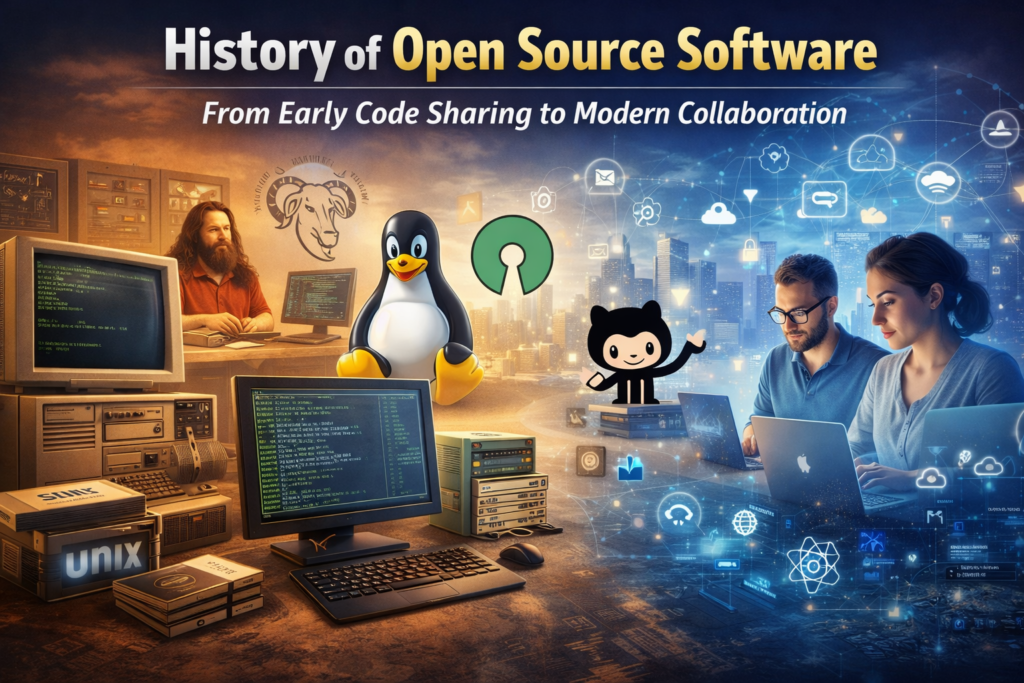
The History of Open Source Software is not just a chronicle of technical achievements; it is a story of a fundamental shift in human philosophy. It describes a transition from a world where software was a secret, guarded asset to one where global collaboration is the engine of innovation. Today, open source powers everything from the world’s largest supercomputers to the smartphone in your pocket. To understand this journey, we must look at how the evolution of open source software mirrored the broader History of Software Engineering, moving from informal academic exchanges to the structured, multi-billion-dollar ecosystems we see today.
1950s–1960s: Early Software Sharing in Academia
In the earliest days of computing, software was not seen as a product to be sold. During the era of the History of Computer Hardware, software was often provided for free by manufacturers to help users operate their massive, room-sized machines. In academic circles, such as MIT and Stanford, programmers shared code freely as a matter of professional courtesy.
Early mobile communication and data processing relied on this open exchange. If a researcher found a bug or developed a new feature, they would share the “source code” with others so the entire community could benefit. This culture of transparency was the organic precursor to what we now recognize as the free software movement.
1970: UNIX and the Beginning of Source Code Distribution
As the 1970s arrived, the commercial value of software began to rise. This was a pivotal moment in the History of Operating Systems. AT&T’s Bell Labs developed UNIX, and because of anti-trust regulations at the time, they could not officially sell it as a product. Instead, they licensed the source code to universities for a nominal fee.
This led to a flourish of innovation as students and professors began modifying UNIX to suit their needs. However, toward the end of the decade, corporations realized that “closing” the code—restricting access to the underlying instructions—was the key to high profit margins. The era of proprietary software had begun, leading to a “lock-in” culture that frustrated many veteran programmers.
1983: GNU Project and Richard Stallman
Frustrated by the increasing restrictions on software, a programmer at MIT named Richard Stallman launched the GNU Project 1983. His goal was ambitious: to create a completely free operating system that would allow users the freedom to run, copy, distribute, study, change, and improve the software.
Stallman founded the Free Software Foundation (FSF) and authored the GNU General Public License (GPL). This “copyleft” license was a legal masterpiece; it used copyright law to ensure that the software remained free forever. This moment is widely considered the formal birth of the free software movement, emphasizing that “free” referred to liberty, not price.
1991: Linux Kernel and Global Collaboration
While the GNU Project had developed many components of an operating system, it lacked a working “kernel”—the core that communicates between hardware and software. In 1991, a Finnish student named Linus Torvalds filled this gap by releasing the Linux Kernel 1991.
Unlike previous projects, Torvalds utilized the early internet to invite others to contribute. This was the first major instance of massive, decentralized open source collaboration. Developers from around the world began sending “patches” to improve the code. The combination of GNU tools and the Linux kernel created a powerful, free alternative to proprietary systems, forever changing the History of SDLC (Software Development Life Cycle) by introducing highly iterative, community-driven development.
1998: Birth of the Open Source Initiative (OSI)
By the late 1990s, the term “Free Software” was causing confusion in the business world, as executives associated “free” with “low quality” or “no profit.” In 1998, a group of developers, including Eric S. Raymond and Bruce Perens, founded the Open Source Initiative 1998. They introduced the term “Open Source” to focus on the practical, economic benefits of sharing code rather than the moral arguments of the FSF.
This distinction proved highly successful. It allowed corporations to engage with the open source software timeline without feeling politically aligned with the more radical free software movement. The OSI created a set of standards that defined what qualified as “Open Source,” providing a framework for the commercial adoption of these tools.
2000s: Explosion of Open Source Projects and Communities
The new millennium saw a massive explosion in modern open source projects. The “LAMP stack” (Linux, Apache, MySQL, PHP/Python/Perl) became the backbone of the World Wide Web. During this time, the History of Cybersecurity became intertwined with open source, as the “many eyes” theory suggested that having more people look at the code made it more secure.
Major tech companies like IBM began investing billions into Linux, realizing that sharing the cost of infrastructure software allowed them to compete more effectively on services and hardware. Communities like Wikipedia and Creative Commons also emerged, applying the “open” philosophy to information and creative works.
2010s: Open Source in Enterprise and Cloud Computing
In the 2010s, enterprise open source became the industry standard. The rise of cloud computing, led by platforms like AWS and Google Cloud, was built almost entirely on open source technologies like KVM, Docker, and Kubernetes.
Companies that previously fought open source, most notably Microsoft, underwent a massive cultural shift. Microsoft eventually acquired GitHub, the world’s largest host for open source code, and became one of the largest contributors to open source projects globally. Open source was no longer a hobbyist’s alternative; it was the foundation of the global economy.
2020s: Open Source Today
As we look at the History of Open Source Software in the current decade, the focus has shifted toward Artificial Intelligence (AI) and Machine Learning. Projects like TensorFlow, PyTorch, and Llama have made cutting-edge AI tools available to everyone, preventing a monopoly on the future of intelligence.
However, the community also faces new challenges, such as “software supply chain security” and the sustainability of maintainers who manage critical projects without pay. Despite these hurdles, open source continues to be the primary driver of innovation in fields like blockchain, edge computing, and space exploration.
Frequently Asked Questions (FAQs)
1. What is the main difference between Free Software and Open Source?
While they often refer to the same set of licenses, “Free Software” focuses on the user’s ethical and moral rights to control their technology, while “Open Source” focuses on the practical and collaborative advantages of sharing code.
2. Is open source software less secure than proprietary software?
Generally, no. Because the code is public, bugs and security vulnerabilities can be found and patched by anyone in the world. This transparent process often leads to more robust security over time.
3. How do open source companies make money?
Most companies make money by providing professional support, managed cloud hosting, or “open core” models where the basic version is free, but advanced enterprise features require a paid subscription.
4. Who owns the Linux kernel?
No single person or company owns it. It is licensed under the GNU GPL v2, which means it is owned by the thousands of individual contributors who have written its code over the last three decades.
Conclusion
The History of Open Source Software serves as a powerful reminder that the greatest human achievements often come from cooperation rather than competition. From the early days of academic sharing to the multi-trillion-dollar cloud industry, the open source model has proven that transparency and community are the fastest paths to progress. As we move further into an era defined by AI and decentralized systems, the principles of open source collaboration will remain the compass that guides us toward a more innovative and equitable digital future.